Regarding the UAV implementation plan to share logistics burden in HCMC, Deputy Director Pham Huynh Quang Hieu of the municipal Science and Technology Department first stressed the most prioritized points.
The concept of a low-altitude economy is triggering a fresh revolution, effectively shifting the economic development space from the ground up to a multi-tiered airspace below 1,000 meters.
With this ambitious plan, the city heavily prioritizes transitioning its mindset from purely managing airspace to actively exploiting low-altitude zones as a lucrative economic resource. Officials consider this a pivotal catalyst for driving the development of industry, services, logistics, and smart urban infrastructure.
Simultaneously, HCMC will carefully prepare its low-altitude space aligned with altitude stratification, heavily investing in the construction of corresponding technical infrastructure.
The Deputy Director then introduced the specific implementation roadmap for this low-altitude economy in HCMC.
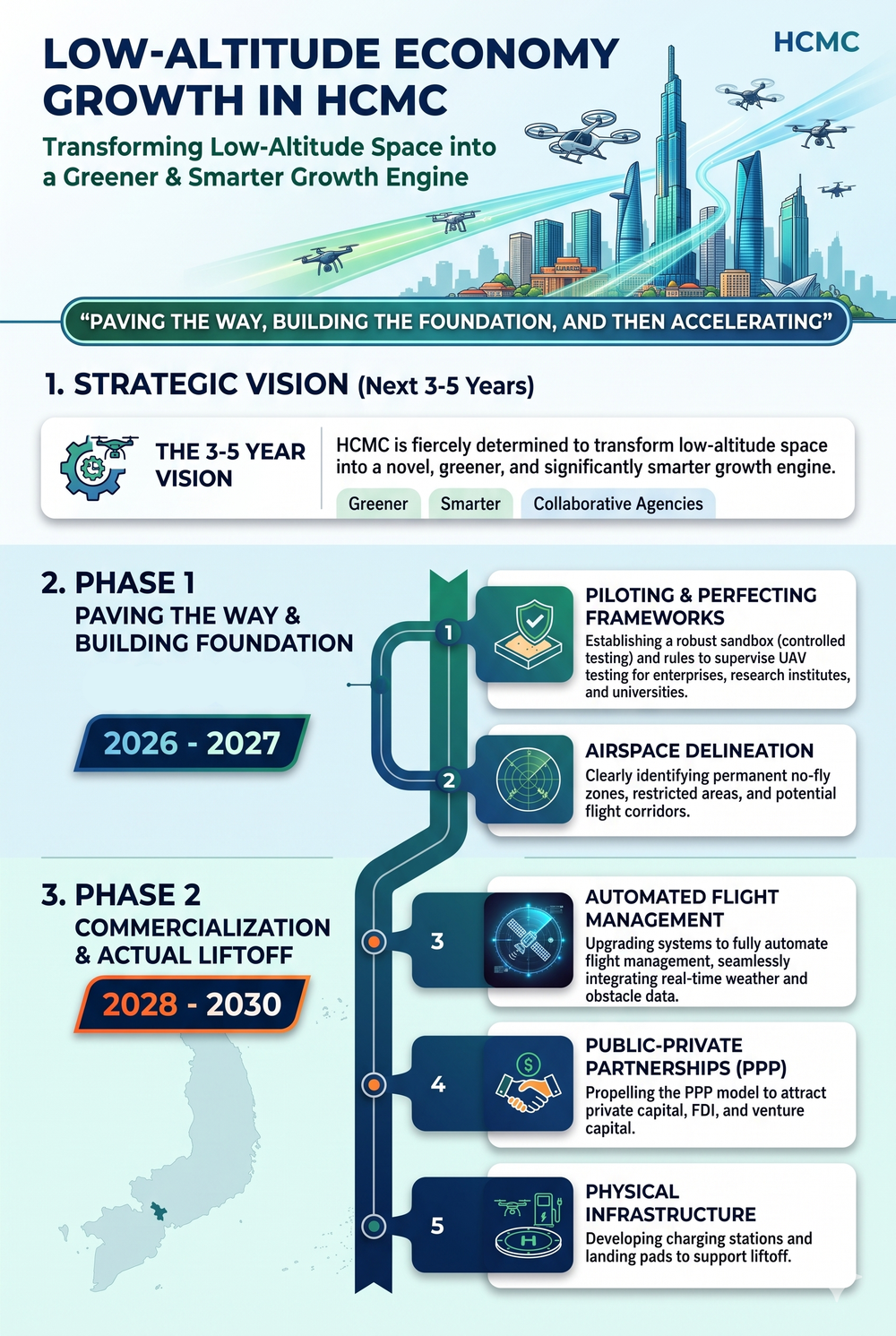
Over the next three to five years, encouraged by synchronized involvement from various agencies, HCMC is fiercely determined to transform low-altitude space into a novel, greener, and significantly smarter growth engine. The municipality is focusing intensely on “paving the way, building the foundation, and then accelerating.”
Specifically, the 2026-2027 period will heavily concentrate on piloting and perfecting institutional frameworks, alongside establishing a robust sandbox (a controlled testing mechanism). Through this, authorities will declare regulations for managing and supervising UAV testing, effectively forging a safe legal space for enterprises, research institutes, and universities to push for innovation.
During this critical phase, the city will also clearly delineate low-altitude space, concretely identifying permanent no-fly zones, restricted areas, and potential flight corridors.
The 2028-2030 period marks the era of commercialization and actual liftoff. HCMC will upgrade its system to fully automate flight management, seamlessly integrating real-time weather and obstacle data. Concurrently, it’ll strongly propel the public-private partnership (PPP) model to successfully attract private capital, FDI, and venture capital funds into physical infrastructure like landing pads and charging stations.
Deputy Director Pham Huynh Quang Hieu also mentioned the most formidable bottleneck hindering HCMC’s low-altitude economy.
The initial hurdle is undeniably legal barriers and airspace management. This is widely considered the primary “knot” because flight licensing procedures remain incredibly complex.
To swiftly dismantle this, based on the Urban Development Law, the HCMC People’s Committee has assigned its Department of Planning and Architecture to take the lead.
They’re actively coordinating with the HCMC Command, the municipal Public Security Department, the Science and Technology Department, alongside relevant units to advise the HCMC People’s Committee and the HCMC People’s Council on considering a resolution that regulates the establishment, appraisal, approval, and adjustment of high-altitude and low-altitude spatial planning within the locality.
The second major bottleneck resides within physical and digital infrastructure. A low-altitude economy simply can’t operate smoothly without a highly specialized infrastructure ecosystem catering to positioning, connectivity, and delivery, coupled with a Low-Altitude Unmanned Aircraft System Traffic Management (UTM) network and strong ground infrastructure.
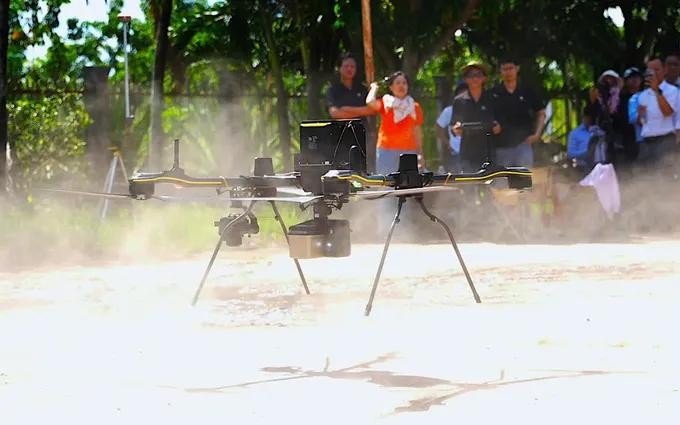
Currently, the Ministry of Public Security and the HCMC Public Security Department are diligently researching and will soon deploy a centralized UAV registration system to drastically facilitate management, supervision, and licensing protocols.
The HCMC Command is also heavily testing and will soon operationalize the UTM system to effectively manage low-altitude space alongside monitoring aerial vehicles.
Regarding testing and innovation mechanisms, regrettably, research institutes, universities, and tech startups still encounter numerous hurdles, meaning they can’t yet robustly commercialize laboratory prototypes or dual-use products.
)