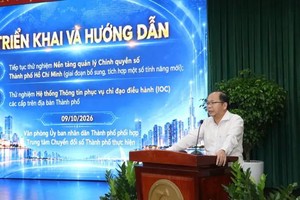
An inspection team from the National Assembly's Science, Technology and Environment Committee worked with the Ho Chi Minh City People's Committee on October 13 regarding the implementation of digital transformation policies.

Key survey findings and local progress
Speaking at the meeting, Tran Van Khai, Vice Chairman of the Committee and Deputy Head of the inspection team, said that through actual surveys on October 12 at the Ho Chi Minh City Public Administrative Service Center, the Thu Duc Ward Public Administrative Service Center, the Dong Thanh Commune People's Committee, the Dong Thanh Commune Public Administrative Service Center, and the City Data Center, the team recognized shifts in grassroots working methods. Many processes have been gradually modernized, contributing to improving the operational efficiency of the local government and the quality of service for citizens.
He highly appreciated the sense of responsibility and coordination of local agencies and units, noting practical issues as a basis for considering and proposing solutions to continue improving the efficiency of digital transformation, especially in handling administrative procedures and providing online public services.

Beside the results achieved, the implementation of digital transformation at the surveyed units still faces certain limitations: statistical data across systems remains inconsistent, causing difficulties for reconciliation, and the system has not fully recorded the procedure implementation process to determine the level of proactive engagement by citizens when using online public services.
This creates immense pressure as each commune and ward civil servant must concurrently use 30 to 36 specialized software applications and spend five hours per day on data entry, while specific feedback regarding a single interconnected account has not yet been received from ministries and central agencies.
Achievements and remaining challenges
The team also assessed that since the implementation of Resolution No. 57-NQ/TW dated December 22, 2024 of the Politburo on breakthroughs in science and technology development, innovation, and national digital transformation, Ho Chi Minh City's digital transformation work has achieved many positive results. The rate of online dossiers increased sharply from 21.85 percent to 60.16 percent as of September 2026.
The city has put 13 shared cloud computing platforms into stable operation, while its data warehouse has accumulated 56.5 million digital records and documents. Portal 1022 has received more than 8 million feedback submissions, with a resolution rate of 99.97 percent.
Locally, innovative initiatives have emerged, including a pilot ‘lawyer robot’ in Thu Duc Ward. The digital economy has also become a key growth driver, accounting for 45.38 percent of the city's GDP, with more than 294,000 technology enterprises.
Beside the positive results, during the discussion session, members of the inspection team expressed concern over the trend of fragmenting public service portals into individual sector applications surrounding citizens, which diminishes the advantages of the "one-stop" model.
The current system is optimized for computers, whereas citizens habitually use mobile phones. Members raised concerns about infrastructure congestion causing a drop in the dossier digitization rate in the third quarter.
Citywide, 155 databases have not yet connected to the National Data Center. Consequently, over 71,000 dossiers have been overdue (accounting for nearly 48 percent) from June 2026 to date. In addition, delegates expressed concern over the science and technology market, where the trading floor introduced 25,000 technologies but only about 600 types were active, and the data trading floor project remained stalled, taking over eight months for consultation without completion.
HCMC accelerates Resolution 98 implementation
Vice Chairman Nguyen Manh Cuong of the Ho Chi Minh City People's Committee clarified the city’s breakthrough approaches to implementing Resolution 98.
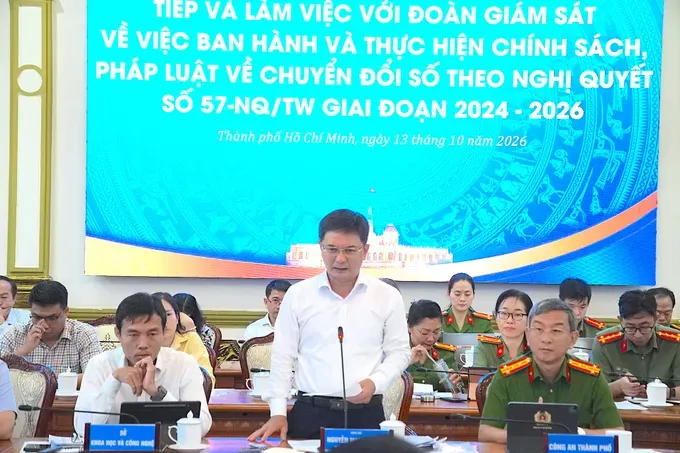
Regarding human resources, the city initially succeeded in attracting a number of experts to key positions and will finalize specific preferential policies within this October. To resolve market bottlenecks, the city operated the Management Board of a venture capital fund involving state budget capital to lead the market, ready for disbursement between now and the end of the year. The City People's Committee agreed with the feedback and will urgently conduct an overall review to complete the report to send back to the inspection team.
Concluding the working session, Deputy Head of the inspection team Tran Van Khai recognized Ho Chi Minh City's efforts but requested urgent training for officials and support for the digital technology team. The city must ensure a 3 percent budget expenditure for science and technology (1 percent for digital transformation), enhance information security rates, verify data, and use practical results to evaluate and plan department heads.