Diverse real-world applications
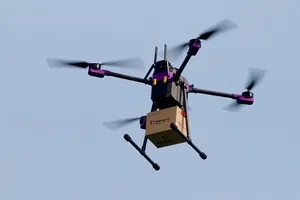
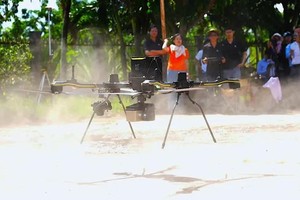
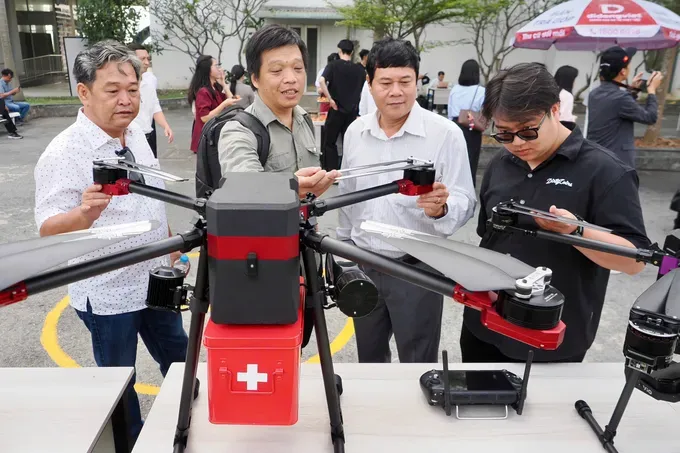
In a recent development, the HCMC Department of Science and Technology partnered with the Saigon Hi-Tech Park (SHTP) Management Board and various tech firms, including Saolatek, Realtime Robotics, and their partner Di Dong Viet, to launch a pilot program for Unmanned Aerial Vehicle-based delivery within the SHTP grounds.
While this initiative is currently a trial focused on short-haul delivery capabilities, it marks a significant “kick-off” for bringing Unmanned Aerial Vehicles (UAVs) into the fabric of daily life in HCMC. Based on the results of these trials, the participating units envision expanding the flight range to cover greater distances, such as the route from Can Gio to Vung Tau, to meet logistics demands in an expanding urban space.
Deputy Director Pham Huynh Quang Hieu of the HCMC Department of Science and Technology noted that the delivery trial at SHTP is being implemented under a sandbox mechanism, a controlled testing environment for new technological solutions regarding unmanned aircraft, pursuant to Resolution No.20/2024/NQ-HDND dated November 14, 2024, by the HCMC People’s Council.
The deployment of this sandbox aims to create a real-world testing ground for high-potential technologies, thereby providing practical evidence for regulators to refine appropriate mechanisms and policies.
The push to integrate UAVs into real-life scenarios has been gaining traction across various units recently.
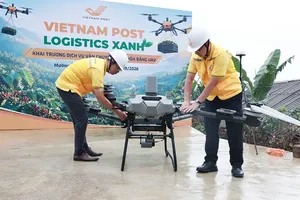
By late December 2025, Duc Giang General Hospital in Hanoi and Vietnam Post Corporation (Vietnam Post) had initiated a pilot program transporting medical supplies via UAVs within a 10km radius in Hanoi.
Chairman Nguyen Truong Giang of Vietnam Post positioned this as a strategic “new service layer” designed to bypass urban congestion. Consequently, the hospital anticipates a marked reduction in transit times for biological samples, enhancing medical responsiveness.
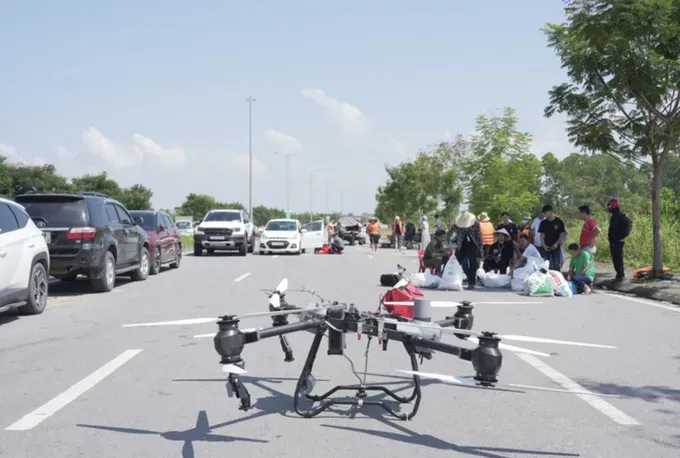
The efficacy of such technology was previously demonstrated during the severe floods of late 2025. Viettel reportedly conducted nearly 300 emergency relief flights across the Central Highlands.
“From a solution originally developed for commercial logistics, Viettel Post’s UAV system is proving its flexibility in urgent situations,” remarked Deputy General Director Le Tuan Anh, attributing the success to rigorous research and technical readiness.
Surge in domestic manufacturing
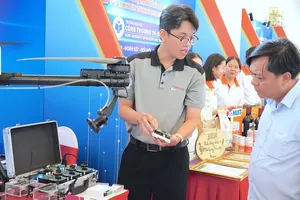
Capitalizing on the UAV sector’s promise, domestic firms are ramping up investment. Notably, Gremsy JSC recently broke ground on a VND550 billion (US$21.6 million) facility at SHTP.
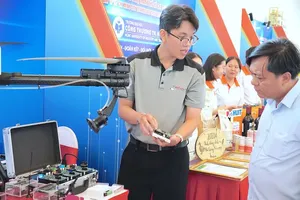
A specialist in next-gen gimbals, payloads, and camera modules for UAV systems since 2011, Gremsy has already exported to 83 countries, with North America accounting for over 50 percent of the revenue. With plans to launch up to 100 new products annually, the company aims to significantly deepen its footprint within Vietnam’s manufacturing ecosystem.
Alongside Gremsy, the UAV ecosystem at SHTP also features the presence of Saolatek, an enterprise that grew out of a startup in the High-Tech Business Incubator. Saolatek’s UAV products have reportedly reached various international markets and are highly rated for their quality.
Director Tran Anh Tuan of Saolatek remarked: “Saolatek views this testing phase as a golden opportunity to contribute data and practical experience. It’s about helping regulatory agencies establish a foundation to build and perfect a suitable legal framework for civil UAVs down the road.”
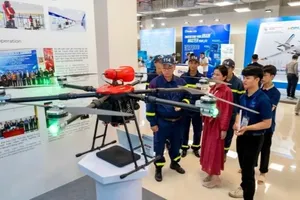
On a broader scale, several major conglomerates have also begun entering the fray. Recently, CT Group established CT UAV and built a research and production facility in Thuan An Ward of HCMC. The company also just announced three UAV models serving surveillance/patrol, firefighting, and smart agriculture.
Among them, the Hexarotor Firefighting UAV line operates automatically using AI, capable of guiding water hoses, spraying foam, and dropping fire-extinguishing balls. The CT-Spectral 12kg model serves “Agriculture 4.0,” carrying a load of 12kg for spraying, fertilizing, and crop monitoring.
Furthermore, CT Group has announced a 400ha UAV complex project in Tay Ninh Province. According to Vice Chairman Doan Trung Kien of the Tay Ninh Province People’s Committee, this UAV tech complex isn’t just an investment project; it’s a strategic high-tech hub linked to digital data development and the construction of a UAV ecosystem.
FPT Corporation has also made initial moves into the UAV manufacturing sector. During a field survey of the science, technology, and innovation ecosystem by HCMC leadership in the Binh Duong area, General Director Nguyen Van Khoa of FPT Corporation expressed a desire to work with the city to build policies for the “low-altitude economy” along with a land fund of around 200ha for a UAV production zone.
Meanwhile, Viettel has already researched and produced dozens of UAV varieties serving both civil and national defense security purposes. It appears this tech giant is well-positioned to lead Vietnam’s UAV manufacturing sector.
Specialized UAVs: Sector ripe for growth
According to Tran Anh Tuan, Standing Vice Chairman cum CEO of the Vietnam Aviation-Aerospace-UAV Network, with a long coastline, extensive island systems, and a diverse agricultural base, Vietnam is a highly potential market for specialized UAV lines.
UAVs don’t just play a role in national defense; they are being applied increasingly widely in civil sectors such as precision agriculture, logistics, security monitoring, energy management, and search and rescue.
Important policies such as the Politburo’s Resolution No.57-NQ/TW on breakthroughs in science, technology, and national digital transformation as well as Resolution No.68-NQ/TW on private economic development, alongside the “Make in Vietnam” strategy, are creating favorable conditions for core technology industries to develop, readying them to invest and integrate deeply into the UAV value chain.