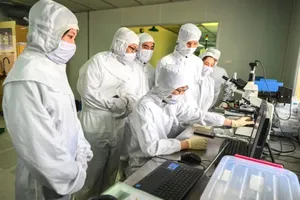
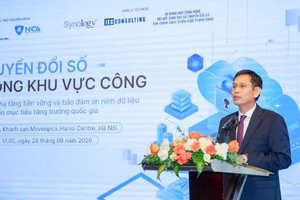
Three resolutions just passed at the session of the Ho Chi Minh City People's Council on September 22 will unlock resources for scientific research, promoting high-tech product lines to be strongly applied in the economic and social reality of the city.
Infrastructure gaps hold back Ho Chi Minh City’s tech ambitions
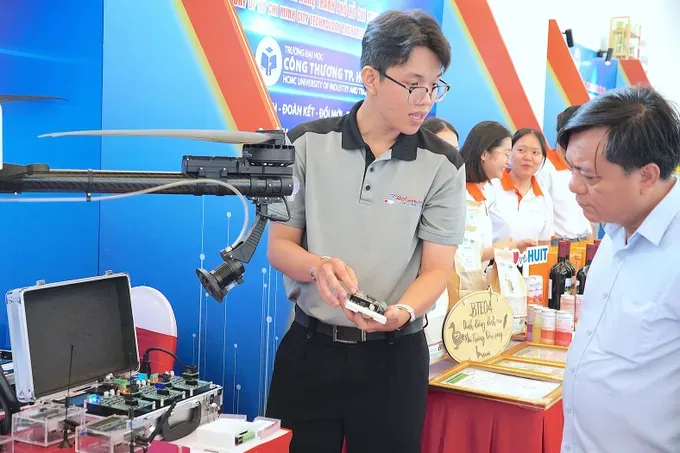
The city currently has more than 6,000 microchip engineers, accounting for the majority of the country's workforce. The Ho Chi Minh City High-Tech Park (SHTP) alone is managing 1,166 high-tech projects with a cumulative capital exceeding US$13.4 billion, gathering many leading multinational corporations such as Intel, Samsung, and NVIDIA.
Despite possessing abundant brainpower and large foreign direct investment (FDI) capital, without in-depth testing tools, domestic enterprises still find it very difficult to intervene deeply and autonomously in the global value chain.
To complete a microchip design or a new artificial intelligence (AI) solution, engineers must spend years of hard work. However, the gap from a blueprint to a product that can be tested, produced, and commercialized is an entirely different story, shared Truong Minh Dat, managing director of Benkon (an enterprise owning an IoT energy management solution and a cooling service rental model).
According to Truong Minh Dat, to step out of the laboratory, enterprises are required to have expensive machinery, measuring, testing, and simulation equipment worth up to millions of US dollars. This is a vast "void" that many domestic units cannot balance on their own, especially in industries requiring super-large capital sources such as semiconductors, AI, and big data. The lack of infrastructure meeting standards causes many research results, no matter how excellent, to stop at the laboratory scale.
In addition, startups also face capital difficulties. Recently, Benkon held 7 patent applications and was chosen by WinCommerce (belonging to Masan Group) to deploy for 6,000 stores, but the characteristic of "spending capital first, collecting money later" forces enterprises to bear heavy pressure. Benkon's story reflects the general reality of the technology startup community in Ho Chi Minh City. Although holding many valuable patents, innovative enterprises still face difficulties in accessing credit capital when the banking system requires loans to be secured by tangible assets.
Ho Chi Minh City moves to break R&D infrastructure bottlenecks
Vo Minh Thanh, deputy director of the Ho Chi Minh City Department of Science and Technology, said the city currently holds a major advantage in terms of the startup network and vibrant science and technology activities. However, the core bottleneck that needs to be resolved fundamentally and early is the infrastructure serving research and development (R&D).
The National Assembly’s Resolution 98/2023/QH15 on piloting a number of specific mechanisms and policies for the development of Ho Chi Minh City (amended and supplemented in Resolution 260/2025/QH15) has opened up many outstanding preferential mechanisms, but the practical implementation process still has obstacles.
The absence of shared laboratories, prototyping facilities, and internationally standardized testing systems is implicitly holding enterprises back, causing the flow of brainpower to be congested.
The door to breakthrough developments has just been opened when the Law on Urban Development officially takes effect on October 1, 2026. According to Clause 2, Article 30 of the law, the Ho Chi Minh City People's Council is entitled to stipulate mechanisms and preferential policies to support the development of infrastructure, innovation systems, and organizations operating in the fields of science and technology, innovation, and digital transformation.
On that basis, at the recent 5th session of the Ho Chi Minh City People's Council, term XI, 2026-2031 tenure, the city People's Council passed 3 resolutions on supporting innovative startups, developing research infrastructure, technology transfer, and intellectual property. Accordingly, the non-refundable support level for incubation costs is VND50 million per project at the idea stage, VND100 million at the verification stage, and VND500 million at the acceleration stage, an increase of 25 percent compared to before.
Regarding infrastructure, the maximum support level is VND25 billion per organization or enterprise for infrastructure belonging to the strategic technology list, not exceeding 50 percent of the project funding. Infrastructure and equipment of innovation centers and innovative startup support centers have a base ceiling of VND100 billion per center, applied according to groups and support conditions.
Patents belonging to the strategic technology list and strategic technology products are supported with a maximum of VND80 million (for domestic patents) and VND100 million (for foreign patents).
Director Nguyen Hai An of the Ho Chi Minh City Biotechnology Center assessed that digital transformation or R&D investment is not a campaign slogan but a life-or-death race shaping the economic position of a central urban area. Investing in science and technology is therefore both a pressure and an epochal responsibility.
A key feature of the new support policies is that funding will not be provided as direct cash grants but will instead be closely tied to a company's R&D capabilities, investment progress, and operational performance. To access seed funding, businesses must allocate at least 2 percent of their revenue to R&D, or spend a minimum of VND200 billion annually. Their research departments must employ between three and ten staff members with university degrees or higher, with at least 50 percent being Vietnamese nationals.
Funding will be disbursed based on project milestones. For physical infrastructure projects, funding will be released in three phases at 40 percent, 30 percent, and 30 percent, respectively. For digital infrastructure projects, funding will be released in two phases at 60 percent and 40 percent, respectively. Projects must commit to maintaining their approved purpose for three to five years, storing data in Vietnam, and complying with cybersecurity regulations.
“These resolutions remove longstanding constraints and will help the city achieve breakthroughs in science and technology, innovation, and digital transformation in the coming years,” emphasized Vo Minh Thanh, Deputy Director of the Ho Chi Minh City Department of Science and Technology.
Tran Quy, Director of the Vietnam Institute for Digital Economy Development:
A breakthrough through the “Three-tier infrastructure strategy”
Three resolutions approved by the Ho Chi Minh City People's Council to support innovative startups, develop research infrastructure, promote technology transfer, and strengthen intellectual property rights are expected to create an exceptional legal framework, comprehensively remove infrastructure bottlenecks, and establish an optimal testing environment for businesses. These measures will serve as a powerful catalyst for the commercialization of high technology and help drive the city's economic growth toward a double-digit target.
Ho Chi Minh City could strictly apply the co-funding principle. Under this approach, the government would provide partial support, while businesses or research institutions would be required to contribute matching funds. For large-scale projects, the level of budget support should be proportional to the amount of private capital mobilized, the extent of infrastructure sharing with the community, and the technological outputs achieved.
At the same time, Ho Chi Minh City should implement a “three-tier infrastructure strategy.” Specifically, Tier 1 would focus on developing core shared infrastructure, including standardized laboratories, supercomputers, AI infrastructure, and open data platforms. Tier 2 would concentrate on strategic technology infrastructure such as semiconductors, AI, and big data. Tier 3 would establish policy testing environments (sandboxes) and pilot manufacturing zones to accelerate the commercialization of technologies. Together, these three solutions would attract social resources and create a comprehensive R&D ecosystem for Ho Chi Minh City.
Trinh Xuan Thang, Director of the Research and Development Center, Ho Chi Minh City High-Tech Park:
Unlocking seed capital, activating digital growth drivers
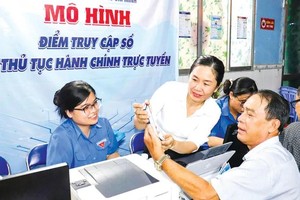
Ho Chi Minh City has completed only about 53 percent of its annual digital transformation plan and continues to face infrastructure bottlenecks, despite 93.3 percent of administrative procedures already being available through online public services.
To address these challenges, the resolution governing the establishment of enterprises, participation in enterprise formation, management and administration roles, and capital contributions to enterprises for commercializing scientific research outcomes and technology development based on intellectual property owned by universities, institutes, and science and technology organizations under the city's management, as well as allowing public employees to participate in enterprise activities, represents a major breakthrough.
The resolution includes seed funding of up to VND25 billion per organization or enterprise from the city budget. The objective is to attract additional private investment into large-scale digital infrastructure projects and provide a timely boost for research institutes, universities, and core technology enterprises.
To maximize the effectiveness of seed funding, it should be accompanied by flexible allocation mechanisms. Ho Chi Minh City should optimize connected resources, especially as information technology infrastructure is being standardized across 168 communes, wards, and special zone. Support policies should avoid situations in which businesses make overlapping investments in similar server systems and software platforms, resulting in wasted resources.
In addition, financial support policies should be based on the city's new Digital Transformation Index (DTI) and prioritize organizations that have genuinely mastered emerging technologies.