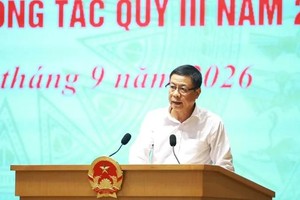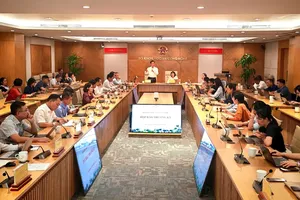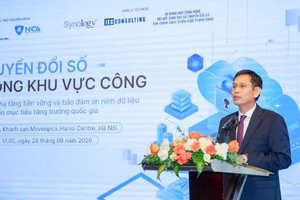
Dang Minh Thong, Deputy Secretary of the HCMC Party Committee as well as Deputy Head of the HCMC Steering Committee for Science, Technology, Innovation, and Digital Transformation, emphasizes that the timeline to complete the action plan is brutally strict.
Executing Plan No.05-KH/BCDTW (issued on July 11, 2026 by the Central Steering Committee on science, technology, innovation, and digital transformation regarding a 100-day push to clear digital bottlenecks across the political system), this 100-day action plan is fiercely implemented to tackle digital bottlenecks within the municipal political system.
The primary objective focuses on resolving overdue tasks alongside clearly identified hurdles. Its major spirit demands real work yielding genuinely usable, thoroughly verifiable products. The blueprint explicitly establishes a “6 clears – 1 consistent” principle, mandating clear personnel, responsibilities, timelines, plus consistent grassroots leadership.
He stressed that merely acquiring hardware or installing software can’t be considered crossing the finish line. It’s more critical to fundamentally shift toward a comprehensive lifecycle management mindset, spanning from identifying needs to securing tangible, operational outputs. For Party agencies, digital transformation inherently stems from pressing needs to revamp advisory methods.
Ultimately, this transformation must systematically renovate work organization, drastically reduce manual operations, plus substantially elevate data quality while guaranteeing security right from the get-go. Therefore, this 100-day milestone essentially serves as a rigorous litmus test evaluating municipal execution capabilities.
Deputy Secretary Dang Minh Thong reported that halfway through the plan, the Party agency bloc successfully accomplished half of its 18 targets and 8/29 tasks. Remaining objectives are rolling out on schedule.
Notably, he directed the HCMC Party Committee Office to pilot the Information System for Leadership and Direction of Party Committees and Agencies in HCMC (iCPV-HCMC System). It seamlessly applies artificial intelligence built upon proprietary data platforms, essentially strengthening decision-making plus workflow automation.
However, tasks concerning infrastructure, digitization, cybersecurity, plus human resources still lag behind. These initial fifty days helped HCMC pinpoint flowing versus congested areas. During the remaining timeframe, officials must fiercely resolve these bottlenecks. Whatever’s already clear can’t wait; it must be tackled immediately without agonizing delays.
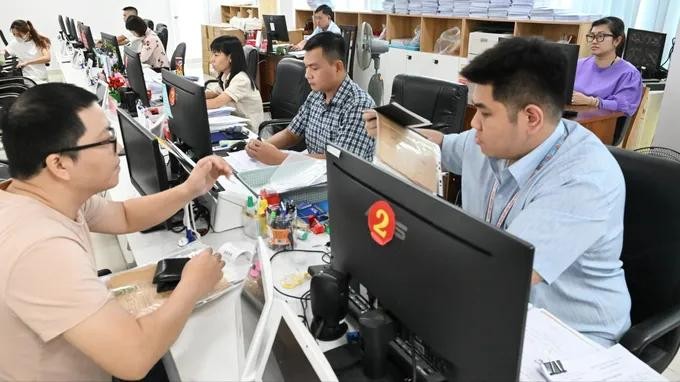
The digitization of documents remains a highly notable bottleneck that HCMC must execute with immense urgency. Because the sheer volume of dossiers is staggeringly massive, it demands rigorous archival expertise.
Agency heads must immediately inspect workflows to uncover exactly where hurdles lie; wherever the tangle is, it’s absolutely crucial to unknot it promptly. Lagging units will be specifically urged to hit assigned deadlines. Ultimately, the objective isn’t merely counting scanned pages. It’s to forge a strong digital repository that can be effortlessly queried and exploited. This data must strictly guarantee being accurate, unified, and widely shared to serve leadership tasks.
Deputy Secretary Dang Minh Thong mentioned that the iCPV-HCMC System should radically renovate working methods across municipal Party agencies. Technology only genuinely holds value when it’s seamlessly woven into daily operations. Bureaucrats stubbornly clinging to archaic habits, like relentlessly printing paper or repeatedly inputting identical data across several channels, isn’t genuine digital transformation.
Therefore, this system ambitiously targets a unified, highly secure environment for task tracking plus data exploitation, applying AI atop the city’s robust data foundation. HCMC will formulate a concrete roadmap gradually eradicating parallel paper-electronic processing, strictly excluding specific state secret protections.
Existing data must be recycled without demanding redundant re-entry unless genuinely imperative. Throughout the trial run, officials are continuously updating the system. Existing information must be vigorously exploited for administration, and authorities won’t create separate input channels merely to churn out repetitive reports.
The Deputy Secretary declared the utmost requirement for agency heads with the remaining time. Firstly, leaders must comprehensively audit their assigned tasks, immediately pinpointing overdue duties and locating exact bottlenecks. Every single mandate must possess clear personnel, timelines, alongside concrete responsibilities.
He’s strictly requiring all units to firmly prevent new overdue tasks from cropping up. Any agonizing difficulties regarding manpower or funding must be resolved at breakneck speed; internal red tape simply can’t be the culprit dragging down overall progress. Furthermore, lagging units must transparently report root causes alongside feasible remediation plans.
Notably, the HCMC Party Committee Office must urgently flesh out missing regulations, proactively materializing Plan No. 213-KH/VPTW to foolproof infrastructure for the 2026-2030 period. Concurrently, the HCMC Public Security Department must meticulously track progress, issuing early warnings for snags, while the municipal Department of Science and Technology must focus on perfecting platforms while rigorously guaranteeing system safety.
The deeper the digital transformation goes, the more massive the demands for data security become. Deputy Secretary Dang Minh Thong outlined practical solutions handling this pressing issue.
He stressed that network safety, data protection, and state secret safeguarding must inherently walk hand-in-hand with digital upgrades right from the starting line. They simply can’t be treated as an afterthought. From the initial design phase to data exploitation, the absolute imperative of security must sit squarely at the forefront. If critical systems haven’t strictly secured safety prerequisites, they absolutely can’t be thrown into operation.
Regarding metrics definitively proving the plan has genuinely met stringent requirements, the ultimate yardstick must be deeply rooted in substantive results. Success hinges on whether systems operate steadily, whether officials actually use them daily, and whether workflows are genuinely processed digitally.
Standardized data must drastically slash manual labor, empowering leaders to finally make data-driven decisions. HCMC is mandated to spearhead this massive charge. Consequently, every official must drastically revamp working methods, forging an ironclad execution discipline while fostering a data-driven administrative approach across the entire system.