The boom in e-commerce is fundamentally transforming Vietnam's postal sector. With billions of packages moving each year, the boundaries between postal, transport, and logistics services are increasingly overlapping, requiring a new and more suitable management approach for the postal industry.
Differentiating service categories
According to Minister of Science and Technology Vu Hai Quan, after more than 15 years of implementation, the 2010 Law on Post has enabled significant development in the sector. However, alongside the achieved results, the 2010 law has revealed several shortcomings and limitations, no longer proving suitable or keeping pace with the practical development of the postal field. Therefore, a comprehensive amendment to the Law on Post is urgent in the current context to overcome these existing limitations and build a legal foundation for the postal sector to become an essential infrastructure of the country and the digital economy.
The draft amended Law on Post developed by the Ministry of Science and Technology introduces a new approach. Rather than relying on commercial names or business models, it classifies services based on the nature of operations and specific identifying characteristics of postal services.
This new approach helps resolve one of the most confusing issues today: distinguishing between postal services and independent transport or logistics services.
In essence, transport only moves goods from an origin to a destination. Meanwhile, certain independent logistics activities may cover stages such as warehousing, loading and unloading, consolidation, or inventory management, without forming a full postal network.
Conversely, when an enterprise organizes a closed-loop service network to accept postal items, sort, transport, track, and deliver them to a designated address or location as agreed, those operations possess the defining characteristics of a postal service and fall within the scope of the Law on Post.
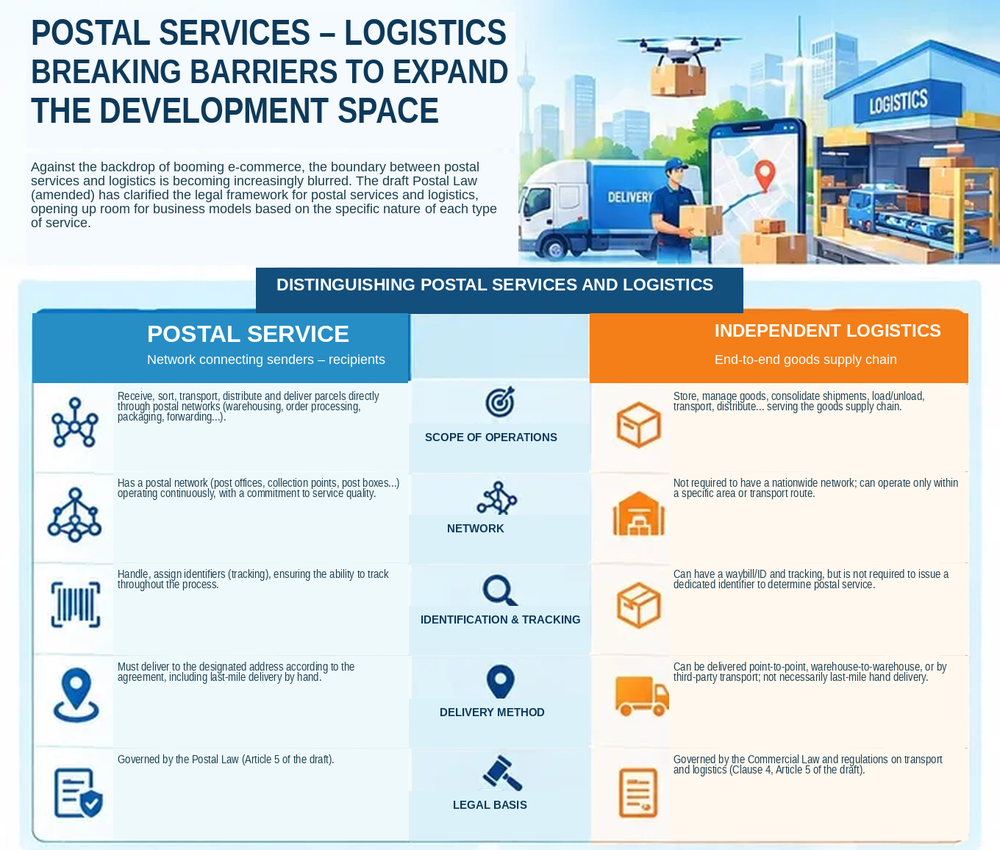
The draft amended Law on Post does not intend to sweep all logistics into the postal domain, but aims to establish clear boundaries based on operational substance. Under Clause 4, Article 5, independent transport and logistics operations that do not fully meet the defining characteristics of postal services are excluded from its scope.
This method also provides clarity for e-commerce. E-commerce involves buying and selling goods and providing services online, whereas the order fulfillment stage may utilize postal services or other delivery methods. Therefore, these two concepts must be distinguished rather than equating e-commerce with postal operations.
Revised Postal Law prioritizes traceability in the digital era
As the market scale expands to billions of postal items annually, traditional management methods are increasingly unable to meet practical demands. The draft amended Law on Post thus places its focus on the ability to identify and track every individual postal item.
Accordingly, each postal item is processed individually, assigned an identifier, and guaranteed full traceability throughout the service delivery process. This is not only a technical requirement, but also forms the foundation for risk management, service quality improvement, control of prohibited items, fraud prevention, and protection of user rights.

A notable feature is that the law does not impose a single technology model. Instead, it defines core characteristics, allowing enterprises to proactively choose appropriate technologies and organizational methods. This represents a significant management mindset in the digital economy: the law establishes principles and responsibilities, while giving enterprises room to innovate their models and technologies.
The postal market stands at the intersection of digital infrastructure, e-commerce, logistics, and the data economy. Thus, the objective of revising the Law on Post is not to raise additional barriers between sectors, but to clearly define management boundaries so that all fields can grow together. Defining scope by operational substance rather than commercial names, modernizing the postal network, and permitting enterprises to own, lease, or jointly operate infrastructure represent highly practical changes.
A clear legal framework will help enterprises understand precisely what services they offer, what obligations they must fulfill, and how they can structure their networks. More importantly, such transparency minimizes two key risks: regulatory overlap that increases compliance costs, and regulatory gaps that result in unfair competition.
Deputy Prime Minister Ho Quoc Dung said the core objective of the latest amendments to the Postal Law is to build national infrastructure and establish postal services as essential infrastructure that strongly supports the digital economy and e-commerce while promoting the development of the private sector.
The amendments change the management approach, shifting the focus from “pre-inspection” to “post-inspection,” marking a breakthrough in state management of postal services. They also improve the public-service mechanism and add provisions on postal data, risk management, and ensuring absolute security and safety in postal operations.