This news was released by the World Intellectual Property Organization (WIPO) in Geneva, Switzerland, on the afternoon of September 29, the Ministry of Science and Technology announced.
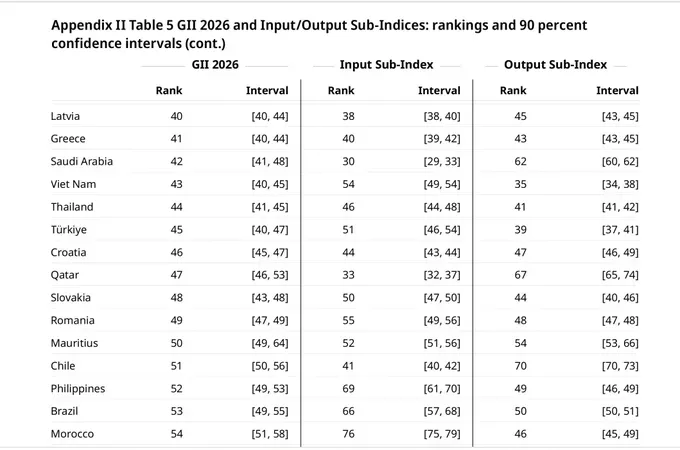
Since 2016, Vietnam's GII score has steadily improved, jumping 16 places from 59th to 43rd. In 2026, Vietnam continued to see an improvement in its innovation outputs ranking, rising two places compared to 2025 from 37th to 35th, which helped boost its overall ranking by one spot, achieving the goal set by the Government.
In the GII 2026 report, Vietnam maintained its second position among lower-middle-income nations. The lower-middle-income country ranked ahead of Vietnam is India, which holds the 38th spot. Only two upper-middle-income countries ranked above Vietnam (China at 10th and Malaysia at 34th), while all other countries ranked above Vietnam are industrialized and high-income economies. Within the ASEAN region, Vietnam continued to surpass Thailand, ranking third behind Singapore and Malaysia.
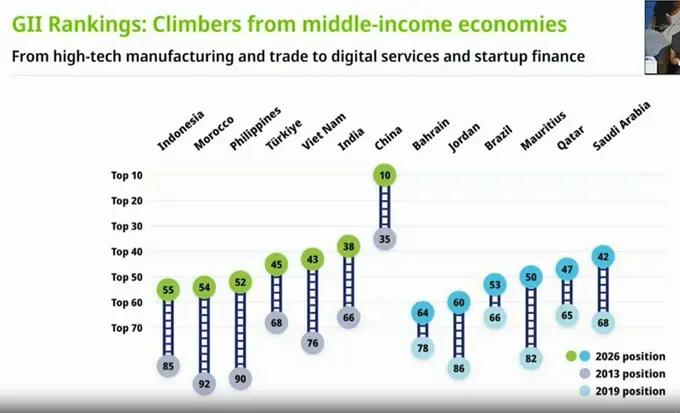
WIPO recognized Vietnam as one of seven middle-income countries making the fastest progress in ranking since 2013 (along with China, India, Türkiye, the Philippines, Morocco, and Indonesia). Vietnam is also one of three countries overperforming relative to their level of development (alongside China and India). For 16 consecutive years, Vietnam has consistently achieved innovation results above its development level, demonstrating efficiency in translating input resources into innovation outputs.
Minister of Science and Technology Vu Hai Quan stated that the two-place rise in Vietnam's innovation output index is a highly noteworthy result. This outcome stems from the very decisive implementation of Resolution 57-NQ/TW over the past year. Specifically, financial resources invested in science and technology, innovation, and digital transformation have seen a sharp increase.
Furthermore, through the implementation of Resolution 57-NQ/TW, the system of policies and laws on science and technology, innovation, and digital transformation is being gradually perfected. At the same time, the involvement of stakeholders ranging from the State and businesses to research institutes and universities has contributed to the initial formation of an innovation ecosystem in Vietnam.
These efforts have initially created positive changes and yielded preliminary results for innovation, helping Vietnam's GII rise by one spot compared to 2025 and achieve the goal set by the Government, heading toward the objectives of entering the Top 40 by 2030 and the Top 30 leading innovation nations in the world by 2045.
The Global Innovation Index (GII), published by WIPO, is a globally recognized tool for assessing national innovation capacity. It reflects countries’ socio-economic development models based on science and technology (S&T) and innovation.
Through the index, countries can gain a comprehensive picture of their strengths and weaknesses. The GII is currently used by the Governments of many countries as an important reference tool for public administration and for developing S&T and innovation policies.
According to WIPO’s 2025-2026 survey results, 93 member countries and economies use GII results in formulating S&T and innovation strategies and policies. In recent years, the Vietnamese Government has used this index as one of its key governance and management tools, assigning ministries, agencies, and local authorities shared responsibility for improving the country’s performance on the index.