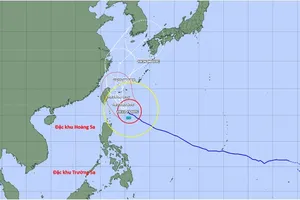
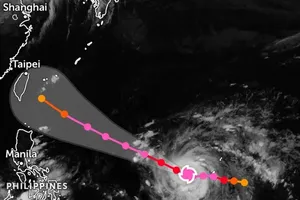
The system is generating strong winds and rough seas in the northeastern waters of the northern East Sea, posing risks to maritime activities.
As of the afternoon of June 4, the center of the tropical depression was located at approximately 19.6 degrees North latitude and 117.8 degrees East longitude, over the eastern waters of the northern East Sea, about 650 kilometers northeast of the Hoang Sa (Paracel) Special Zone.
Maximum sustained winds near the center of the system reached force 6, equivalent to 39–49 kilometers per hour, with gusts up to force 8.
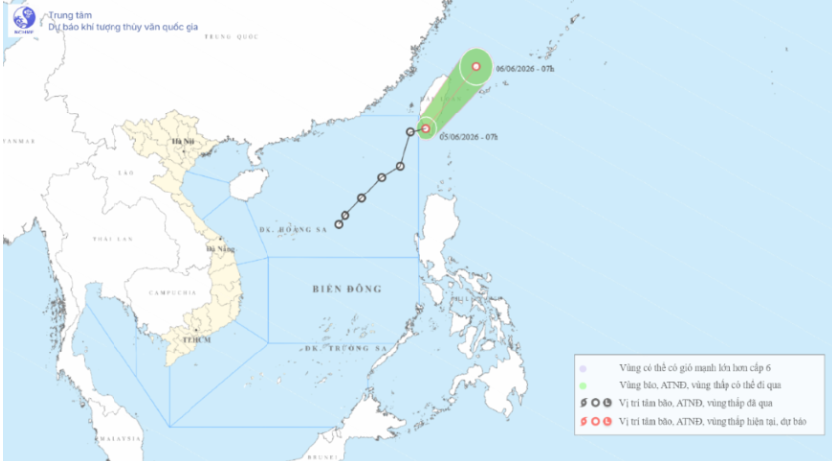
Meteorologists warned that the tropical depression is causing strong winds of force 6 and gusts of up to force 8 across the eastern part of the northern East Sea. Wave heights are forecast to range from two to four meters, resulting in rough sea conditions.
Vessels operating in the affected waters face potential hazards from thunderstorms, waterspouts, strong winds, and high waves. Authorities have issued a level 3 natural disaster risk warning for the eastern and northeastern areas of the northern East Sea.
Heatwave in North temporarily eases amid widespread thunderstorms
According to the National Center for Hydro-Meteorological Forecasting, the heatwave in the Northern region temporarily ended on June 5. However, forecasters warn that hot weather is likely to return between June 6 and June 7 before another period of widespread thunderstorms affects the region.
On the evening of June 4, thunderstorms spread across the Northern region, including Hanoi and several provinces in the midland and delta areas. Heavy rain, accompanied by strong, gusty winds, was recorded in many parts of the capital city overnight.
Data from the Vrain rainfall monitoring system showed that from 7:00 p.m. on June 4 to the morning of June 5, many localities in the Northern and North-Central Vietnam recorded significant rainfall.

The highest was in Thai Nguyen Province, with 126.6 mm measured at Trung Hoi station. Other notable readings included Dien Bien (112.6 mm), Quang Ninh (105 mm), Thanh Hoa (104.2 mm), Phu Tho (97.6 mm), Lao Cai (93.4 mm), Hanoi (90.4 mm) and Bac Ninh (89.4 mm).
Several other areas, including Tuyen Quang, Hai Phong, Hung Yen, Ninh Binh and Nghe An, recorded rainfall between 60mm and 80 mm.
Rainfall across the Central localities, from Quang Tri to Da Nang, was largely insignificant, staying below 10 mm. By comparison, the Central Highlands and Southern regions experienced more scattered and uneven precipitation, ranging from light to moderate levels, with Lam Dong at 38 mm, An Giang at 24.4 mm, and Ho Chi Minh City at 18.2 mm.
Due to the influence of thunderstorms, the heatwave across the Northern region ended temporarily on June 5, with daytime temperatures dropping to around 32–33 degrees Celsius. Scattered showers and thunderstorms are expected to continue in northwestern and mountainous areas during the late afternoon and evening.
Meteorologists forecast that hot weather will return to northern Vietnam from June 6 and June 7, with maximum temperatures reaching 35–36 degrees Celsius and locally up to 37 degrees Celsius. However, localized thunderstorms may still occur in the late afternoon and evening during this period.
Weather models also suggest that from around the afternoon of June 8, a weak influx of cooler air combined with a low-pressure trough and upper-level jet stream may trigger widespread rainfall and thunderstorms across the Northern region. This could temporarily suppress the heatwave, with some areas experiencing moderate to heavy rain, lightning and strong winds due to atmospheric instability.
While the Northern region sees widespread rainfall, the Central Highlands and Southern regions will continue to experience scattered showers and thunderstorms in the afternoon and evening of June 5. However, the National Center for Hydro-Meteorological Forecasting expects rainfall intensity to decrease significantly compared to previous days, generally ranging from 10–30 mm, with isolated areas exceeding 60 mm.