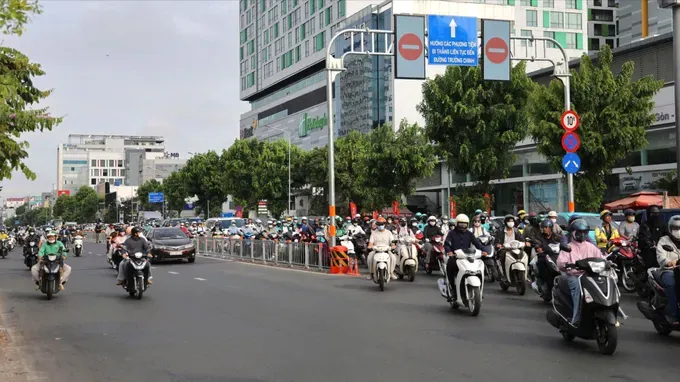
On May 15, Ho Chi Minh City officially implemented a new traffic management plan featuring a flexible reversible lane system on Cong Hoa Street, Tan Son Nhat Ward. This marks the first time the city has applied a time-based traffic regulation model on a route approximately 2.5 km in length, stretching from Truong Chinh Street to Ut Tich Street, a corridor long regarded as one of the city’s chronic congestion hotspots.
Under the new plan, the two central lanes on Cong Hoa Street will be flexibly adjusted to change traffic direction according to different time periods during the day. In the morning, priority is given to increasing the number of lanes in the direction from Truong Chinh Street toward the city center and Tan Son Nhat Airport in order to reduce traffic pressure caused by vehicles converging on the airport gateway area. In the late afternoon and evening, the arrangement is reversed, with more lanes allocated to traffic moving from the city center toward suburban areas to accommodate higher travel demand after working hours.
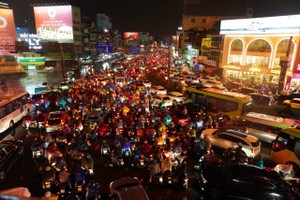
During the morning peak hours, traffic volume from the Hoang Hoa Tham overpass area and surrounding streets flowing onto Cong Hoa Street increased significantly from early in the day. Between 7:00 and 8:30 a.m., vehicle queues stretched across multiple sections of the route, particularly at intersections and merging points.
On the first day of implementation of the new traffic plan, many road users experienced confusion while traveling. Some drivers had to slow down, stop to observe, or proceed cautiously to determine the appropriate direction, leading at certain times to cases of lane misalignment or incorrect lane changes. However, prolonged congestion did not occur thanks to the continuous traffic management efforts of the authorities.
Officers and personnel from the Tan Son Nhat Traffic Police Team of the Traffic Police Division under the Ho Chi Minh City Department of Public Security were fully deployed at key checkpoints along the route. Patrol units regularly used loudspeakers to provide guidance and remind road users to comply with traffic signage, while also directly assisting in traffic regulation at heavily congested points. As a result, by around 8:00 a.m., despite a continued increase in traffic volume, vehicle flow had begun to stabilize compared to the early peak period.
Alongside positive outcomes, the installation of movable median barriers revealed several shortcomings on the first day of implementation. At certain locations, pedestrians encountered difficulties crossing the road as the barriers obstructed direct passage, requiring them to walk further to find suitable crossing points. Some residents have suggested that the authorities consider adding more safe pedestrian crossing locations to ensure greater convenience and safety for pedestrians.
During the afternoon peak hours, traffic volume from the steel overpass at the Lang Cha Ca intersection toward Truong Chinh Street continued to increase. Despite the heavy traffic density, vehicle flow generally remained stable, moving continuously but at a slower pace compared to off-peak periods. Severe congestion did not occur, and key intersections were largely kept under control through the management and coordination of traffic police forces.