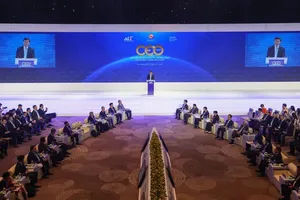
On the afternoon of October 27, experts and businesses discussed solutions for technology commercialization, policy improvements, and low-altitude economy market development in Vietnam during the session “New Economic Sectors: Unlocking the Potential of the Low-Altitude Economy.”
The discussion was a part of the Autumn Economic Forum 2026.

Vice Chairwoman Nguyen Thi Hai Hang of the Low-Altitude Economy Alliance said mastering core technologies immediately remains a major challenge for Vietnamese businesses. She suggested prioritizing sectors with strong practical demand, such as precision agriculture, infrastructure monitoring, logistics, and healthcare, to create markets, build capabilities, and gradually increase technological self-reliance.
According to her, several Vietnamese companies have successfully developed and commercialized key components, including flight controllers. However, to improve competitiveness, businesses need policy support for research and development, as well as international cooperation to gain access to advanced technologies.
Highlighting practical applications, Bui Minh Phuong, deputy director of the Low-Altitude Space Development Institute, said that in the Mekong Delta, more than 3,000 unmanned aerial vehicles (UAVs) are already being used by farmers for agricultural production, including seeding, irrigation, and crop protection spraying. This provides a foundation for expanding UAV applications into other high-demand sectors.
Information shared at the discussion indicated that the global UAV services market is projected to reach US$28 billion. Vietnam aims to establish three national-level flight testing zones and master 30 percent–40 percent of core equipment technologies by 2030. By 2045, the low-altitude economy is expected to account for about 1.5 percent of GDP, with domestic localization exceeding 85 percent.
Public-service procurement seen as key to commercialization

Nguyen Van Thuat, deputy director of the Department of Economy and Digital Society under the Ministry of Science and Technology, emphasized the need to distinguish between successful flight testing and successful commercialization.
He said a viable business model must meet three conditions, including a market with paying customers, safe operational capabilities, and the ability to scale without requiring a complete redesign of infrastructure and technology.
To achieve these goals, deputy director Nguyen Van Thuat proposed expanding the Low-Altitude Economy Alliance and strengthening links between businesses, universities, and research institutes to build domestic value chains.
He also recommended that the Government play a market-creating role by commissioning public services that use UAVs, such as traffic monitoring, forest-fire warnings, search and rescue operations. Such demand would provide an initial market for businesses, helping them refine products, verify operational effectiveness, and gradually commercialize their technologies.
According to experts, developing the low-altitude economy requires not only research and manufacturing capabilities but also an appropriate legal framework, a safe testing environment, and a sufficiently large market. State involvement during the initial phase will enable Vietnamese enterprises to gradually master technologies, increase their localization rates, and integrate more deeply into the global value chain.