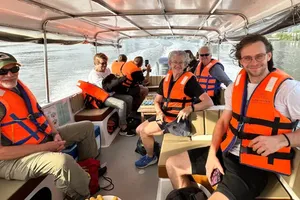
Three days after the tragic capsizing of a tourist canoe in Phu Quoc Island, almost all businesses operating canoe tours in the special zone have temporarily suspended their activities.
The latest rigorous inspection conducted by the Phu Quoc Special Zone administration on July 9 revealed that out of more than 100 passenger canoes touring the islands, only about 70 vessels actually met the operational requirements for the SB classification (featuring a completely sealed roof); consequently, the remainder were strictly suspended from operating. Functional forces also uncovered numerous instances of businesses illicitly operating water scooters, canoes, and paragliders without satisfying the necessary conditions.
Various coastal tourist hotspots in the Central region have also glaringly exposed substantial gaps in management.
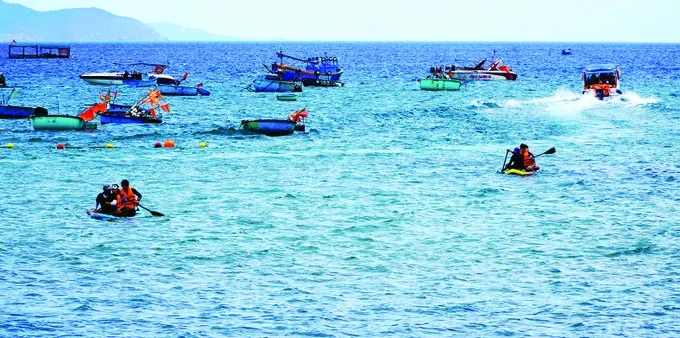
Over at the Nhon Ly Peninsula in Quy Nhon Dong Ward of Gia Lai Province, on July 14, despite rough seas and an official notice to temporarily halt operations, countless canoes and boats stubbornly continued to ferry eager tourists out to the coastal islands surrounding Eo Gio and Hon Seo.
For Mr. Tr.H., who owns multiple canoes in Nhon Ly, the inconsistent enforcement of operational suspension regulations during bad weather has created a chaotic environment. “The compliance just isn’t uniform, which ultimately leads to unhealthy competition and heavily conceals potential risks,” he explained.
On the bustling Phan Thiet – Phu Quy route, where eight vessels operate regularly, heavy sedimentation in the maritime navigational channel forces many high-speed ferries to desperately hire fishing boats just to tow them out of the port, substantially driving up operational costs and quietly harboring severe safety risks.
Meanwhile, in Khanh Hoa Province, the sheer transportation pressure is absolutely colossal during the peak summer tourism season. According to the Inland Waterway Port Authority operating under the provincial Department of Construction, approximately 400 to 500 tourist boats actively navigate across Nha Trang and Vinh Hy bays every single day. Moreover, on weekends and public holidays, the total number of vessels departing the bustling docks can skyrocket to roughly 1,000 trips.
For Nguyen Phuoc Thang, a lecturer at Victoria Hoa Binh University, the grim string of recent disasters, ranging from the canoe sinking in Cua Dai (2022) to the boat capsizing in Ha Long Bay (2025) and the latest tragedy in Phu Quoc, painfully illustrates systemic loopholes in ensuring maritime tourism safety.
He argued that authorities simply can’t casually apply the safety mindset designated for massive cargo ships or large-scale passenger ferries to small tourist boats. Specifically regarding enclosed-deck vessels, he suggested it’s crucial to carefully research a more suitable type of life jacket so passengers can actually escape the confined cabin before the buoyancy violently kicks in.
Besides that, he emphasized the vital need to widely disseminate precise emergency evacuation procedures prior to every single voyage, steadily building a robust safety culture within the maritime and waterway sectors closely mirroring that of the aviation industry.
Following the horrifying accident, the Phu Quoc Special Zone People’s Committee issued an urgent directive tightening waterway transportation management. Accordingly, functional agencies must intensify rigorous inspections of technical conditions, life-saving equipment, and operator certificates right before any vessel departs.
An An Giang Province Department of Tourism leader proposed reconsidering operational licenses for SB-standard canoes featuring sealed roofs after recognizing that numerous severe accidents recently are inextricably linked to this specific vehicle type.
For Lieutenant Colonel Luong Ba Duy, Head of the Nhon Ly Border Guard Station, rigorous enforcement is the only way forward. He stated his unit has coordinated with the Traffic Police to boost inspections, only permitting vehicles to operate when they guarantee optimal conditions and valid paperwork. Simultaneously, they’ve demanded a complete halt to boarding passengers in dangerous areas whenever the sea gets rough.
Currently, the Quy Nhon Dong area doesn’t possess a docking wharf meeting strict technical standards. Since the infrastructure primarily consists of spontaneously erected docks, underlying risks remain dangerously potent.
According to Senior Lieutenant Colonel Nguyen Hong Vang of the Gia Lai Province Public Security Department, since early 2026, his unit collaborated with the Border Guard to organize 231 patrol shifts. This massive effort meticulously controlled 744 vehicles and processed 15 violation cases, primarily centered around overloading passengers and violating registration protocols.
Moving forward, these dedicated forces will maintain a relentless 24/7 patrol at critical estuaries to strictly control safety conditions before any vessel leaves the dock.
In the wake of the Phu Quoc tragedy, the Quang Ngai Province Department of Construction strictly demanded tightened safety measures across key island routes. They mandated that only vehicles boasting optimal technical conditions and sufficient life-saving equipment can operate, resolutely refusing departure clearance whenever the weather turns fiercely adverse.
Over on the Phan Thiet – Phu Quy route, the Binh Thuan Maritime Port Authority issues departure licenses only after thoroughly inspecting dossiers, crew certificates, and weather conditions. For Director Do Van Thuan, strict adherence to natural limits is non-negotiable. He explained that if vicious gusts reach level 8 (62-74 km/h) or conditions violently exceed established safety limits, passenger ships simply won’t be permitted to leave. Furthermore, authorities routinely coordinate to comprehensively inspect passengers and life-saving equipment before every trip.
Down in Khanh Hoa Province, authorities sternly requested a sweeping review of all inland waterway ports, forbidding vehicles from mooring at unlicensed locations. Concurrently, they strongly urged businesses to proactively move boats into safe shelters whenever the weather gets nasty, while heavily stepping up crucial incident response training for crew members.