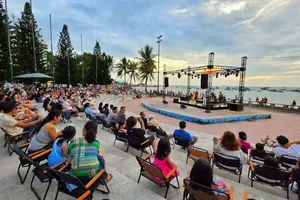
At the conference, the Ministry of Foreign Affairs noted that Halal tourism is undeniably one of the fastest-growing segments, driven primarily by a specific tourist demographic boasting prolonged stays, robust spending power, and a strong tendency to purposefully select safe, remarkably friendly destinations that deeply respect their unique culture and religious beliefs. However, the glaring gap between this colossal potential and the national tourism industry’s actual capacity to adequately respond remains quite substantial.
To further clarify this pressing issue, Deputy Director Ha Van Sieu of the Vietnam National Authority of Tourism analyzed that to successfully woo Muslim visitors, the tourism industry must synchronously satisfy stringent requirements regarding accommodation, gastronomy, prayer spaces, alongside tailored services and authentic experiences perfectly aligned with their specific cultural and religious tenets.
Meanwhile, it’s quite evident that Vietnam’s Halal tourism ecosystem is far from complete, as service infrastructure remains somewhat limited, the domestic workforce isn’t systematically trained, certification standards aren’t universally unified, and promotional activities across key Muslim markets are still remarkably modest.
From an entirely different perspective, international experts argue that the primary challenge doesn’t merely lie in physical infrastructure or hospitality services, but rather in the vital ability to maintain a digital presence.
For CEO Fazal Bahardeen of CrescentRating and HalalTrip from Singapore, navigating this complex digital landscape is crucial. He indicated that the global Muslim population is accurately projected to reach 2.57 billion by 2036, with the vast majority being predominantly young, highly tech-savvy individuals.
Currently, roughly 80 percent of Muslim travelers routinely utilize artificial intelligence (AI) to efficiently search for information and carefully plan their upcoming trips. If comprehensive data regarding domestic hotels, restaurants, and certified Halal services in Vietnam isn’t rigorously standardized so that AI can easily recognize and proactively recommend it, local destinations will ultimately struggle to reach this lucrative demographic right from the initial search phase.
A diplomatic representative of Pakistan in Vietnam observed that the country is currently offered a massive opportunity to deeply participate in the global Halal economy. Just looking at Pakistan and Indonesia alone, there’re nearly half a billion Muslims; if Malaysia, Bangladesh, India, and the affluent Gulf states are also factored in, it’s undeniably a market of colossal scale.
Therefore, Vietnam genuinely needs to heavily prioritize building a robust Halal tourism industry, actively developing a comprehensive chain of standardized products and premium services before aggressively expanding into the international arena. Pakistan stands fully ready to continually assist Vietnam in adequately training its human resources, cooperating on official Halal certification, and facilitating market connectivity.
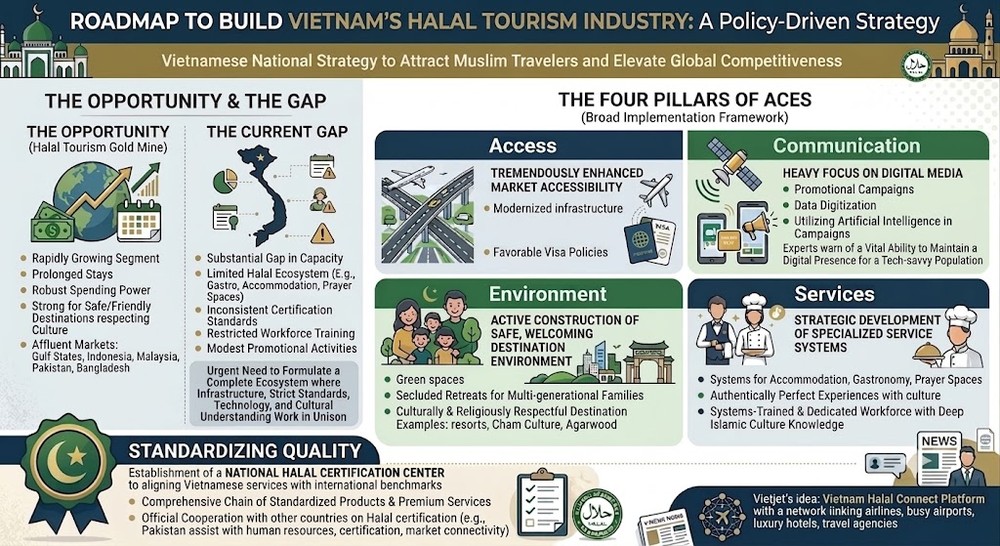
Concurrently, Deputy Director Ha Van Sieu proposed broadly implementing the Access – Communication – Environment – Services (ACES) action framework based on four central pillars:
- tremendously enhancing market accessibility through modernized infrastructure and favorable visa policies;
- heavily pushing digital media communication;
- actively constructing a safe, welcoming destination environment;
- strategically developing specialized service systems alongside a dedicated workforce possessing deep knowledge of Islamic culture.
Consequently, the strategic establishment of a National Halal Certification Center will significantly contribute to standardizing service quality in strict accordance with recognized international benchmarks.
Meanwhile, Chief Commercial Officer at Vietjet Ha Nang Viet suggested proactively building a seamless “Vietnam Halal Connect” platform. He explained that this digital network would efficiently link airlines, busy airports, luxury hotels, travel agencies, and various service providers to ultimately forge an uninterrupted “Halal journey” straight from the departing flight right through to the final destination.
Various experts also recommended that Vietnam rapidly accelerate data digitization, creatively apply artificial intelligence in broad promotional campaigns, and enhance comprehensive workforce training. At the same time, the country should actively expand strategic cooperation with neighboring ASEAN nations to construct interconnected tourism routes, effectively prolonging tourist stays, and boosting their overall expenditure.
In the end, the message passionately shared by numerous delegates at the conference was incredibly clear. If Vietnam truly wants to effectively exploit this Halal tourism “gold mine,” it urgently needs to thoughtfully formulate a complete ecosystem, a dynamic space where physical infrastructure, strict standards, modern technology, skilled personnel, and deep cultural understanding smoothly operate in absolute unison.
Once achieved, Halal tourism will play a pivotal role in diversifying the international tourist market, reliably creating a powerful driving force to substantially elevate service quality and sharpen the competitive edge of Vietnamese tourism in this completely new developmental phase.
According to the UAE Ambassador to Vietnam, Khanh Hoa Province boasts numerous distinct advantages to successfully attract high-end tourist flows originating from the Middle East. The coastal locality clearly possesses a high-quality resort network featuring multiple secluded retreats perfectly suited to the specific demands of multi-generational families, which is a hallmark characteristic of affluent Gulf travelers.
Besides that, the rich Cham culture and aromatic agarwood (Oud) are incredibly unique elements that forge a signature identity, substantially contributing to boosting the region’s overall appeal to Muslim holidaymakers.