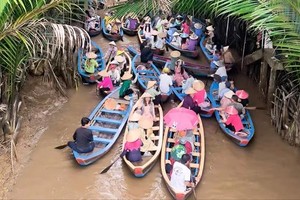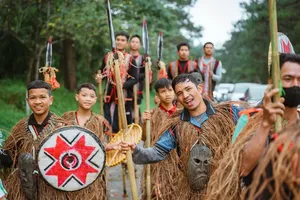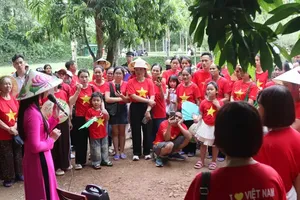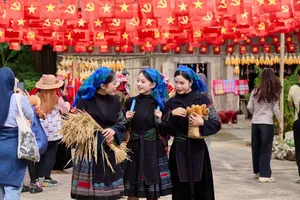
Recently, the integration of production and experience has not only revitalized rural areas but also enhanced the value of agricultural products, created additional employment opportunities, and provided stable income for the local population.
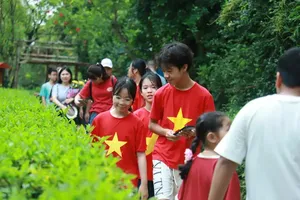
On weekends, the narrow road leading to the Tuy Loan vegetable area in Hoa Vang Commune, Da Nang City, is filled with the joyful laughter of children. Amidst the lush green of the jute, mustard greens, and pennywort, "outdoor classrooms" are taking place.
The vegetable fields and plots of land have transformed into classrooms, with farmers acting as "teachers" guiding each child in sowing seeds, watering plants, and harvesting. The Tuy Loan fresh vegetable cooperative, once a traditional vegetable-growing area, has now donned a "new outfit" by integrating production with experiential tourism. Each year, this place welcomes nearly 6,000 visitors, primarily students, families, and tourists seeking a slower pace of life in the heart of the city.
Tran Thi Anh, 57 years old from Hoa Vang Commune, recounts that her family previously faced financial difficulties with unstable seasonal income. Since joining the cooperative and cultivating various types of vegetables, she now earns approximately VND5 million each month.
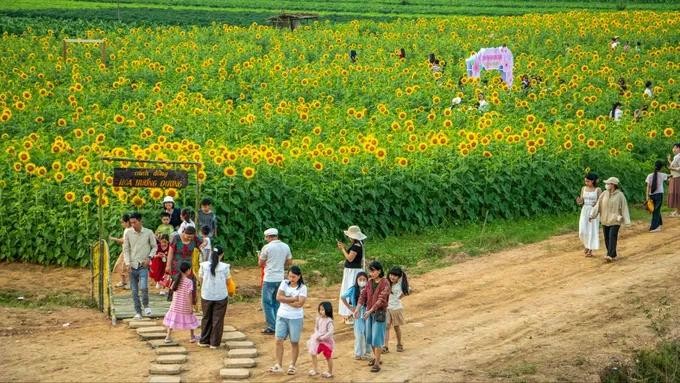
In Vu Gia Commune, Da Nang City, fields of sunflowers have been experimentally planted as a new highlight. Chairman Le Phan Minh of the Commune's People's Committee said that this model serves not only for tourism but also for livestock feed and seed extraction for production purposes.
The chairman revealed that local leadership aims to create a tourism space that combines agricultural experiences, providing stable employment and income for the local residents throughout the year.
At Thuan Nghia ecological vegetable village along the Kon River in Tay Son Commune, Gia Lai Province, the story of “agriculture linked with tourism” is being told in a new way.
Le Thanh Quang, a 42-year-old bok choy farmer, bundled his bok choy while contemplating the past, a time when production was significantly influenced by market volatility, and abundant harvests frequently resulted in decreased prices. Currently, by implementing VietGAP standards, his farm has established reliable sales channels and experienced a noticeable increase in revenue.
“At times, bok choy has brought in VND20 million–VND30 million per month. In good years, 2,500 square meters of land can generate VND120 million–VND150 million,” the bok choy farmer said.
Beyond production, the locality is gradually developing community-based tourism. In 2024, a tourism development project for Thuan Nghia vegetable village was approved, covering 38.5 hectares. Alongside 19 hectares of VietGAP-certified cultivation, the village is also leveraging its cultural assets from centuries-old traditional houses to the shrine dedicated to the “silkworm progenitor." These elements create a distinctive stop where visitors can not only observe but also connect with the village’s history.
In other parts of Gia Lai, similar models are taking shape. Vinh Son Commune is being oriented toward developing community-based tourism linked to vegetables, flowers, and fruit cultivation.
Meanwhile, the An Toan medicinal plant region is building production–consumption linkages while integrating homestay services and expanding experiential spaces. As farmers learn to tell their own stories, each harvest season opens up new opportunities—year-round, resilient, and full of promise.



)