According to the plan, the draft Law on Housing (amended) will be submitted to the National Assembly for consideration at its second session in October 2026. The draft law is expected to overcome policy bottlenecks and open up opportunities for low-income earners to settle down by focusing on developing rental housing.
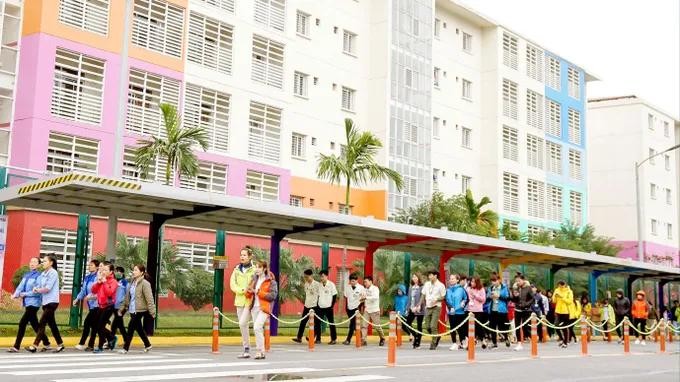
Reporters from SGGP Newspaper recorded the current reality of rental housing and opinions from relevant agencies and real estate businesses regarding mechanisms and policies to attract investment into this sector.
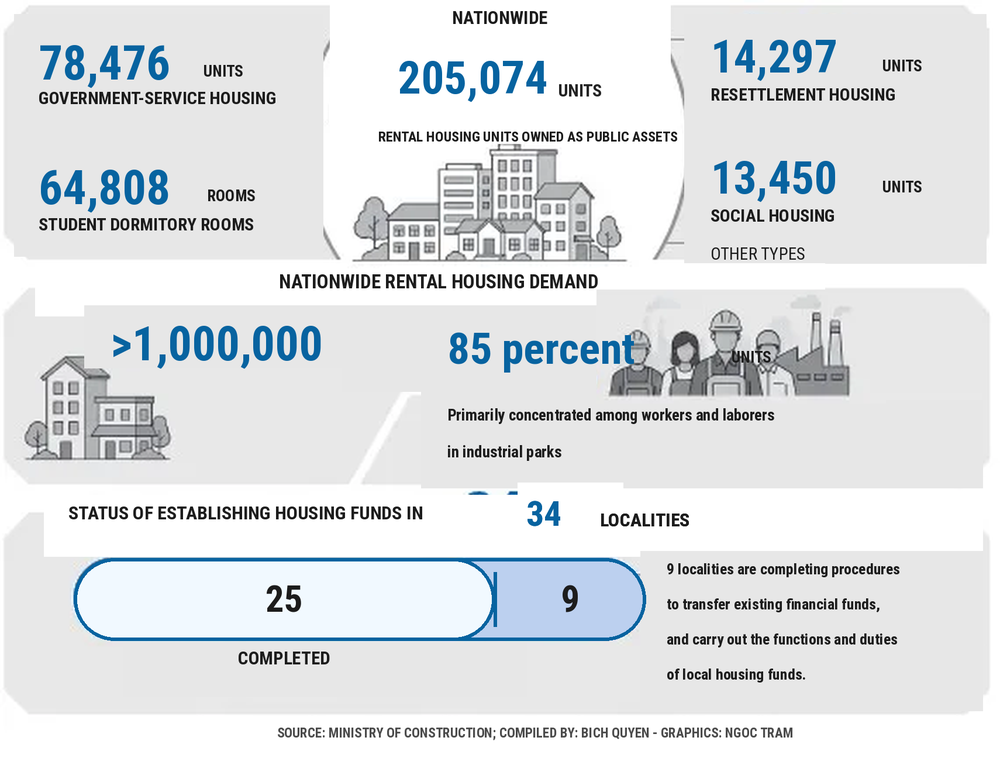
After decades of refining policies and dedicating substantial resources to housing development, the real estate market still primarily focuses on commercial housing and social housing segments for sale. Meanwhile, the massive demand for rental housing and social housing for lease-purchase with suitable quality and prices remains largely unmet.
Low income earners hope for a stable place to live
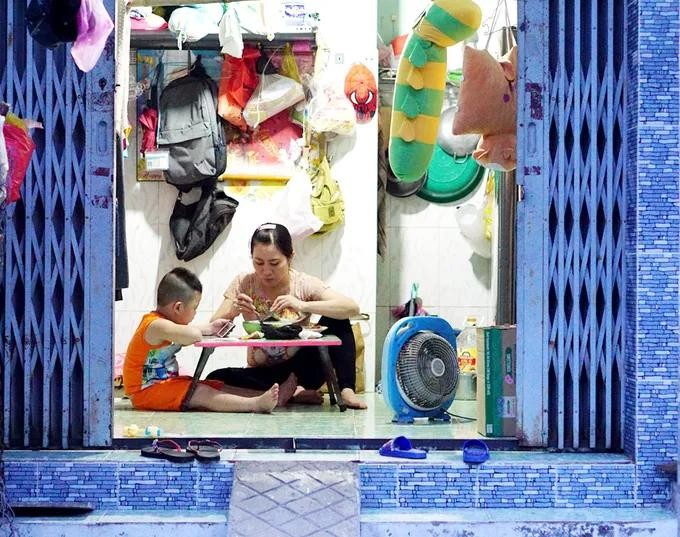
Pham Thi Tuyen, an office worker, is staying at a boarding house located deep in a small alley on Bui Dinh Tuy Street, Binh Thanh Ward, Ho Chi Minh City. The lodging of less than 20 square meters serves as both a resting place and living space for her entire family of five. When SGGP reporters arrived, she was busy preparing dinner. Seeing guests, she quickly wheeled her motorbike inside to make way for passersby. Tuyen shared that after more than 10 years of marriage and moving four times, this is the best boarding house her family has lived in. She said that having a shouse is just a distant dream when she and her husband's combined monthly income is around VND30 million (US$1,200). After covering living expenses, they are left with just VND5 million-VND6 million (US$200-US$240) in savings each month.
Not daring to dream of buying commercial housing, purchasing social housing, which is meant for low-income earners, is also not easy.
Nguyen Duc Hanh, who has worked at a business in My Hanh Commune, Tay Ninh Province for nearly 10 years, moaned that a social housing project more than 10km away from his workplace costs around VND21 million per square meter. For a two-bedroom apartment of about 60 square meters, the price ranges from VND1 billion to VND1.25 billion. If he wants to buy, he must have about VND300 million ready for the initial payment and bear many expenses until receiving the house and moving in.
Not only Hanh, but many workers and average-income earners in Tay Ninh Province also cannot afford the initial sum along with monthly principal and interest installment costs when buying social housing. Additionally, some projects are in inconvenient locations with inadequate public amenities, making many unenthusiastic about this type of housing. For instance, the Luong Hoa social housing project is about 13km from the nearest industrial zone. For workers working shifts and commuting by motorbike, this distance is quite far. Consequently, most workers here opt to rent rooms or boarding houses.
Having invested in rental housing for over 10 years, Le Huu Nghia, General Director of Le Thanh Company, noted that based on research into housing rental demand, the company recorded that about 80 percent to 90 percent of workers without housing wish to rent stably for 49 years. However, support policies for people to own housing have not proven effective. Disbursement results of the preferential loan support package for buying social housing under Government Resolution 33/NQ-CP issued in March 2023 remain very low. By the end of April 2026, only about VND11.3 trillion had been disbursed out of the total package value of VND120 trillion (later increased in scale to VND145 trillion).
According to the Ho Chi Minh City Department of Construction, the city's social housing development target for the 2021-2030 period is 199,400 apartments.
During the 2021-2025 period, Ho Chi Minh City completed 17,902 out of 18,143 planned social housing condos, achieving 98 percent of its target. However, the results have yet to meet actual demand.
As a result, the city will need to develop an additional 181,257 social housing apartments between 2026 and 2030. For rental housing in particular, Ho Chi Minh City is committed to creating approximately 50,000 apartments.
Many localities join in building social housing
In Ho Chi Minh City, according to the City Federation of Labor, a preliminary survey shows that currently about 33,520 workers and laborers have housing needs. Among them, 3,181 cases need to rent, while 30,339 cases need to lease-purchase, accounting for more than 90 percent. Most surveyed workers stated that they need shelter to stabilize their lives and remain committed to the city. This reflects that worker housing development should not be viewed merely as an immediate issue, but rather as a long-term human resource development strategy for Ho Chi Minh City.
Da Nang City is one of the leading localities in developing social housing, possessing a fairly large state-owned housing fund.
Le Van Tuan, Deputy Director of the Da Nang City Department of Construction, informed that the Housing Management and Exploitation Center is managing nearly 11,000 apartments and social housing condos under state ownership, along with nearly 2,000 student dormitory rooms.
Hoang Thi Dieu Thuy, a worker at Ba Sao Garment Company, is one of those renting social housing in Lien Chieu Ward for five years. She said the rental rate of about VND2 million per month is very suitable for workers' incomes and, importantly, remains stable over the long term. The home meets her family's essential needs, from living space to her child's schooling and recreation.
However, according to Thuy, to rent a house, tenants must complete numerous documents such as business confirmations, pay slips, and local verifications, leaving a vast number of workers in Da Nang still struggling with private rentals.
With approximately 2.7 million workers, over 70 percent of whom live in boarding houses, Hanoi City also faces difficulties in resolving housing needs for its residents.
The Hanoi Department of Construction stated that the city is implementing a series of new mechanisms to boost the rental housing market, including mechanisms to convert commercial housing projects into rental housing, establish a housing fund for high-quality workforce, and invest in synchronized infrastructure to encourage development. However, moving from mechanisms and policies to actualizing housing projects for citizens remains a long story.
Similarly, in Dong Nai City, over 700,000 workers are living and working concentrated in various industrial zones, with a housing demand of about 150,000 to 160,000 apartments. To solve the housing puzzle for workers, Dong Nai City has set a target for the 2025-2030 period to complete at least 65,000 social housing apartments. In reality, the existing and future supply of social housing still leaves a significant gap compared to demand.