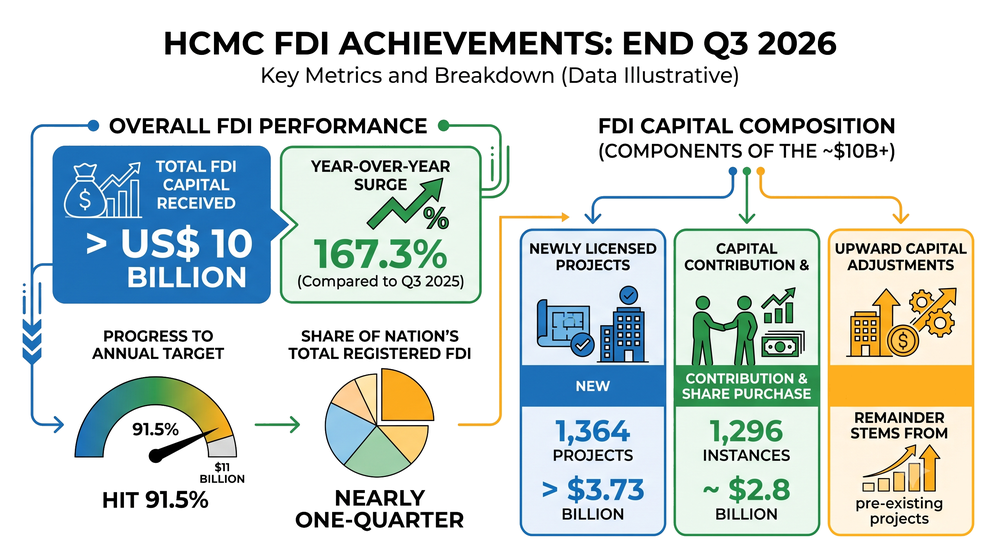
Approaching the end of the third quarter of 2026, HCMC received over US$10 billion in FDI capital, a surge of 167.3 percent compared to this time in 2025, essentially hitting 91.5 percent of its annual target ($11 billion) while accounting for nearly one-quarter of the nation’s total registered FDI.
More importantly, the city is drawing in capital following the precise logic of a multi-tiered economic hub. It registered 1,364 newly licensed projects boasting a total registered capital of over $3.73 billion, alongside 1,296 instances of foreign investors contributing capital or purchasing shares valued at approximately $2.8 billion; the remainder stems from upward capital adjustments of pre-existing projects.
Furthermore, the destinations of these capital flows have supposedly shifted, transitioning from rudimentary factories toward advanced technology, data centers, plus diverse services.
The processing and manufacturing sector currently accounts for merely 7.5 percent against a staggering 59.5 percent of the total newly registered and augmented capital, which stands as a glaring testament to HCMC’s transition into a vastly different phase of the global value chain.
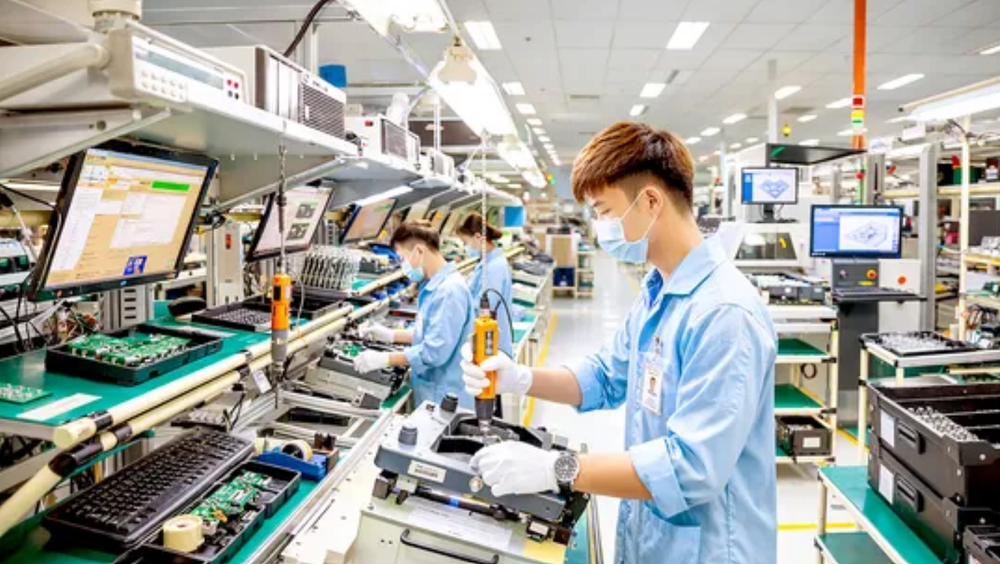
Labor-intensive assembly operations are steadily migrating toward provinces offering larger land banks plus lower costs, while the city retains sectors possessing significantly higher knowledge and capital content. These predominantly include design, research and development (R&D), digital infrastructure, finance, logistics, along with supply chain coordination.
Take February 2026 for instance, when the G42 Group (UAE) alongside a domestic joint venture featuring FPT, Viet Thai, and VinaCapital reportedly signed a framework agreement to actively develop a hyperscale data center system with a total investment of approximately $2 billion.
By late April 2026, Saigon Hi-Tech Park (SHTP) had successfully lured in an additional 4 high-tech projects boasting total capital exceeding $1.23 billion, heavily focusing on data centers, biomedical technology, plus smart electronic devices. Another remarkably eye-catching case is TikTok, marked by its strategic shift of over $1 billion in investment capital straight into e-commerce and logistics, specific domains that HCMC inherently aspires to lead on a regional scale.
The phenomenal results garnered over the past 8 months are firmly proven not just by raw numbers but through the intrinsic quality, central efficiency, plus widespread ripple effects of the capital sources. Notably, the Vietnam International Financial Center in HCMC (VIFC-HCMC), acting as a vital channel for capital conduction and circulation, has practically emerged as a novel instrument alongside traditional FDI. It’s decisively contributing to shaping capital quality while restructuring the city’s broader economic framework.
Even though the annual capital attraction target is practically wrapped up, the subsequent late-2026 sprint plus the crucial momentum-building phase for the next period still mandate HCMC to rapidly hammer out every single policy solution.
Regarding quantity, it’s imperative to pivot from event-based investment promotion toward targeting pre-prepared project portfolios that explicitly feature cleared land banks, preliminary environmental impact assessments, concrete power supply schemes, plus pre-approved incentive frameworks.
On the quality front, city authorities desperately need to establish a comprehensive set of FDI project evaluation criteria that stretches well beyond merely examining registered capital figures. This framework must systematically measure the degree of linkage between FDI enterprises and domestic firms, their capacity to join supply chains, localization rates, land and energy utilization efficiency, alongside stringent environmental plus sustainable development standards.
As to disbursement, establishing a separate monitoring mechanism specifically tailored for project clusters exceeding $100 million is absolutely critical, which requires binding committed progress milestones coupled with explicitly designated accountable points of contact.
Furthermore, periodically publishing the ratio of realized capital against registered one as a formal macroeconomic management indicator is necessary, placing it on par with capital attraction targets, while clearly delineating contributed capital from mobilized capital within massive projects.
Authorities should wholeheartedly adopt a cluster-based promotion model firmly anchored to the international financial center ecosystem, free trade zones, plus high-tech and digital tech parks, rather than fruitlessly promoting isolated, disjointed projects. They must fundamentally transition from merely competing via isolated incentives toward fiercely competing through a robust investment climate, superior infrastructure, skilled human resources, premier support services, alongside the sheer accompanying capacity of the government.
Ultimately, HCMC will fundamentally hit its FDI attraction target for this year. What’s substantially more important is exactly how much of that capital physically materializes into cutting-edge factories or data centers, how many engineers find employment, plus precisely how many Vietnamese enterprises secure a foothold within those sprawling global supply chains.