According to data from the Ho Chi Minh City Department of Construction, as of the end of April 2026, the city had 16 social housing, worker housing, and old apartment redevelopment projects eligible for loans under the VND145 trillion program. However, only four projects and seven individual home buyers had received funding.
Chairman Le Hoang Chau of the Ho Chi Minh City Real Estate Association said the city completed only about 17,000 social housing units during the 2021-2025 period. For 2026-2030, it has been assigned a target of developing 200,000 units.
Although Ho Chi Minh City has raised the monthly income ceiling for social housing buyers from VND20 million to VND25 million, the biggest challenge remains the shortage of available housing.
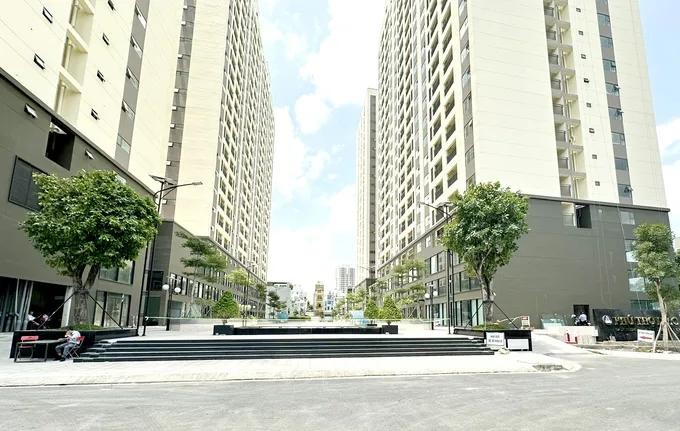
For example, a social housing project on Ly Thuong Kiet Street in Dien Hong Ward offers 1,025 apartments, including 270 rental units and more than 750 units for sale. However, about 12,000 people have applied to purchase homes there. One reason for the limited supply is that some developers have struggled to access preferential loans under the government program.
For workers, despite broader eligibility requirements, owning a social housing unit remains out of reach because of the shortage of available projects.
Pham Thi Tuyen, a resident of Binh Thanh Ward, Ho Chi Minh City, said she has been searching for social housing for more than three years but has yet to find a suitable project.
"The social housing project on Ly Thuong Kiet Street has announced its selling price, but demand is so high that many applicants, including me, have no chance of buying a home," she said. "Another project on Phan Chu Trinh Street in Binh Thanh Ward, launched in 2025, is reserved for resettlement residents and is not available to people like me. Social housing projects in what was formerly Binh Duong are also too far from my workplace."
Whereas, developers have also struggled to access the credit package. Director Le Huu Nghia of Le Thanh Company said the Government's VND145 trillion credit package, implemented through nine commercial banks, was designed to provide preferential financing for social housing and worker housing projects.
However, when developers sought loans at the program's preferential interest rate of 6.1 percent per year, banks rejected their applications.
According to the director, banks said long-term deposit rates currently range from 8 percent to 9 percent annually, making it unprofitable to lend at 6.1 percent. He urged authorities to introduce more flexible lending rates that better reflect market conditions.
A representative of Phu Cuong Investment JSC said the company has encountered the same difficulty because of the gap between banks' funding costs and the program's preferential lending rates.
Only 8.5 percent is disbursed in three years
According to the State Bank of Vietnam, by the end of May 2026, only about VND12.44 trillion had been disbursed under the VND145 trillion social housing credit program established under Government Resolution 33/2023. Of that amount, about VND10.64 trillion was lent to project developers, while roughly VND1.8 trillion went to home buyers.
Outstanding loans under the program total about VND10.18 trillion. After three years, only about 8.5 percent of the package has been disbursed.
A separate program launched a year ago to help people under age 35 purchase social housing has disbursed only about VND383 billion.
The State Bank said the biggest bottleneck remains the shortage of social housing projects. Too few projects have reached the implementation stage, leaving banks with an insufficient number of legally qualified projects to evaluate and finance.
To encourage lending, the central bank has assigned significantly lower risk weights to social housing loans than to conventional commercial real estate loans, allowing banks to expand lending to the sector more confidently.
The State Bank is also studying a dedicated refinancing mechanism for commercial banks, particularly state-owned lenders, to support rental social housing projects, which require long investment recovery periods while banks mainly rely on short-term deposits.
Authorities expect the mechanism to help address long-term financing needs for developers and support an expansion in the supply of social housing in the coming years.