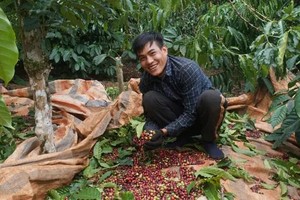
For Mr. Doan Duc Hoa, residing in Chau Duc Commune, his agricultural journey officially commenced in 2019. While numerous local households still engage in fragmented production, he deliberately opted to invest methodically in his family’s nearly 2-hectare durian orchard.
Recognizing that Chau Duc’s gravel-mixed basaltic red soil possesses excellent drainage capabilities highly suitable for durian trees, Mr. Hoa ventured across the Southeast and the Central Highlands to acquire invaluable experience, thereby systematically perfecting his cultivation techniques. His orchard predominantly cultivates Thai and Ri6 durian varieties.
To slash labor costs and meticulously control the caregiving process, he invested over VND100 million (US$3,850) into an advanced irrigation system, alongside roughly VND220 million ($8,500) for a state-of-the-art plant protection spraying mechanism. Both systems are fully automated, seamlessly ensuring that water and chemical volumes are distributed significantly more evenly and precisely.
Consequently, the orchard’s durian yield averages roughly 25 tonnes per hectare, with some years remarkably exceeding 30 tonnes. With an average 2026 selling price hovering around VND43,000 - 45,000 ($1.65 to $1.73) per kilogram, this year’s harvest generated nearly VND2 billion ($77,000) for his family after deducting overarching expenses.
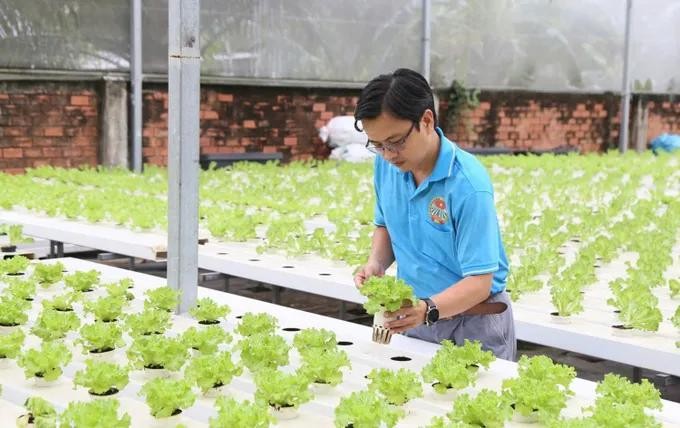
Similarly harnessing technology to boost efficiency, Director Lam Ngoc Tuan of Tuan Ngoc Agricultural Cooperative in Long Truong Ward actively developed a recirculating hydroponic vegetable farming model utilizing IoT. Established in 2019, the cooperative specializes in producing leafy greens. On a 1,000-square-meter footprint, cultivating vegetables in traditional soil yields roughly 10 kilograms daily, whereas the hydroponic framework astonishingly achieves 100 kilograms.
The membrane greenhouse system effectively mitigates adverse weather impacts, while nutrition is controlled hydroponically. Expanding from its HCMC-based model, the cooperative developed an additional 5,000 square meters of greenhouses in Lam Dong. “HCMC’s available land is increasingly shrinking. We must calculate the exact extracted value per square meter by employing automated technologies plus standardized production protocols,” Director Tuan shared.
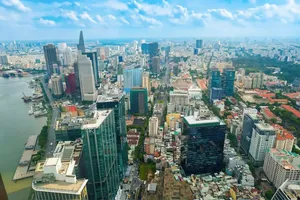
HCMC currently boasts a natural area exceeding 677,000 hectares, wherein agricultural land accounts for approximately 428,600 hectares, representing exactly 63.3 percent. Rapid urbanization as well as relentless climate change is posing myriad formidable challenges, explicitly demanding the agricultural sector to embrace high-tech applications while vigorously pivoting toward green, circular, organic, plus digitally transformed development trajectories.
In reality, science and technology have become increasingly deeply embedded across multiple agricultural production domains within the city. Regarding crop cultivation, the city houses 692 facilities applying advanced technology across 18,432 hectares, plus 24 organic production establishments covering 248 hectares. Furthermore, it has issued 131 planting area codes and 61 packaging facility codes strictly serving export purposes.
Within the livestock sector, the city possesses 797 high-tech pig, cattle, and poultry farms, maintaining a staggering total herd of roughly 14.5 million heads. In the aquaculture sphere, the metropolis operates 171 high-tech brackish water shrimp farming facilities spanning 173 hectares, plus 2 advanced breeding centers covering 12 hectares.
The HCMC Department of Agriculture and Environment stated that in 2025, the agricultural sector contributed nearly 2 percent to the city’s GRDP. During the first six months of 2026, the agriculture, forestry, alongside fishery sectors achieved a robust growth rate of 2.99 percent, successfully meeting and surpassing the targets delineated in Plan No. 44/KH-UBND dated February 2, 2026, issued by the HCMC People’s Committee concerning the facilitation of double-digit growth across the municipality in 2026.
HCMC’s main agricultural development orientation is currently being crystalized so that agriculture isn’t merely measured by production scale or its GRDP contribution proportion, but is firmly situated within a much broader developmental ecosystem inherently linking agriculture with scientific technology, environmental sustainability, market dynamics, alongside farmers’ livelihoods.
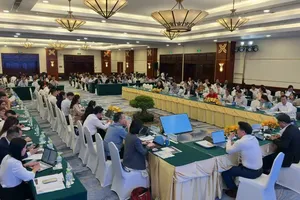
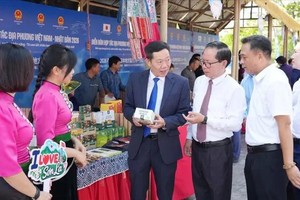
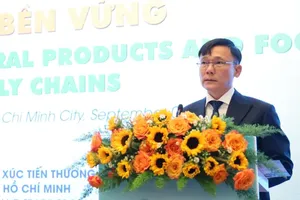
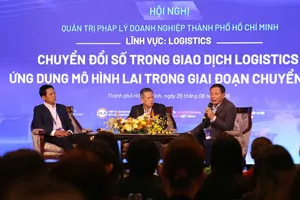
Speaking at a recent seminar focusing on connecting high-tech agricultural value chains, jointly organized by the Management Board of the HCMC Agricultural Hi-tech Park plus and the Korea-Vietnam Trade Promotion Center, Vice Chairman of the HCMC People’s Committee Bui Minh Thanh firmly asserted that amidst rapid urbanization and increasingly glaring climate change, agriculture doesn’t merely generate commercial products but essentially serves as a vital ecological shield for the city.
Consequently, urban agricultural advancement must be meticulously calculated by its sheer capacity to generate income for farmers, contribute significantly to the urban economy, protect the environment, alongside architecting production spaces perfectly aligned with a bustling megacity.
For Vice President Tran Minh Hai of the Institute for Public Policy and Rural Development, fostering a new generation of digital farmers is critical. Historically, tech applications ostensibly seemed reserved for massive enterprises.
Currently, they’re being incrementally integrated into agricultural production. These include IoT sensors collecting environmental data, automated systems seamlessly regulating water, alongside sophisticated farm management software meticulously tracking the production pipeline. When multiple households collaboratively participate, capital investments in membrane greenhouses or robust traceability systems become vastly more economically viable.
Meanwhile, Head Pham Dinh Dung of the HCMC Agricultural High-Tech Park Management Board noted that municipal authorities just promulgated the Urban Agriculture Development Program spanning the 2026-2030 period. This ambitious program explicitly targets successfully developing a highly modern, sustainable foundation.
Specifically, the average production value per hectare of urban cultivation is projected to reach VND700 million ($27,000) annually by 2030. Simultaneously, it’ll exceed fifty percent of the agricultural sector’s total production value moving forward today.