The move is expected to both prevent the waste of public assets and increase the supply of affordable housing, contributing to social welfare.
Thousands of resettlement homes left vacant
At the Vinh Loc B Residential Area in Tan Vinh Loc Commune, nearly 1,000 resettlement apartments have remained vacant for years. Weeds have overgrown walkways in unoccupied apartment blocks, while the lack of regular maintenance has left many units in poor condition. Exterior walls show peeling paint and public spaces are largely deserted.
According to Truong Ngoc Thanh Nhan, Vice Chairman of the Tan Vinh Loc Commune People's Committee, the Vinh Loc B resettlement complex is part of a 30-hectare residential project comprising 45 apartment blocks. Completed in 2013, the project has allocated 986 apartments, while another 953 units in 22 buildings remain unused.
A similar situation exists at the Binh Khanh Resettlement Area in An Khanh Ward, where thousands of apartments in a prime location have stood empty for years. Damaged walls, overgrown vegetation, shuttered ground-floor premises and layers of dust reflect the prolonged vacancy.
Built in 2013 to resettle households displaced by the Thu Thiem New Urban Area project, the Binh Khanh complex failed to attract residents. Authorities are now preparing to auction 3,790 apartments after several previous auction attempts were unsuccessful.
At the Canh Dong Mat Meo Resettlement Area in Long Huong Ward, dozens of four-story townhouses fronting National Highway 51 have been abandoned for years. Only a handful are occupied as business offices or shops, while many others display "For Lease" signs. Deeper inside the project, numerous houses have deteriorated, with cracked walls and moss-covered facades.
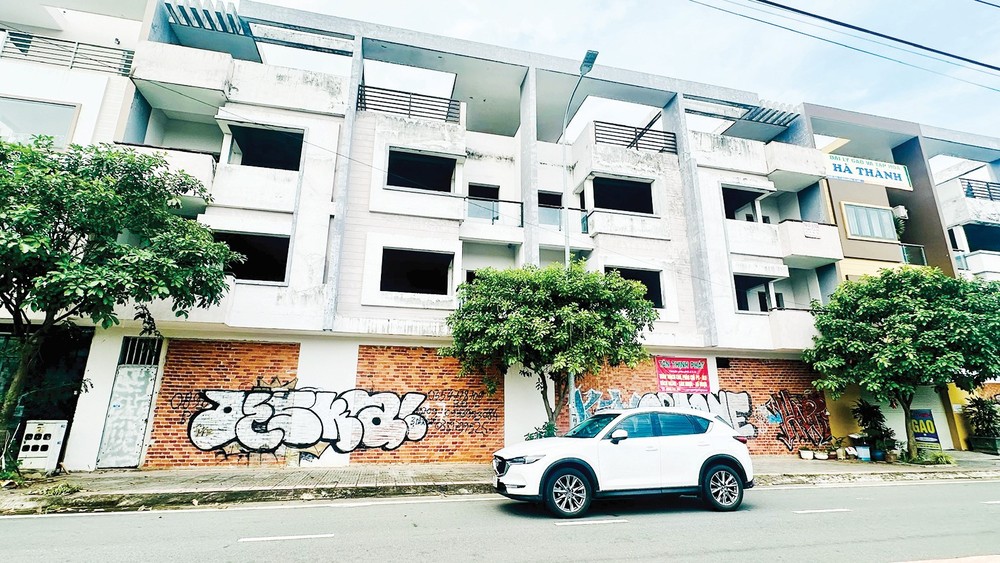
The 2.2-hectare project, completed in 2018 at a cost of more than VND146.6 billion (approximately US$5.6 million), comprises 82 unfinished townhouses intended for households displaced by river embankment and other infrastructure projects in the former Ba Ria City.
The Tan Phuoc Resettlement Area in Tan Phuoc Ward faces a similar situation. Although completed in 2016 with 532 residential lots, only 14 households have built homes and moved in. Other resettlement projects, including H20, Bau Beo and Phu My, also have very low occupancy rates.
Converting idle housing stock
In a recent report submitted to the Ministry of Construction, the Ho Chi Minh City Department of Construction said it plans to convert resettlement housing with no remaining demand into social housing.
A representative of the department's Urban Development Division said the conversion forms part of the city's strategy to expand social housing and rental housing. Existing resettlement housing may be repurposed as social housing, while projects still under construction could have their development objectives adjusted depending on actual demand.
The resettlement housing stock in Tan Vinh Loc Commune has already been submitted to the Ho Chi Minh City People's Committee for consideration for conversion into rental social housing, following a proposal from the Ho Chi Minh City Labor Federation to provide accommodation for workers and laborers. Relevant agencies are currently assessing renovation costs.
Meanwhile, authorities are continuing legal procedures to organize another auction of apartments at the Binh Khanh Resettlement Area.
Urban planning expert Nguyen Huu Nguyen from the Ho Chi Minh City Urban Planning and Development Association said the policy would help resolve the long-standing surplus of unused resettlement housing while significantly expanding the city's supply of social housing.
He said the converted units would allow people without adequate housing to either purchase or rent homes according to their financial capacity.
Lawyer Nguyen Van Hau, Chairman of the Vietnam Jurists Commercial Arbitration Center, said that the conversion must comply with the 2023 Housing Law and Government Decree No. 95/2024/ND-CP. Under the regulations, the municipal Department of Construction, together with ward and commune authorities, must review and identify resettlement housing projects that are no longer needed or are being used inefficiently. Authorities must also demonstrate that there is no remaining demand for resettlement housing in the area and ensure that the conversion does not result in losses of public assets while remaining consistent with the province's approved housing development plan.
According to the Ho Chi Minh City Department of Construction, as of June 5, the city's Housing Management and Construction Quality Inspection Center was managing 10,449 state-owned resettlement apartments. Most of these properties are located within the former boundaries of Ho Chi Minh City before the recent administrative reorganization and were originally designated for public investment projects and resettlement programs.
The city plans to convert suitable unused resettlement housing projects into social housing and rental housing to better meet growing demand for affordable accommodation.