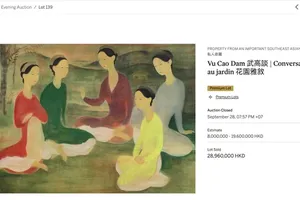
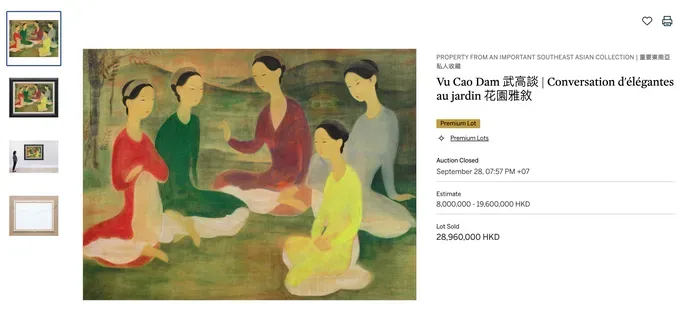
In the recent autumn auction held by Sotheby's auction house in Hong Kong, China, the silk work Conversation d'élégantes au jardin (Elegant Ladies Conversation in the Garden) by Vietnamese artist Vu Cao Dam was hammered at US$3.69 million (about VND96 billion), becoming the highest-priced Vietnamese painting sold publicly at an auction in history.
More than five years of waiting for a new price benchmark
During Sotheby's Hong Kong, China regular autumn auction of Modern and Contemporary Art held at the end of September, 18 works in the Vietnamese segment (created by Vietnamese artists, artists of Vietnamese origin, or featuring content linked to Vietnam) were put up for auction. In the end, all 18 works found new owners. Among them, 13 works sold above their high estimates, and all surpassed their low estimates.
The centerpiece was Conversation d'élégantes au jardin (1939) by artist Vu Cao Dam, executed in ink and gouache on silk, measuring 85.6 x 114.5 cm. The work was hammered at HKD28.96 million, equivalent to US$3.69 million including taxes and fees. This price surpassed the previous record of US$3.11 million for the painting Portrait de Mademoiselle Phuong (Portrait of Miss Phuong) by artist Mai Trung Thu, which was also set at Sotheby's Hong Kong, China on April 18, 2021.
The Vietnamese art market had to wait more than five years to establish a new price milestone. With this outcome, artist Vu Cao Dam now has a second work exceeding the million-dollar mark, following Femmes au bain (Women Bathing, 1944), which was hammered in 2020 for US$1.04 million. Notably, among the top five highest-priced Vietnamese paintings sold at auction to date, Sotheby's auction house accounts for four.
According to curator Ace Le, Senior Advisor to Sotheby’s, the recent auction revealed several encouraging signs. Purchasing power was no longer concentrated in the high-end segment but was more evenly distributed across the high- and mid-range markets, while domestic buyers accounted for the majority of purchases. This broad-based demand, together with a strengthening economic foundation and a stable political environment, provides key conditions for the development of a sustainable art market.
Tran Luu Hau and signals from the resistance-generation artists
Alongside familiar names associated with Indochina art, particularly artists who graduated from the Indochina Fine Arts College between 1925 and 1945, the auction also delivered a significant result. Cong vien 15 (Park 15), a large-format acrylic painting created in 2005 by Tran Luu Hau and measuring 160 × 405 cm, was hammered at US$360,000, or more than VND9 billion, more than double its high estimate. The sale also set a record auction price for a work by an artist of the resistance-era generation.
Tran Luu Hau (1928–2020) was a prominent figure among resistance-generation artists. He attended the Resistance Fine Arts Class (1950–1953) led by artist To Ngoc Van, was later sent to study at the Surikov Academy of Fine Arts in Moscow, Soviet Union, and taught at the Hanoi University of Fine Arts for nearly 30 years.
In 2001, he was awarded the State Prize for Literature and Art. He was considered one of the "four pillars" of resistance artists Nhan - Hoa - Hau - Kiem (Luu Cong Nhan, Le Huy Hoa, Tran Luu Hau, and Nguyen Trong Kiem).
Starting from the late 1980s amid the atmosphere of Renovation (Doi Moi), his painting style gradually shifted from realism to semi-abstraction and then abstraction. His subject matter remained the sea, streetscapes, trees, flowers, and young women, but his perspective and technique had transformed. Cong vien 15 (Park 15), first exhibited in a solo exhibition in April 2005 in Hanoi, stands as a representative work of this transition. Long, strong, and decisive brushstrokes were used; colors were placed side by side with rare confidence; and his stage design experience transformed the large canvas into a realm of form and color. Upon his passing, a representative of the Vietnam Fine Arts Association described him as "a great master of Vietnamese fine arts."
For many collectors, the price achieved by Cong vien 15 serves as a noteworthy signal. While Indochina art has long been regarded as "blue chip" assets with enduring value, the resistance generation of artists is likely the next frontier. Naturally, this remains a prediction, and a single result is insufficient to confirm a trend. However, a work from this generation far exceeding expectations indicates that the market is beginning to more fully appreciate the artistic value of a crucial era in Vietnamese art history.
Also at Sotheby’s Hong Kong (China) Autumn Sale of Modern and Contemporary Art, several other works by Vietnamese artists or featuring Vietnamese subjects performed well including Nha nhac (Mélodie, 1950) by artist Mai Trung Thu sold for US$587,000; Di cho ve (Le retour, 1933) by Joseph Inguimberty fetched US$342,000; Cho doi (Waiting, 1946) by Le Pho realized US$277,000; and Den Angkor Wat (Angkor Wat Temple, 1938) by Tran Binh Loc sold for US$244,000.