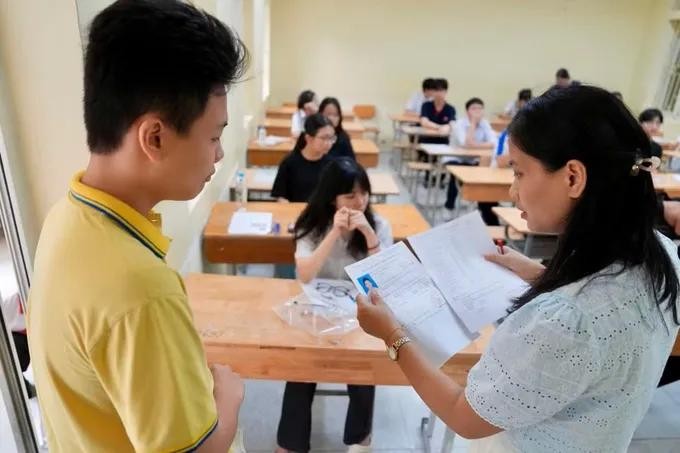
On May 18, the Prime Minister issued Directive No. 20/CT-TTg on organizing the 2026 high school graduation examination and enrollment for universities and vocational education.
The Prime Minister has directed leaders of ministries, agencies, and localities to draw up detailed plans and options for upcoming exams and enrollment. He emphasized adherence to the “six-clear” principle that includes clear people, clear work, clear time, clear responsibility, clear products, and clear authority, ensuring accountability at every stage.
The directive aims to strengthen leadership and guidance, stabilize the exam process, ease pressure on students, reduce costs, and uphold fairness and integrity in evaluating academic performance. Reliable data generated from the exams will also serve as a foundation for universities and vocational institutions in their admissions processes.
Ministries, agencies, and localities must coordinate synchronously and closely to successfully organize the exam and enrollment. The process must meet professional requirements and be safe, serious, and practical, while fitting the conditions of each locality, region, and the whole country. They must ensure quality and confidentiality in exam question formulation, with a suitable level of differentiation for the exam's purpose.
Training institutions must announce enrollment methods and conduct the 2026 enrollment in a consistent, fair, and objective manner. This process must accurately evaluate learner capabilities and ensure uniform control over input quality, contributing to high-quality human resource training for socio-economic development and a double-digit economic growth goal.
The Ministry of Education and Training must enhance inspection and supervision to maintain exam discipline. All stages before, during, and after the exam must be checked. Efforts must focus on preventing cheating in all forms, especially via high-tech devices. Strict reporting regimes must be implemented before, during, and after the exam, and exam results must be announced accurately, timely, synchronously, and transparently.
The Prime Minister required chairpersons of provincial and municipal people's committees to take full responsibility for exam preparation and organization in their localities. They must provide favorable conditions for candidates regarding transportation, accommodation, and other necessities. Special attention must be given to students in mountainous, remote, border, island, and ethnic minority areas, or those facing socio-economic difficulties. No student should miss the exam due to manageable transport or accommodation issues.
The Ministry of Public Security will direct police units and localities to monitor the situation closely. They must proactively detect and strictly handle legal violations, particularly the trading and use of high-tech devices and Artificial Intelligence (AI) to cheat in the exam.
The 2026 high school graduation examination will take place on June 11 and June 12.