On April 20, in Ho Chi Minh City, the Ministry of Education and Training (MoET) held the 2026 National University Admissions Conference. In addition to reviewing the 2025 admissions cycle, the ministry announced key updates for the 2026 admissions process.

According to MoET, a standout feature of the 2025 admissions cycle was the high enrollment rates in teacher training, engineering and technology, and strategic technology fields. The proportion of admitted candidates who enrolled reached 90 percent of allocated quotas—the highest level in the past four years.
However, several shortcomings persisted. Some candidates provided incorrect information, failed to carefully review their applications, or did not complete all admission procedures, while others missed registration deadlines. On the institutional side, certain universities failed to update data promptly or report accurately, some did not participate in the centralized admissions system, and errors occurred during the selection process.
Presenting the 2025 admissions report, Prof. Nguyen Tien Thao, Director General of the Higher Education Department under MoET, noted that since 2022, more than one million candidates have taken the national high school graduation exam each year. The number of admitted and enrolled students has steadily increased. In 2025, the enrollment rate reached a record 90 percemt of quotas, the highest in four years. MoET data also show that 76 percent of higher education institutions achieved enrollment rates exceeding 80 percent, up from 63 percent in 2023 and 71.38 percent in 2024.
Across disciplines, 12 out of 24 fields accounted for nearly 90 percent of total enrollments, while the remaining 12 fields made up just 10 percent, each enrolling fewer than 10,000 students.
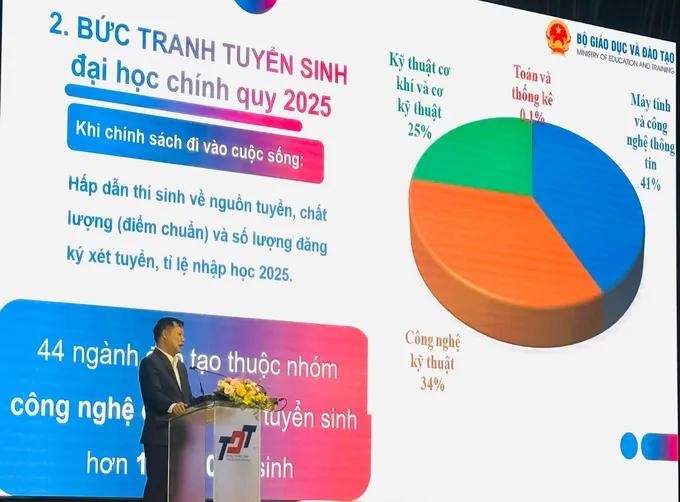
In teacher training programs, enrollment rates also exceeded 90 percent in 2025, with strong demand driven by new policies under the Law on Teachers. Similarly, strategic technology and STEM fields attracted increasing numbers of applicants, both in quality and quantity.
For 2026, MOET will announce minimum quality assurance thresholds for three groups of disciplines: teacher education, health sciences, and law.

Notably, the ministry plans to roll out talent development programs in semiconductor technology, nuclear science, and railway engineering. Strategic technology fields will remain a priority, alongside scholarship programs for engineering and master’s degrees in STEM (science, technology, engineering, and mathematics).
Resolutions 57 and 71 require the entire education sector to accelerate digital transformation, develop data systems, and integrate with the National Data Center. As 2026 marks the first year of intensified digitalization across the sector, all universities are expected to coordinate closely with MOET to fulfill these objectives in line with the Politburo’s directives.
In particular, newly emerging disciplines aligned with national development needs will be prioritized, with STEM, technology, and engineering fields expected to account for around 50 percent of total enrollment quotas.