The incident involving five students at Luong The Vinh Primary School in Ben Cat Ward being forced by their homeroom teacher to prick their own hands with a syringe as discipline severely shocked the public. This approach immediately encountered fierce backlash, with critics arguing it was an anti-educational act violating physical integrity and traumatizing students psychologically.
The Ben Cat Ward People’s Committee concluded the incident demonstrates a profound violation of teaching ethics, infringes upon children’s rights, and exerts a negative impact on the educational environment.
Prior to this, handling a group of students engaging in violent behavior, recording a clip, and disseminating it online at Phuoc Nguyen Junior High School in Ba Ria Ward also sparked mixed reactions. The school required students directly involved to write self-reflection essays and assigned teachers to monitor their behavioral correction. Witnesses who had recorded and spread the clip were reprimanded.
Its principal Nghiem Xuan Chau stated the disciplinary action followed Circular No. 19/2025/TT-BGDDT from the Ministry of Education and Training. Given the incident’s severity, violating students faced the highest level of discipline permitted by the regulations.
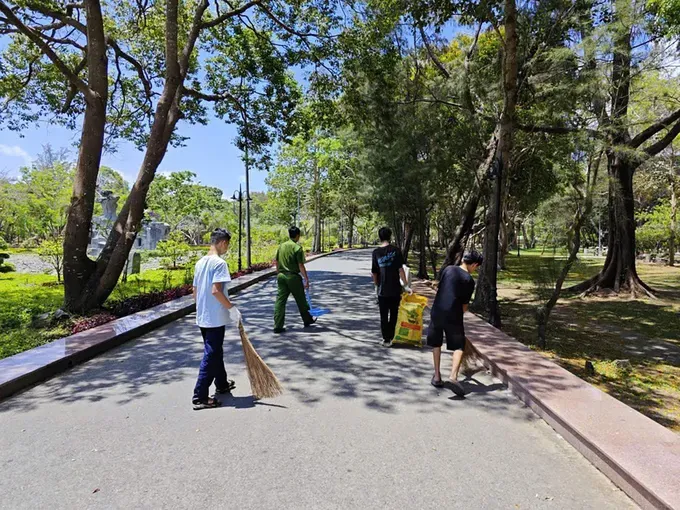
In Con Dao Special Zone, a different approach to disciplining “misbehaving” students has also drawn attention. Instead of deploying familiar disciplinary measures, the students were tasked with cleaning the campus, tending to the greenery, pulling weeds, and caring for the graves of fallen heroes at the Hang Duong Cemetery. It’s hoped that this lesson in gratitude would help cultivate a sense of responsibility and assist the students in reflecting upon and rectifying their behavior.
Distinguished Teacher Le Thi Lan Anh, former Vice Principal of Tran Nguyen Han High School, expressed that determining appropriate student discipline remains a pressing concern for educators. While positive discipline is emphasized, its specific implementation often leaves teachers bewildered. She noted applying Circular 19/2025/TT-BGDDT to unmanageable students sometimes makes them feel there is nothing to fear.
Lacking sufficient deterrents, students easily trivialize consequences, treating violations as safe zones. Conversely, teachers often feel powerless confronting deviant, provocative behavior. She argued that schools urgently need appropriate tools to effectively handle violations. However, discipline must absolutely respect a student’s honor and physical integrity. Effective education requires empathy, understanding, and close family coordination.
According to Deputy Head Vu Xuan Huong of the Psychology – Education Faculty at Nguyen Tat Thanh University in HCMC, disciplining students remains necessary, but it should pivot from a punitive approach toward an educational one, helping them recognize their mistakes, correct them, and mature. Shifting from “punitive to positive discipline” aligns with current educational trends and the ultimate goal of student progress.
Eliminating suspensions or expulsions doesn’t equate to loosening discipline. The core of the matter is that schools must select disciplinary measures appropriate to the severity of the violation, the specific circumstances, and their actual efficacy in modifying behavior.
From the perspective of educational psychology, handling students must adhere to certain principles: avoiding harm to the student’s dignity and body; focusing on the wrongful act rather than labeling the individual; and creating opportunities for the student to make amends through concrete actions.
“I believe the most appropriate approach is a combination of stringency and support. Student discipline should be executed in a strict yet humane manner, setting boundaries without causing insult, addressing the issue while opening doors for rectification,” Deputy Head Vu Xuan Huong emphasized.

Dr Nguyen Thi Toan Thang from the Party Building Faculty of HCMC Cadre Academy commented that in modern educational science, discipline is not synonymous with physical punishment. At its core, discipline is a process of guiding behavior based on understanding, personal awareness, and responsibility.
Any form of discipline that causes harm or forces personal injury crosses an ethical boundary, falling squarely into the realm of violence. The effects of such actions do not merely manifest as temporary physical wounds but embed deeply within the psychological structure of a child, eroding personal worth and shattering trust in teachers.
Educational research demonstrates that behavioral correction efficacy doesn’t hinge upon punishment severity, but rather on helping students understand, accept, and rectify their mistakes. Positive discipline is not leniency; it’s a scientifically grounded system where students are guided to identify wrongful behavior, comprehend consequences, and participate in remediation. Restorative practices facilitate immediate adjustments and forge permanent control.
As Vietnamese education undergoes rigorous restructuring, maintaining violent discipline is archaic and detrimental to the credibility of the entire system. A truly meaningful educational environment must always be erected upon safety, respect, and genuine connection.
The solutions include:
- redefining the concept of discipline in teacher training and professional development; discipline must be seen as a core pedagogical competency linked to evidence-based behavioral management and positive intervention;
- establishing systematic disciplinary procedures within schools, equipped with clear supervisory mechanisms, to supplant the arbitrary handling by individual teachers;
- enhancing the socio-emotional capacities of both teachers and students through training in emotional regulation and communication skills;
- ensuring unity among the school, family, and society in deploying positive educational methods;
- establishing clear accountability mechanisms coupled with professional support, and creating a supportive system for teachers to enhance their capacities.
According to Circular No. 19/2025/TT-BGDDT, student rewards and discipline are directed to transition from “punitive to positive discipline.” Consequently, disciplinary measures for primary school students consist of two forms, namely reminders and apology.
Disciplinary measures for students beyond the primary level include reminders, criticism, and a written self-reflection. Previously applied disciplinary forms such as reprimands before the class or the school disciplinary council, school-wide warnings, or expulsions for a week or a year have all been abolished.
For the 2025-2026 academic year, the HCMC Department of Education and Training has provided guidance on handling student discipline via a 5-step procedure:
- Step 1: Detection and recording;
- Step 2: Private discussion and reminding (primary level prioritizes reminding and may require an apology for level-2 repeated offenses);
- Step 3: Criticism (for non-primary levels when a level-1 offense is repeated after a reminder, or a level-2 offense occurs);
- Step 4: Written self-reflection (when a level-2 offense is repeated after criticism, or a level-3 offense occurs, requiring confirmed commitment and cooperation from parents, and documentation);
- Step 5: Support and remedial activities (involving the student in school counseling or social work activities, which are not punitive but community-oriented actions aligned with the educational plan).