According to the Ministry of Education and Training, since 2026, the ministry has selected universities to implement talent-oriented engineering and master’s degree programs in STEM fields, including science, technology, engineering and mathematics. The ministry is also encouraging universities to prioritize admissions and launch new academic programs in strategic sectors needed for national development.
Policy impact on admissions
Professor Dr. Nguyen Tien Thao, Director General of the Higher Education Department under the Ministry of Education and Training, said that in implementing Politburo Resolution No. 57-NQ/TW on breakthroughs in science, technology, innovation, and national digital transformation, Resolution No. 71-NQ/TW on breakthroughs in education and training and the Prime Minister’s Decision No. 1002/QD-TTg approving the project on training human resources for high-tech sectors for the 2025–2035 period with a vision toward 2045, the Ministry of Education and Training of Vietnam has issued an action plan to guide universities in standardizing, innovating, and implementing talent-training programs for engineers, master’s students, and doctoral candidates in basic sciences, engineering, and strategic technology fields.
According to officials, these policies have already had a positive impact on 2025 university admissions, with strategic technology majors attracting a growing number of students.
Admissions results for 2025 showed that among the 12 academic fields with the highest enrollment numbers, engineering technology ranked second with 65,826 enrolled students, while computer science and information technology ranked fourth with 62,397 students. Engineering-related majors ranked sixth with 39,939 students.
Overall, 44 majors classified under strategic technology fields enrolled more than 150,450 students, accounting for over 22 percent of total university enrollments in 2025.
Among those students, computer science and information technology accounted for 41 percent, engineering technology for 34 percent, mechanical and mechanical engineering fields for 25 percent and mathematics and statistics for 0.1 percent.

Priority for national strategic sectors
According to Deputy Minister of Education and Training Le Quan, in implementing the project on training human resources for high-tech sectors for the 2025–2035 period with a vision toward 2045, the Ministry of Education and Training of Vietnam will continue expanding admission quotas for STEM disciplines and the country’s 10 strategic technology sectors, with the goal of raising enrollments in these fields to around 50 percent of total university admissions, compared with the current rate of just over 31 percent.
The ministry will also prioritize and facilitate pilot training programs and the launch of new academic majors in fields considered essential for national development.
Special priority will also be given to universities piloting and launching new academic programs in fields considered essential for national development.
In addition, the ministry plans to select around 80 qualified talent-training programs for implementation beginning in 2026, serving approximately 3,000 students. In subsequent years, the number is expected to rise to 100 programs with around 6,000 students annually.
The ministry will also guide universities in launching talent-oriented doctoral programs from 2026, initially including about 60 programs and 300 doctoral candidates, before expanding to 100 programs with 800–1,000 doctoral researchers per year.
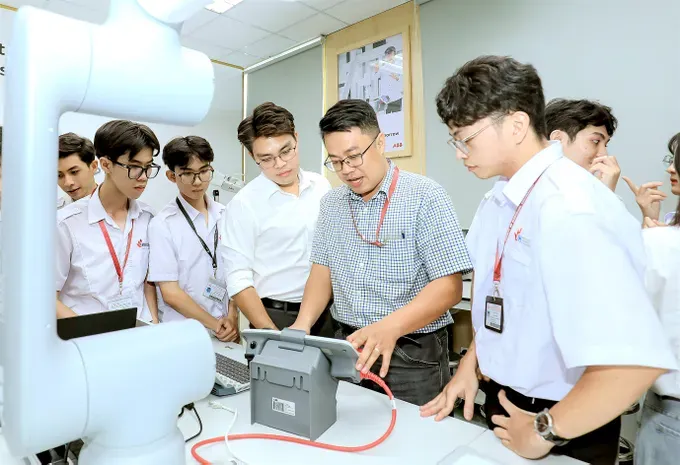
Dr. Nguyen Trung Nhan, Head of the Training Department at Ho Chi Minh City University of Industry, said the university has registered bachelor’s and master’s programs in STEM fields for 2026, describing the move as a positive signal for attracting and training strategic technology talent to support the country’s development in the new era.
Meanwhile, several universities in Ho Chi Minh City are planning to launch new strategic technology majors. These include data engineering and environmental engineering technology at Ho Chi Minh City University of Technology and Education; digital economics and financial technology at Ho Chi Minh City University of Law; applied biology, applied mathematics, and construction engineering at Ho Chi Minh City Open University; and cybersecurity at Ho Chi Minh City University of Technology.
The Prime Minister also issued Decision No. 29/2025/QD-TTg on August 28, 2025, introducing special preferential credit policies for students and researchers in science, technology, engineering and mathematics fields.
Under the policy, learners can receive loans covering tuition fees and living expenses of up to VND5 million (US$190) per month throughout their studies, with a preferential annual interest rate of 4.8 percent.