The establishment of the fund is viewed as a strategic step toward realizing the spirit of Resolution No. 71-NQ/TW, issued by the Politburo, which emphasizes breakthroughs in education and training development.
If operated effectively, the fund is expected to expand opportunities for learners to access quality education while contributing to the identification, nurturing, and development of talent in the service of the country.
A national-level mechanism to support learners
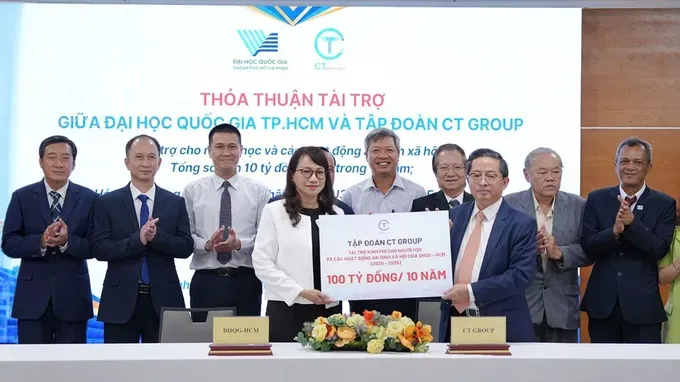
According to Deputy Minister of Education and Training Le Quan, the current scholarship system remains fragmented, with many programs designed only for the short term and lacking mechanisms for early identification and continuous nurturing of talented students. At the same time, there is no national-level focal agency with sufficient legal and organizational capacity to coordinate, mobilize, and effectively utilize scholarship resources from both the state budget and society.
Therefore, the establishment of the National Scholarship Fund, serving as a national policy instrument, is expected to create breakthroughs in supporting learners while contributing to the identification and cultivation of talent. With substantial resources and a more systematic organizational structure, learners would gain access to long-term, continuous, and interconnected support throughout different levels of education.
The fund is also expected to enhance the effectiveness and transparency of scholarship support while avoiding overlaps in resource allocation. At the same time, it would help address existing shortcomings of the scholarship system, particularly fragmentation and short-term support mechanisms.
Under the draft decree, the fund is designed to operate in a modern, transparent, and flexible manner, with specific regulations governing its organizational structure, operational principles, financial mechanisms, scholarship selection procedures, disbursement, post-audit processes, and digital data supervision.
The draft also proposes five scholarship programs, including talent scholarships, overseas study scholarships, scholarships under international agreements, scholarships aimed at attracting foreign students to study in Vietnam, and scholarships for priority groups.
Scholarship selection will be based on a set of specific criteria and scoring mechanisms to ensure objectivity, transparency, and the prevention of conflicts of interest.
Expressing strong support for the establishment of the National Scholarship Fund, Dr. Tran Dinh Ly, Vice Rector of Ho Chi Minh City University of Agriculture and Forestry, highlighted three breakthrough impacts the fund could generate if operated effectively.
First, the fund could broaden access to quality education for pupils, students, trainees, and doctoral candidates who possess strong academic capabilities but face financial difficulties, thereby contributing to educational equity.
Second, it would create greater motivation for learning, research, innovation, and the aspiration to contribute among younger generations.
Third, the fund would provide the State with an additional policy instrument to attract and nurture talent in strategic sectors that are essential to enhancing national competitiveness in the new development phase.
National Scholarship Fund serves as strategic lever for human resource development

Resolution No. 71-NQ/TW issued by the Politburo on breakthroughs in education and training development sets a target of having at least 20,000 students enrolled in talent-oriented programs and 6,000 doctoral candidates in the fields of basic sciences, engineering, and technology by 2030.
Many experts believe that achieving these goals will require a sufficiently strong financial support mechanism capable of reshaping trends in career and academic choices while enabling learners to maintain the financial stability needed to pursue long-term study and innovation.
Dr. Nguyen Trung Nhan, Head of the Training Department at Industrial University of Ho Chi Minh City, said the establishment of the National Scholarship Fund is necessary in the current context, particularly in light of the major orientations set by the Party and the State for education, training, and science and technology development.
According to him, beyond providing greater motivation for capable learners to grow and contribute, the fund’s resources could also support scientists and research groups in implementing breakthrough research projects serving socio-economic development and improving the quality of the national workforce.
According to Dr. Nguyen Trung Nhan, for the fund to operate effectively, it is necessary to establish a dedicated management and executive body under the Ministry of Education and Training, along with an operational mechanism that is transparent, open, and fair, supported by clear selection criteria to ensure accessibility for learners and researchers.
He also stressed that disbursement procedures should be designed in line with the specific nature of scientific research and innovation activities.
Scientific research always involves a degree of risk. He said that minimizing unnecessary administrative procedures would enable scientists to confidently access support from the fund.
According to Dr. Hoang Ngoc Vinh, former Director General of the Department of Professional Education under the Ministry of Education and Training, the core impact of the fund does not lie in simply providing financial assistance but in creating opportunities for truly capable individuals who lack the necessary conditions to pursue their studies and development.
He emphasized that budget resources should be concentrated on areas that are strategically needed by the State but often overlooked by the market, including basic sciences, core technologies, teacher training, healthcare, specialized arts, and disadvantaged groups.
It is necessary to put an end to the practice of spreading support too thinly and shift decisively toward targeted investment, he said.
However, he also stressed that for the fund to operate effectively, it is essential from the outset to clearly define what the fund is intended to do and what it must absolutely not do.
International experience shows that effective scholarship funds are generally built upon three pillars, including clearly defined objectives, professional governance, and fair competition. Rather than spreading resources broadly, these funds are designed to accurately identify talent and revitalize strategic sectors.
Instead of prioritizing the rapid expansion of the fund’s scale from the outset, the foremost objective should be to establish a fund with a high level of credibility. Only when learners trust in the fairness of the system, businesses are confident that resources are being used effectively, and society is able to monitor outcomes transparently can the National Scholarship Fund truly become a policy instrument of substantial significance.
Dr. Nguyen Quoc Anh, Vice Rector of Ho Chi Minh City University of Technology, said Vietnam could draw on the experiences of many countries that have operated scholarship funds effectively in order to develop a model suited to domestic conditions.
For example, in Singapore, scholarships are regarded as a strategic instrument for national human resource development. The State prioritizes investment in key sectors such as technology, engineering, medicine, and public administration, while also establishing mechanisms that link scholarship recipients with the responsibility to return and contribute to the country after completing their studies.
South Korea, meanwhile, stands out for its application of technology in managing scholarship funds in a transparent and efficient manner. The entire process, from application and evaluation to disbursement, is digitized, helping reduce administrative procedures, save time, and ensure equal access opportunities for learners across all localities.
In Germany, scholarship programs are designed to be highly learner-friendly, with a strong emphasis on fairness and accessibility. Students can complete applications through a one-stop mechanism, minimizing complicated paperwork while receiving prompt and transparent support.
These international experiences demonstrate a common approach: scholarships are viewed not merely as a form of financial assistance but as a long-term investment in human resources development.
According to Mr. Huynh Thanh Phu, Principal of Bui Thi Xuan High School, the establishment of the National Scholarship Fund is a policy rich in humanitarian significance while also inheriting the nation’s long-standing tradition of valuing education.
This is not merely a form of financial support but also a powerful social message that the country always values learners, safeguards their aspirations for education, and creates conditions for talent to fully develop, he said.
In his view, the greatest value of the fund lies not in the amount of money provided, but in the sense of reassurance it offers to learners. When students know that they are backed by the sustained support of the State and society, they will gain greater confidence to focus on their studies and boldly pursue challenging fields and professions that require deep academic commitment and long-term research.