The Ho Chi Minh City Department of Education and Training has highlighted a critical shortage of secondary schools in several wards across the city. This pressing infrastructure gap remains a significant hurdle for educational authorities, even as digital mapping is deployed to optimize student enrollment and commuting distances.
Secondary school deficits and overcrowded classrooms
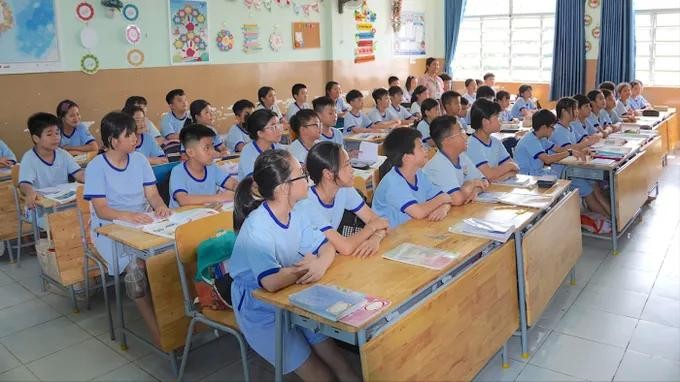
Tay Nam Ward is currently a focal point of this infrastructure crisis. At An Tay Primary School, severe overcrowding has become the norm; some classrooms measuring just 40 square meters are forced to accommodate 58 students, far exceeding the national standard of 35 per class.
The situation is exacerbated by the total absence of a middle school within the ward. Upon completing primary education, students face grueling commutes to neighboring areas. Nguyen Thi Binh, Vice Principal of An Tay Primary School, noted that the school’s 2,600 students, including 400 fifth graders, must eventually be channeled to distant facilities. Historically, students from the Lo O and An Thanh neighborhoods travel 4km to Phu An Secondary School, while those in Giong Soi and Rach Bap must commute 7km to An Dien Secondary School.
According to Dr. Tran Khac Huy, Head of Financial Planning at the HCMC Department of Education and Training, the crisis is partly due to private developers. Authorities have identified 69 designated school sites within approved residential projects where investors have failed to meet construction deadlines.
This shortage extends beyond Tay Nam Ward, with Tan Son and Phu Thuan wards facing similar gaps. In Tan Son Ward, despite having three primary schools, including Tan Tru, Nguyen Van Kip, and Phan Huy Ich, there is no local secondary school for graduating students.
Strategic reviews and new construction plans
A comprehensive survey of HCMC’s 168 wards and communes reveals a massive scale of demand. To meet the city’s target of 300 classrooms per 10,000 school-aged residents, the secondary education sector requires 4,346 additional classrooms across 76 specific localities. Critical needs are highest in Phu Tho Hoa (284 rooms), Tan Khanh (205 rooms), and Binh Hung Hoa (190 rooms).
Local authorities are now aggressively proposing redevelopment and new builds to close this gap. Chairman Le Loi of Phu Thuan Ward People’s Committee has petitioned the city to repurpose a 5,200-square-meter property at 38A Nguyen Van Quy. If approved, the site could be renovated into a secondary school with 31 classrooms in time for the 2026-2027 academic year, providing spots for 700 sixth-grade students.
Similarly, Tay Nam Ward has submitted a formal investment proposal for An Tay Secondary School. The projected VND250 billion (US$9.5 million) facility would span 1.5 hectares and feature 45 specialized classrooms. If greenlit, the project would finally allow local students to complete their secondary education within their own ward, ending the reliance on long-distance transfers to neighboring areas.
According to Deputy Director of the Ho Chi Minh City Department of Education and Training Nguyen Thi Nhat Hang, hundreds of school projects will be rolled out in the academic year 2026–2027.
Ho Chi Minh City currently has more than 2.5 million students. Each year, mechanical population growth adds between 50,000 and 60,000 students, placing significant pressure on school capacity. As of early April 2026, Area 1 (former Ho Chi Minh City) has 297 classrooms per 10,000 school-age residents while Area 2 (former Binh Duong Province) has 200 classrooms and Area 3 (former Ba Ria–Vung Tau Province) has 316 classrooms per 10,000 school-age residents.
From now until the end of December 2026, the city plans to implement 66 school construction projects, adding a total of 1,147 new classrooms with an investment of more than VND5.3 trillion. Of these, 47 projects equivalent to 890 classrooms are expected to be completed before September 5, 2026, while the remaining 19 projects, comprising 257 classrooms, will be finished by December 31, 2026.
In 2027, an additional 100 school construction projects are scheduled, delivering 1,514 classrooms with total investment exceeding VND7.4 trillion.
The Department of Education and Training is currently coordinating with authorities in 168 wards, communes, and special administrative units, along with relevant agencies, to review demand and develop phased investment plans. The goal is for the city to reach 300 classrooms per 10,000 school-age residents by 2030.
Preliminary estimates indicate that between 2026 and 2030, the city will add approximately 12,814 classrooms. However, compared with the total demand for an additional 17,483 classrooms, Ho Chi Minh City still faces a shortfall of 4,669 classrooms in order to meet its target.