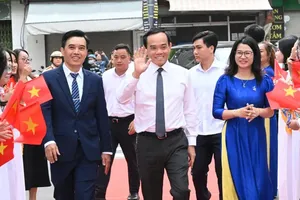
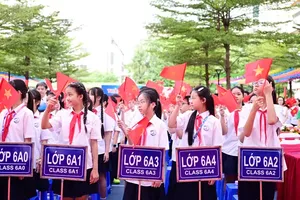
Launched in November 2025, VSAR 2025–2026 attracted more than 5,000 students to its national preliminary round. Among them, 2,930 outstanding contestants advanced to the national finals.
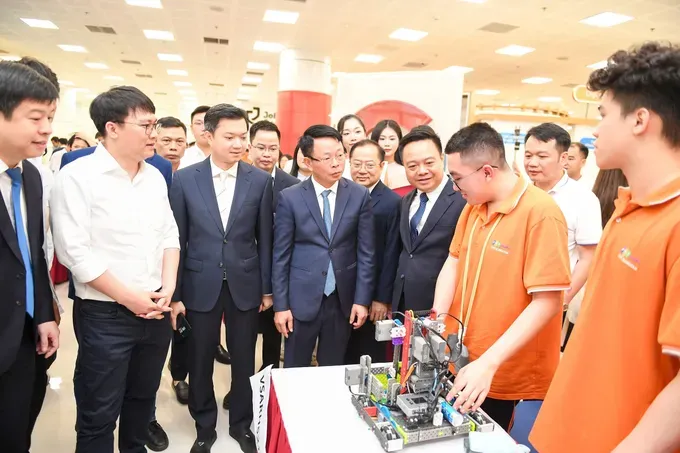
The championship is a nationwide technology competition for Vietnamese students from primary to high school levels. It aims to foster creative thinking, teamwork skills, and the ability to apply technology, artificial intelligence and robotics to solve real-world problems.
This year’s competition focuses on themes related to green energy, sustainable technology, and scientific exploration, creating opportunities for students from grades 1 to 12 to experience hands-on technological challenges.
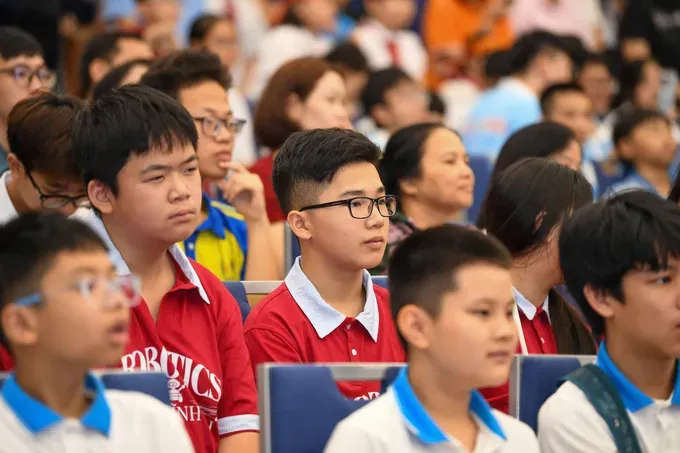
The competition is jointly organized by Tien Phong Newspaper, the National Innovation Center (NIC), the Central Council of the Ho Chi Minh Young Pioneer Organization and Hanoi University of Science and Technology.
Under the theme “Energy for the Future,” organizers hope contestants will not only participate in a technology playground but also become more aware of their responsibility in building a greener, smarter and more sustainable future.
The tournament is conducted in team format, with each team consisting of three to five members and one coach. Teams compete across five categories with different challenges. Category A is designed for primary school students, featuring robots that build wind power plants; category B is for lower secondary students with the same challenge; while category C is for high school students, focusing on robots that construct solar power plants.
The competition includes local qualifying rounds, a national preliminary round and the national finals.
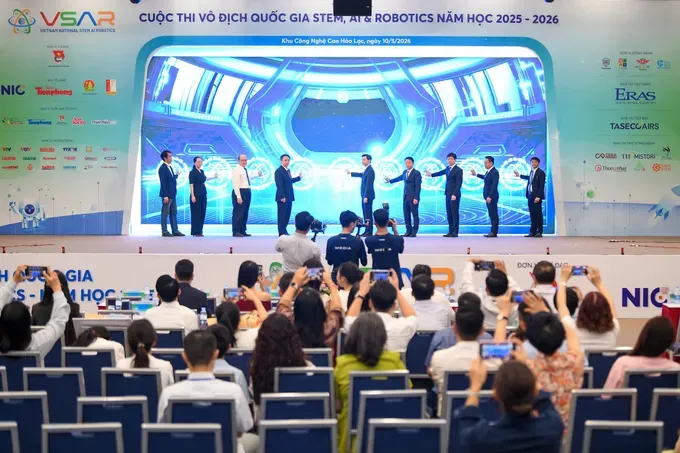
According to Associate Professor Dr. Nguyen Huu Phat, Head of the Faculty of Electronics at the School of Electrical and Electronic Engineering under Hanoi University of Science and Technology and Chairman of the VSAR 2025–2026 Professional Council, many projects demonstrated strong practical applications of STEM, AI and robotics knowledge.
However, he noted that some students currently rely mainly on AI tools, while their ability to analyze core problems, optimize solutions, and develop strong mathematical and physics foundations still requires further improvement.
Creative thinking, analytical ability, and problem-solving skills are the core competencies students need to develop in the AI era. These are also the capabilities that technology can hardly replace, he added.
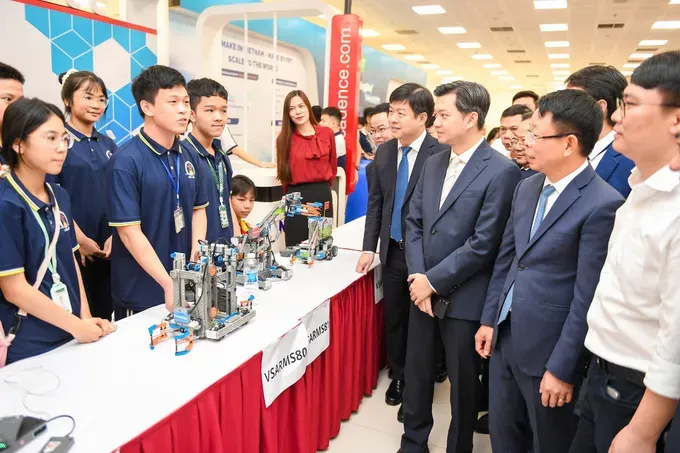
He added that STEM activities and AI applications should be integrated more closely into classroom lessons, practical sessions and real-world projects to help students develop technological thinking early and nurture sustainable innovation capacity.