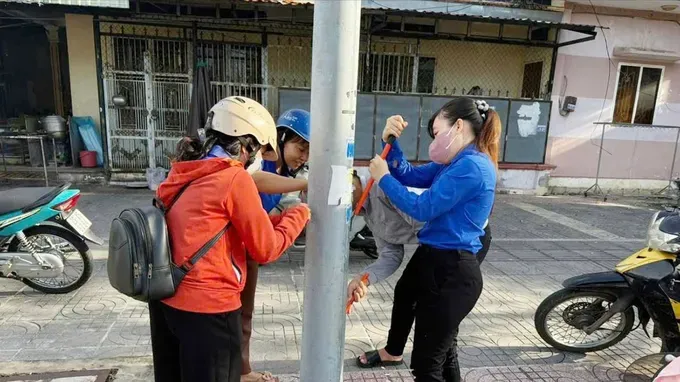
In the early days of April 2026, from the break of dawn, police forces, youth union members, and the civil defense militia in Long Hai Commune launched a unified, unwavering crackdown to strip away illegal advertisements.
Armed with scrapers and cleaning tools, the task forces persistently purified every single electricity pole and wall, restoring a pristine and unblemished appearance to residential neighborhoods. This constitutes a fiercely maintained, multi-phase operation aimed at strictly controlling and repelling the plague of unauthorized advertising.
Prior to the deployment of this meaningful campaign, numerous streets in Long Hai Commune suffered from flyers and illicit ads. Everything from electricity poles and technical boxes to residential walls was densely plastered with small slips promoting unsecured loans, concrete drilling, locksmith services, septic tank pumping, and seasonal labor recruitment.
According to competent authorities, within a brief preliminary sweep, the commune recorded thousands of advertisements defacing key arterial roads, vividly demonstrating the severe complexity of this predicament.
Director Pham Phuoc Binh of the Long Hai Commune Public Security Division stated that given the locality’s specific nature as a bustling tourist hub, the high volume of pedestrian traffic makes its streets highly susceptible to becoming breeding grounds for illegal advertising.
Notably, numerous telephone numbers printed on these flyers exhibit clear hallmarks of involvement in “black credit” (loan sharking) or illicit services of unknown origins, harboring profound risks for the populace. This not only desecrates urban aesthetics but also presents a formidable challenge to public security and order.
Strictly executing the resolute directives of the HCMC Department of Public Security, since September 2025, Long Hai Commune has orchestrated 62 aggressive sweeps mobilizing over 6,000 enthusiastic community participants, maintaining a relentless frequency of twice per week. Tens of thousands of illicit advertising slips have been forcefully eradicated, achieving an impressive clearance rate exceeding 95 percent, thereby rendering numerous streets impeccably clean and unobstructed.
Similarly, in Tan Vinh Loc Commune, along major arteries such as Tran Hai Phung, Vinh Loc, and Lai Hung Cuong, police forces synergized with dedicated youth union members in a synchronized offensive to strip away non-compliant advertisements.
The scourge of “illegal advertising,” featuring content such as septic tank pumping, illicit financial loans, moving services, and Wi-Fi installation, had materialized densely, severely undermining urban aesthetics. This also serves as a catalytic channel facilitating numerous criminal activities, including loan sharking and unlicensed services.
During the recent crackdown, dozens of personnel successfully dismantled approximately 150 non-compliant ad samples, substantially contributing to the restitution of a pristine and beautiful facade for these routes.
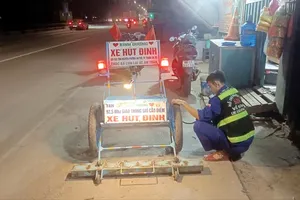
Not merely stopping at the physical removal of junk advertising, the Long Hai Commune Public Security Division is intensely focused on eradicating these violations at their very roots. Professional enforcement measures have been deployed synchronously, ranging from rigorously screening suspects to conducting stealthy patrols and nocturnal ambushes between midnight and 5:00 a.m., the primary timeframe when these criminals typically operate.
Director Pham Phuoc Binh states that merely scraping away ads without addressing root causes is ineffective. Thus, the police seamlessly integrate proactive prevention, vigilant detection, and stringent punitive actions. Recently, they caught two nocturnal law-breakers, imposing administrative penalties to reinforce ironclad local discipline.
In Tam Long Ward, enforcement solutions have also been implemented with synchronous and systematic rigor. The police force, bolstered by the unwavering backing of local organizations, divided into multiple specialized teams, relentlessly patrolling and handling violations across all streets and residential areas.
However, according to Lieutenant Colonel Duong Quang Quy, Deputy Chief of the Tam Long Ward Public Security Division, the advertising content predominantly relates to high-interest “hot loans” and obscure services of unknown origins, harboring profound risks to public order. Alarmingly, numerous phone numbers appear repeatedly, strongly indicating an orchestrated, syndicated dissemination network.
Empirical evidence also demonstrates that despite rigorous removal efforts, after a brief break, illegal ads frequently resurface in specific locations, particularly around bustling markets or temporarily vacant properties.
Confronting this persistent reality, the Tam Long Ward Public Security Division is intensifying unpredictable, unscheduled patrols and imposing severe penalties on all violations. Concurrently, they’re fiercely accelerating propaganda campaigns, proactively mobilizing residents to absolutely refuse any complicity with illegal advertisers.
Over the recent period, the ward has successfully prosecuted and administratively penalized one stark violation. The strategic combination of punishing enforcement and community awareness elevation is universally regarded as the fundamental remedy to sustain long-term efficacy, thereby preserving urban aesthetics and firmly stabilizing public security.
From September 2025 to date, Tam Long Ward has resolutely launched 61 campaigns, drawing the enthusiastic civic participation of nearly 1,000 residents. This cohesive effort resulted in the successful eradication of over 3,300 non-compliant advertising products, achieving a completion rate of roughly 92 percent and prompting a highly visible decline in violation frequencies.