The initiative not only helps protect the environment but also creates additional income for local residents.
From waste to fashionable bags
The modest single-story home of Nguyen Thi Hong Anh in Group 1 of Long Son Commune was once quiet. Over the past seven months, however, mornings there have become lively, filled with the chatter of neighborhood women, the steady rhythm of sewing machines, and the rustling sound of nets being washed in the yard.
Inside the house, dozens of newly finished handbags hang neatly, resembling a small boutique displaying fashion and household accessories.
The bags are made from scraps of fishing nets discarded during fishing and aquaculture operations. Anh and several women in the commune collect the fragments, wash them thoroughly, and carefully cut and sew them into durable shopping bags.
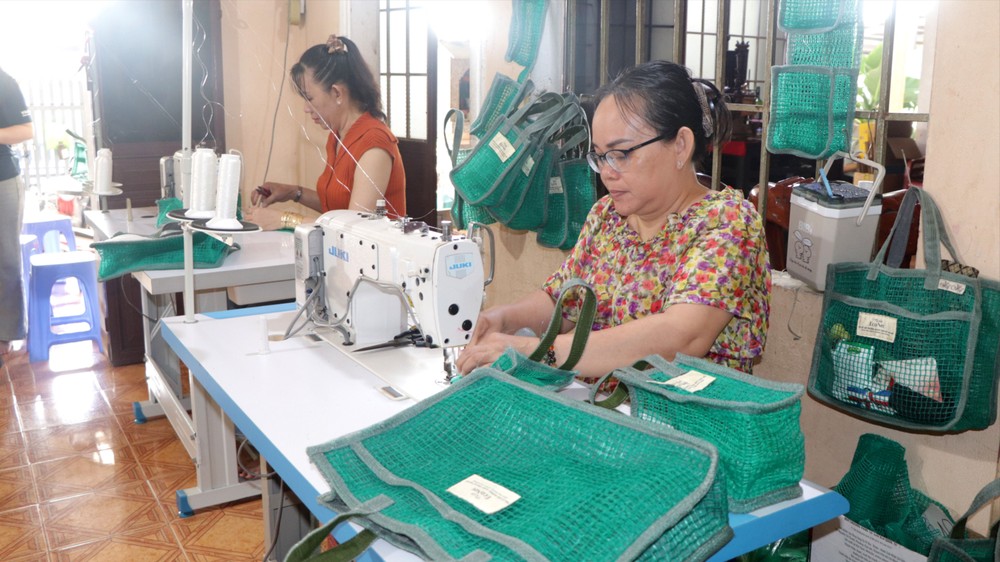
Working diligently at her sewing machine, Anh recalled that the process was not easy. In the early days, she damaged many pieces of netting, broke numerous needles, and used up countless spools of thread while experimenting with techniques.
“Sewing a bag is already challenging, but sewing one from net scraps is even harder because the material is stiff and loosely woven,” she said. “Through trial and error, I gradually improved the design. Each bag now has two lining layers, reinforced seams, and a zipper, making it both sturdy and stylish.”
Initially, Anh produced simple shopping bags measuring about 40 by 36 by 15 centimeters to replace plastic bags. Over time, the group began designing a wider variety of products from net scraps.
Today, their collection includes water-bottle carriers, garlic and onion storage bags, travel bags, leisure totes, pickleball racket bags, laptop bags, and even pet carriers for taking cats outside.
Thanks to the women’s creativity and craftsmanship, the discarded nets have gained a second life as useful and attractive products.
Tran Thi My, one of the participants, said the bags are affordable, durable, and distinctive in style.
“Giving new life to net scraps helps reduce environmental pressure,” she said. “When more people practice recycling and reuse, the environment will become greener.”
Since the project began, seven product lines have been developed and distributed through both online and direct sales channels. With prices ranging from about VND70,000 to VND250,000 per item, the initiative has created part-time employment, providing an additional income of around VND150,000 to VND200,000 per person per day.
At first, the net bags were sold mainly to women in the village for grocery shopping. Today, they have gained wider recognition and demand.
Through green fairs and environmental exhibitions, the bags made by women in Long Son Commune have attracted interest from visitors from Japan, South Korea, Thailand, and other countries, as well as businesses seeking environmentally friendly products for corporate gifts.
For a greener environment and sustainable livelihoods
The idea of turning discarded fishing nets into handbags emerged in August 2025 under the EcoNet bag project. The initiative is part of a circular economy program supported by Long Son Petrochemicals Company Limited (LSP) in Long Son Commune, aimed at creating sustainable value for both the environment and the local community.
Long Son is home to many fishing and aquaculture operations, which generate large amounts of net waste. Because fishing nets are difficult to decompose, they often become an environmental burden if not properly managed.
Doan Y Binh, who oversees the EcoNet bag project, said the initiative seeks to repurpose net scraps from cage construction and fishing activities into higher-value, environmentally friendly products.
By doing so, the project contributes to reducing plastic waste entering the environment and the ocean while promoting greener lifestyles and sustainable consumption.
According to Dinh Vo Kieu Trang, a co-coordinator of the EcoNet project, the initiative also aims to create livelihoods and generate additional income for local women, especially homemakers who need flexible work schedules to balance employment with family responsibilities.
“With this project, women can work close to home, manage their time more easily, and still earn additional income,” she said.
From August to October 2025, LSP supported initial research and product prototyping involving one local business household and five workers. The company provided materials, sewing machines, and equipment worth more than VND50 million.
Following successful trials, EcoNet-branded net bags have been officially available on the market since October 2025, marking a small but meaningful step toward transforming marine waste into sustainable products while improving livelihoods for women in the coastal community.