As the two-tier local government model comes into operation, many wards in Ho Chi Minh City have proactively established Social Welfare Centers. Through these centers, timely assistance has reached vulnerable residents, particularly in urgent cases, with notable effectiveness.
Emergency support in action
When an electrical fire struck the small home of Pham Thi Hong Nhung on Tran Xuan Soan Street, the street coffee vendor was left in a precarious financial state. Although there were no casualties, some property was damaged. For a street coffee vendor with unstable income, the incident left Nhung in a precarious financial state.
At that difficult moment, the Tan Hung Ward Social Welfare Center provided an emergency grant of VND3 million (US$113.67). While modest, the support arrived when it was most needed, helping her manage immediate expenses and, more importantly, reminding her that she was not alone.
Nhung’s story is not an isolated case. Since the rollout of the two-tier local government model, many wards across HCMC have swiftly set up Social Welfare Centers to serve as a frontline support system for residents. Urgent cases such as house fires, accidents, and illness are received, verified, and assisted almost immediately.
According to Chairwoman Pham Thi Hanh Tu of the Vietnam Fatherland Front Committee of Tan Hung Ward, the center was established to ensure that no vulnerable individuals in urban life are overlooked. It operates with the Vietnam Fatherland Front playing a central role, while mobilizing participation from mass organizations, businesses, and donors. This enables resources to be pooled and allocated flexibly, reaching the right people at the right time.
HCMC is also rolling out a Digital Social Welfare application with five core functions: beneficiary management, resource connection, transparency, emergency assistance, and sustainable development.
The platform enables citywide data updates, connects organizations and individuals with those in need, and ensures transparency in receiving and allocating resources. In emergencies, the system facilitates rapid information intake and triggers timely support. Over the long term, it tracks post-assistance outcomes, aiming to reduce poverty sustainably and foster a culture of mutual support within the community.
A notable feature is its case-by-case approach. The center actively gathers information from neighborhoods, conducts verification, and determines appropriate forms of assistance. When necessary, emergency resources are activated immediately, without delay. In a short period, the Tan Hung Ward Social Welfare Center has provided urgent support to 18 cases. It has also carried out regular assistance programs, significantly reducing the number of near-poor households in the area from 131 to 40.
The center has established multiple volunteer teams to respond quickly to emergencies, including volunteer medical teams; business and entrepreneur support groups; the Women’s Union’s “Warm Arms” team; youth support teams; trade union assistance groups; veteran support teams; and voluntary blood donation teams. It has also mobilized a volunteer doctor and a free ambulance to assist residents when needed.
Digital safety nets and local welfare centers transform support systems
In Tan My Ward, a Social Welfare Center was established in August 2025. According to Pham Thi Thuy Ha, Chairwoman of the ward’s Vietnam Fatherland Front Committee, the center has become a focal point for receiving and coordinating resources for vulnerable groups. It has provided more than VND227 million in emergency assistance and awarded scholarships to disadvantaged students.
With a similar spirit, the “Social Welfare Point” model in Phu Nhuan Ward has also been introduced. Chairman Dinh Gia Huynh of the ward’s Vietnam Fatherland Front Committee said that based on surveys of residents’ living conditions, the locality established a structured and transparent system for receiving and delivering support.
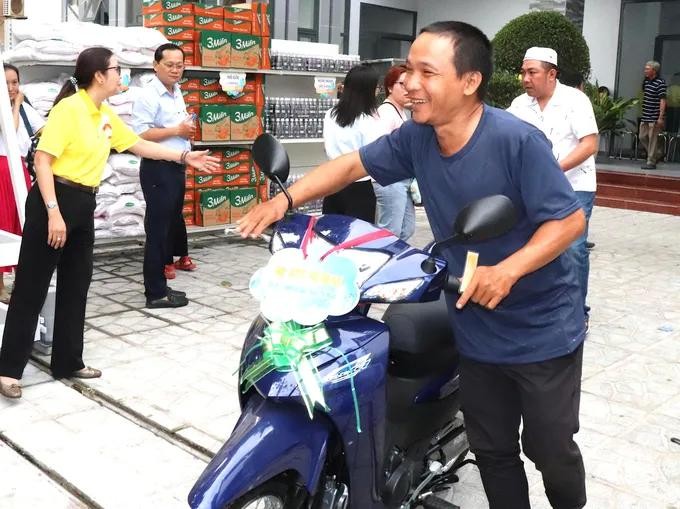
For Tran Van Thanh, a motorbike taxi driver in Phu Nhuan Ward, his aging vehicle—his only source of income—had become a constant source of struggle due to frequent breakdowns. The local Social Welfare Point intervened with timely assistance, providing Thanh with a new motorbike to sustain his livelihood. After nearly two decades in the trade, Thanh noted that his old bike had deteriorated to the point of stalling mid-ride with passengers. “With a new motorbike, I can keep working and earning to support my family," Thanh said. "Before, there were times I truly felt stuck.”
In recent times, the ward’s Social Welfare Center has also organized zero-cost markets, community meals, welfare packages, housing repairs, and livelihood support. Residents not only receive assistance but are also provided with policy guidance, job connections, and healthcare support.