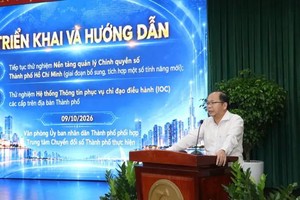
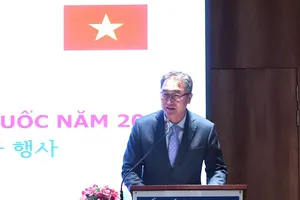
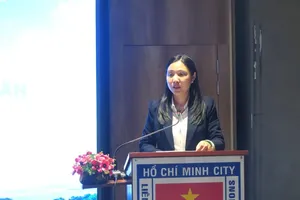
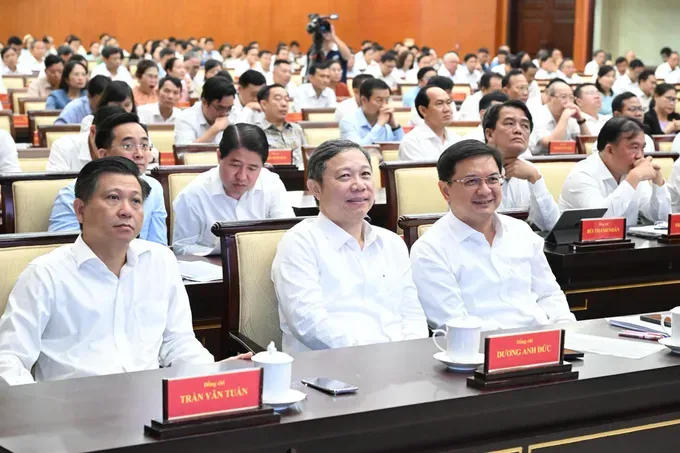
The conference runs in both in-person and online formats, connecting the city’s main venue with Party committees directly under the municipal Party Committee and those of 168 communes, wards and special zones.
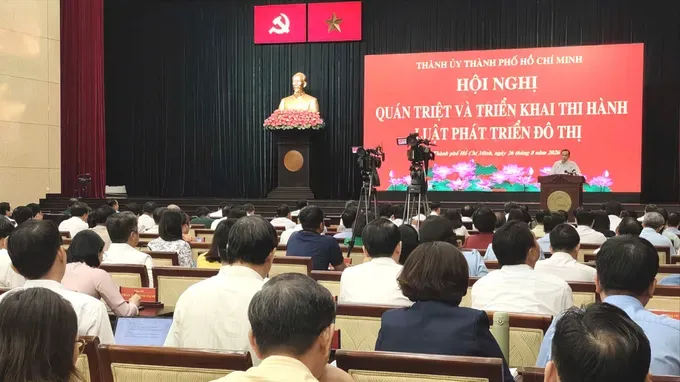
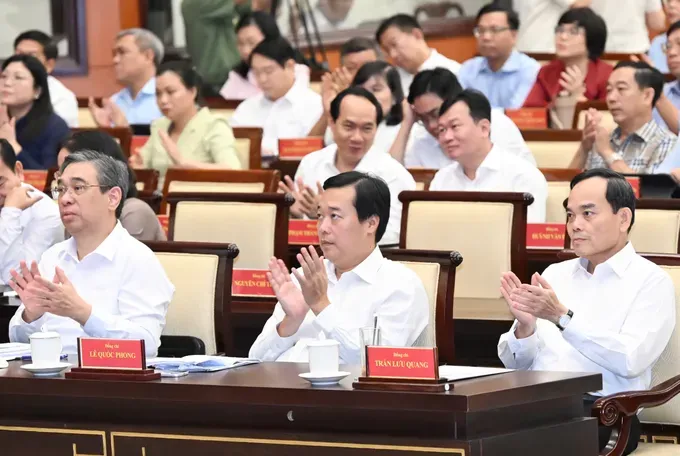
The conference was chaired by Politburo member and Ho Chi Minh City Party Secretary Tran Luu Quang, along with Standing Deputy Secretary Le Quoc Phong, Ho Chi Minh City People’s Committee Chairman Nguyen Van Duoc, People’s Council Chairman Vo Van Minh, Vietnam Fatherland Front Committee Chairman Nguyen Phuoc Loc and other city leaders.
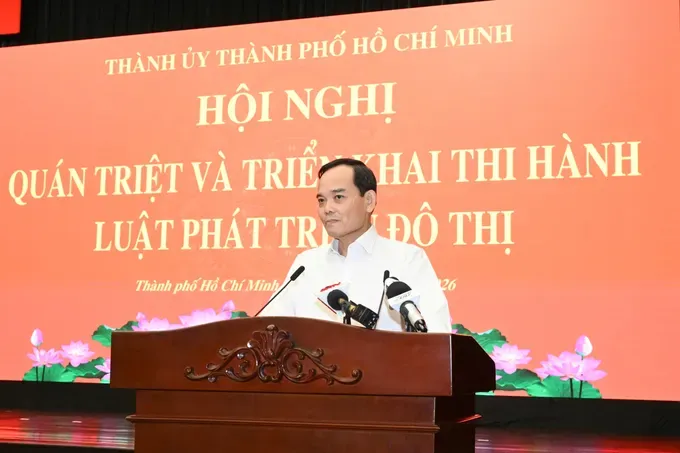
Greater decentralization
Presenting the law’s key provisions and new mechanisms, Vice Chairman of the Ho Chi Minh City people’s Committee Nguyen Manh Cuong said that the National Assembly had passed the Urban Development Law to establish a new institutional framework with greater decentralization, helping cities remove bottlenecks, mobilize resources and develop new economic models.

The law consists of five chapters and 66 articles, covering seven major groups of special policies for the development of special municipalities.
Under the law, Ho Chi Minh City may increase its number of civil servants and public employees by up to 20 percent beyond the central government-assigned payroll. The city may also introduce regulations that differ from those issued by central agencies and pilot new policies for up to five years, subject to approval by competent authorities.
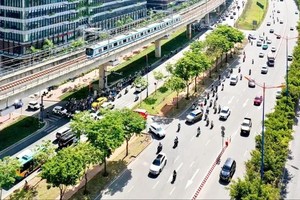
In planning and urban development, the city will prepare a single master plan. The municipal People’s Council will have greater authority over planning underground, low-rise and high-rise spaces, creating more room to efficiently utilize underground and aerial resources.
The law also allows the city to formulate policies for transit-oriented development (TOD) areas, approve railway alignments and stations, and regulate TOD planning and the transfer of planned land-use quotas within TOD areas.
For social housing, the city may appoint investors for social housing and worker accommodation projects on state-managed land without being subject to certain existing regulations.
New momentum for economic development
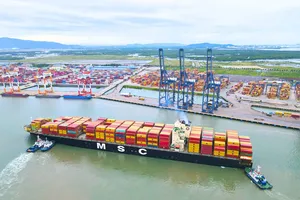
In economic development, Ho Chi Minh City may establish and adjust the boundaries of a free trade zone linked to the international seaport system. Foreign investors in the area will be exempt from obtaining investment registration certificates before establishing economic organizations and will not be required to have investment projects.
The city may also issue municipal and project bonds to raise capital, license investment banks and organize new-generation financial transactions and services, while introducing special incentives for the night-time economy.
Another notable decentralization measure allows Ho Chi Minh City to approve the establishment, merger, division, dissolution, renaming and operation of foreign-invested universities and colleges or institutions involved in joint training programs with foreign partners.
In healthcare and social welfare, the city may coordinate development funds among public hospitals under its management and develop high-tech healthcare services for foreign patients.
In science, technology, innovation and digital transformation, Ho Chi Minh City may establish policies for science, technology and innovation urban areas and introduce controlled regulatory sandboxes for emerging technologies, artificial intelligence, big data and new digital business models.
The law also gives Ho Chi Minh City greater authority over investment decisions, special policies, land-use quotas and independent site-clearance projects, while allowing the city to mobilize additional revenues for urban development.
For regional development, Ho Chi Minh City will serve as the coordinating hub for the special urban region and the Southeastern region, including regional infrastructure, environmental protection and climate change response.
The Urban Development Law also provides mechanisms for special economic zones, non-tariff areas, duty-free businesses and marine economic development, together with requirements on oversight and accountability.
The law will take effect on October 1, 2026, while special tax incentives will apply from the 2027 tax year.
According to Vice Chairman of the Ho Chi Minh City People’s Committee Nguyen Manh Cuong, National Assembly Resolution 98 and Resolution 260 will expire on April 1, 2027, as the city transitions fully to the new law. Approved programs, projects and financial mechanisms already underway before the law takes effect will continue without requiring reapproval.