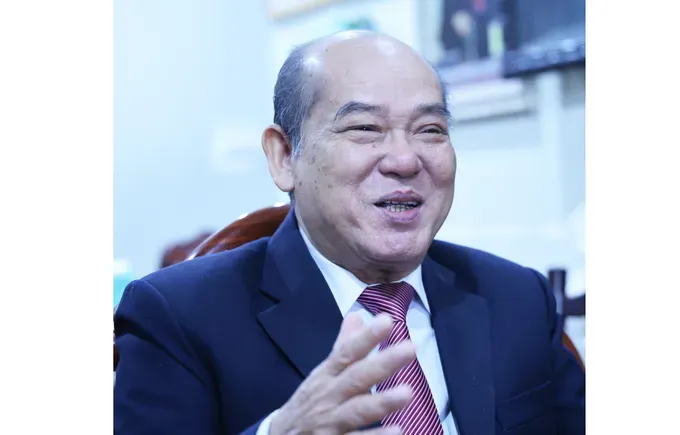
Reviewing the to-do list after the National Assembly approves the Law on Urban Development, former Director Nguyen Duc Ha of the Grassroots Party Department (Party Central Committee’s Organisation Commission) stressed the necessity of stringent power control, leadership accountability, and a contingent of cadres who possess integrity, dare to act, and dare to take responsibility.
The Law on Urban Development allows the city to be significantly more proactive in organizing its apparatus, public service regimes, policy formulation, and piloting new mechanisms tailored to developmental demands.
When greater authority is granted, it’s absolutely crucial that the responsibilities of agencies and their heads become clearer; simultaneously, mechanisms for inspection, supervision, openness, transparency, and accountability must be drastically tightened.
Previously, Resolution No. 04-NQ/TW on “Continuing to strengthen the Party’s leadership in the fight against corruption, waste, and negativity in the new situation” laid out 7 tasks and solutions aiming at the overarching goal of making officials “unable, afraid, unwilling, and unneeded” of corruption, waste, and negativity.
Former Director Nguyen Duc Ha believes that building a contingent of cadres at all levels, especially top leaders, who possess sufficient moral qualities, capability, and prestige to meet task requirements is a critical and breakthrough factor.
In the context of executing new mechanisms and policies, especially when localities are granted additional authority, this requirement must be posited even more clearly and specifically.
Decentralization must go hand in hand with accountability, and authority must be inextricably linked to power control as well as leadership responsibility. Only then do officials have the necessary conditions to proactively resolve work. But at the end of the day, they can’t just pass the buck; they must bear ultimate responsibility for the implementation results.

HCMC is urgently devising resolutions and documents to concretize the Law on Urban Development. Mr. Ha listed essential actions for cadres to breathe life into these new mechanisms.
Every guideline, policy, and new mechanism only truly exerts its intrinsic value when organized and executed rigorously and effectively. Therefore, the cadre force must possess unshakeable integrity, high capacity, a robust sense of responsibility, stay close to the grassroots, and dedicate themselves wholeheartedly to the common good.
That is also the prerequisite for new mechanisms, like the Law on Urban Development, to be deployed in the right direction, generating additional momentum for national development in the new era.
The Central Party has steadfastly affirmed that “Cadre work is the key to linchpin tasks.” Thus, it’s imperative to continue innovating cadre work vigorously, comprehensively, and synchronously, with the primary focus on evaluating and utilizing personnel.
In this new situation, it is necessary to unleash the proactive and creative spirit of cadres and Party members, especially those at the helm. It must encourage and protect officials who embody the “6 dares” spirit: dare to think, dare to speak, dare to act, dare to innovate, dare to confront formidable difficulties and challenges, and dare to take responsibility for the collective benefit.
The former director then mentioned the three pillars for Resolution No. 04-NQ/TW, which dictates building a nation of integrity and a society of integrity:
- Institutions of integrity,
- A public service of integrity,
- A contingent of cadres, Party members, civil servants, and public employees of integrity.
This reportedly reflects the exceptionally high political resolve of the Party and the State in combating corruption, negativity, and waste.
The pressing demand for a clear, transparent institution, an upright public service, and a highly capable cadre contingent becomes increasingly paramount when rolling out new mechanisms and policies, notably the Law on Urban Development. This serves as the foundational bedrock to ensure new mechanisms are executed precisely on target, fully compliant, and highly effective, thereby substantially propelling socio-economic development.
Further explaining the relationship among these three pillars, he likens these three focal points to a “three-legged stool.” Within this triad, an institution of integrity demands that functions, tasks, working regulations, and statutes must be incredibly specific, crystal clear, and airtight. An upright public service necessitates that the working environment and coordination among individuals and organizations be harmonious and tight-knit, guaranteeing democracy, openness, transparency, and scientific rigor.
Meanwhile, a contingent of cadres, Party members, civil servants, and public employees of integrity needs to strictly adhere to regulations. Concurrently, they don’t just follow orders blindly but must be dynamic, creative, and wholeheartedly devoted to the nation and its people.
For HCMC, the Law on Urban Development unlocks an expansive developmental space and substantially greater jurisdiction. However, the mechanism only truly morphs into a driving force and maximizes its effectiveness when it’s actively executed by a public service of integrity and a cadre workforce equipped with sufficient capacity, mettle, the courage to act, and the bravery to bear responsibility, consistently prioritizing the interests of the people and the nation above all else.






)