During the first seven months of 2026, Ho Chi Minh City focused its resources on executing strategic priority tasks, headlined by the drafting of the city's Master Plan for the 2025–2050 period, with a 100-year strategic vision.
Concurrently, municipal authorities prioritized reviewing and finalizing urban planning frameworks for the city's urban rail network, Transit-Oriented Development (TOD) projects, and regional connectivity, while actively resolving planning bottlenecks to clear the way for key infrastructure initiatives.
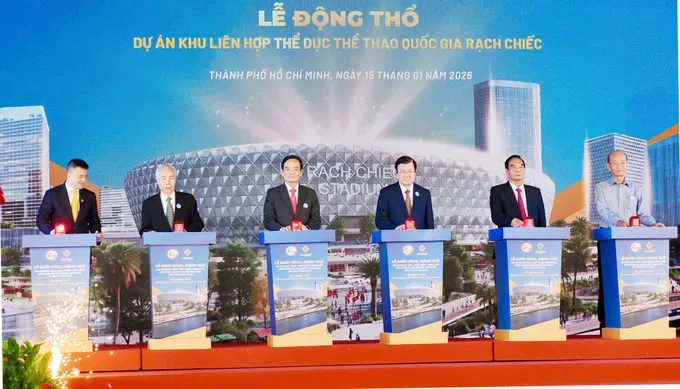
The city accelerated the implementation and groundbreaking of a number of strategic infrastructure projects with a total investment of approximately US$30 billion, equivalent to more than VND782,000 billion. Major projects getting underway included the Rach Chiec National Sports Complex, with an investment of VND145,629 billion (US$5.6 billion); Metro Line No. 2, Ben Thanh–Tham Luong section, VND55,179 billion; Metro Line No. 2, Ben Thanh–Thu Thiem section, approximately VND46,300 billion; the International University Urban Area in Xuan Thoi Son Commune, VND59,000 trillion; the renovation and upgrading of the Ho Chi Minh Museum – Ho Chi Minh City Branch, approximately VND68.7 billion; and the issuance of an investment approval decision for the Can Gio International Transshipment Port, with investment of more than VND128.800 billion.
In addition, eight projects were launched, including the Can Gio–Vung Tau sea-crossing road, with investment of more than VND93,100 billion; Phase 1 of the Cai Mep Ha general cargo and container port, more than VND50,800 billion; the Ho Tram–Long Thanh International Airport urban expressway, more than VND46,900 billion; the Ben Nha Rong–Khanh Hoi Cultural Park and Ben Bach Dang public green space project, more than VND29,300 billion; the mainline component of the Ho Chi Minh City–Moc Bai Expressway, more than VND22,900 billion; the Binh Tien Bridge and Road project, the Pham Van Chi–Nguyen Van Linh section, more than VND6,200 billion; the interchange connecting the Ben Luc–Long Thanh Expressway with Rung Sac Road, more than VND2,900 billion; and the interchange connecting the Ben Luc–Long Thanh Expressway with National Highway 50, approximately VND590 billion.
On the occasion of Vietnam’s National Day on September 2, 2026, Ho Chi Minh City is expected to break ground on 11 projects and inaugurate five others. Projects scheduled to break ground include the Thu Thiem–Long Thanh railway line, with an estimated investment of VND134,000 billion; Component Project 3 to upgrade and expand National Highway 1 from Kinh Duong Vuong Street to the boundary with Long An Province, now Tay Ninh Province, with an estimated investment of VND6,674 billion; the Ba Diem Commune social housing urban area project, covering technical infrastructure works, with an estimated investment of VND64,053 billion; and the social housing project under the Ma Lang and Cho Ga–Gao urban redevelopment project in Ben Thanh Ward, also covering technical infrastructure works, with an estimated investment of VND16,369 billion, among others.
Alongside infrastructure, urban development, and housing projects, Ho Chi Minh City is stepping up social welfare programs, including free bus services, free health checkups for all residents, and the “150 Days and Nights to Complete 1,000 Classrooms” campaign. Efforts to achieve sustainable poverty reduction and build new-style rural areas continue to be implemented in a coordinated manner, while policy-based credit programs are being effectively carried out.