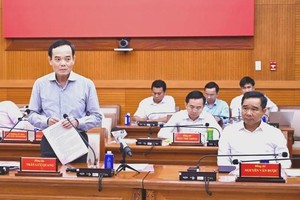
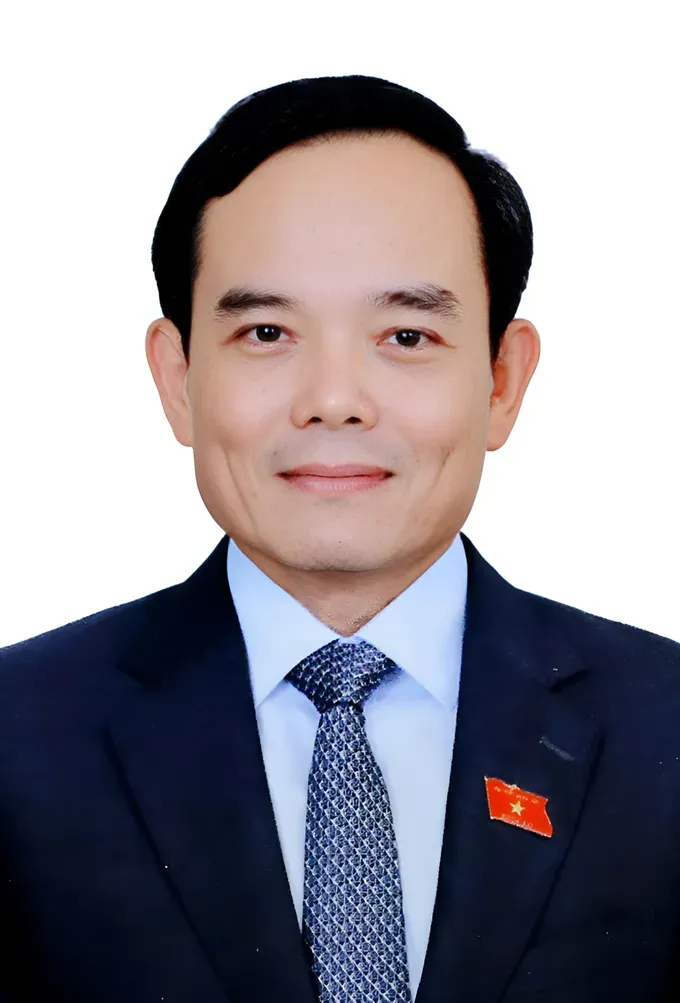
It better fulfills the city’s role as an economic locomotive and regional leader and makes greater contributions to the country, Secretary of the Ho Chi Minh City Party Committee and Head of the Ho Chi Minh City delegation to the National Assembly Tran Luu Quang affirmed.
On August 24, as part of its working agenda, the first extraordinary session of the 16th National Assembly considered and voted to pass the Urban Development Law.
The law is intended not merely to establish a separate mechanism for Ho Chi Minh City, but also to expand decentralization and the delegation of powers, unlock resources, and create development space for the country’s entire urban system and growth poles.
Speaking to Sai Gon Giai Phong (SGGP) Newspaper’s reporters, Secretary of the Ho Chi Minh City Party Committee and Head of the city’s delegation to the National Assembly Tran Luu Quang said that, for Ho Chi Minh City, the law could be viewed as a “springboard” enabling the city to more effectively tap its potential and advantages, generate momentum for rapid and sustainable growth, better fulfill its role as an economic locomotive and regional leader, and make greater contributions to the country.
Creating development space for the entire urban system

According to Secretary of the Ho Chi Minh City Party Committee Tran Luu Quang, Ho Chi Minh City has been involved in drafting this law from an early stage. In March 2026, the Standing Committee of the Ho Chi Minh City Party Committee established a steering committee to study and draft a special urban law, based on a review of the implementation of Politburo Resolution No. 31-NQ/TW dated December 30, 2022, on Ho Chi Minh City’s development. The move was aimed at establishing a stable, long-term legal framework to replace time-bound pilot mechanisms. In July 2026, the Politburo agreed to rename the legislation the Urban Development Law.
This change is of great significance: the law is intended not only to address Ho Chi Minh City’s own development requirements but also to establish a guiding legal framework for the country’s urban system and growth poles. At its core is a shift from primarily relying on time-bound pilot mechanisms to a more stable and long-term legal framework, while continuing to provide room for new initiatives and innovations.
For the southern metropolis, this can be viewed as a “springboard” for the city to more effectively tap its potential and advantages, generate momentum for rapid and sustainable growth, better fulfill its role as an economic locomotive and regional leader, and make greater contributions to the country.
The renaming of the legislation as the Urban Development Law also opens the door for cities such as Hai Phong, Dong Nai, Can Tho, Da Nang, and Hue, as well as Quang Ninh and Bac Ninh, to apply appropriate mechanisms once they meet the prescribed conditions.
Thus, the spirit of the law is not merely to establish a separate mechanism for Ho Chi Minh City but to expand decentralization and the delegation of powers, unlock resources, and create development space for the country’s entire urban system and growth poles.
The law is being drafted in the spirit of strong decentralization and delegation of powers, following the principle that “localities decide, localities act, and localities are accountable.” The draft assigns around 240 matters to the Ho Chi Minh City People’s Council, People’s Committee, and Chairperson of the People’s Committee for detailed regulation.
This provides the city with substantial room to proactively make decisions and organize the implementation of its own development priorities. Greater powers must necessarily go hand in hand with greater responsibilities. The mechanism is designed with “checks and safeguards”: ex ante controls through impact assessments and ex post oversight through supervision, transparency, and individual accountability, particularly that of those in leadership positions.
Ho Chi Minh City is also developing indicators to assess governance performance and the effectiveness of delegated powers, with the results to be disclosed periodically so that residents, businesses, and competent authorities can jointly exercise oversight. At the same time, a clear distinction must be drawn between innovation and the willingness to think boldly and act decisively for the common good and acts that exploit the mechanism for personal gain or violate the law.
The ultimate goal of decentralization and the delegation of powers is not simply to give localities “more authority,” but to enable faster, more practical decision-making and deliver better results. This is also how Ho Chi Minh City understands the responsibility that comes with being entrusted with greater powers by the central government: wherever authority is granted, responsibility must be clearly defined; the greater the powers, the higher the requirements for effectiveness and accountability.
Greater powers also mean greater responsibilities. Ho Chi Minh City will not measure its success by how much authority it is granted, but rather by what concrete results it delivers with those powers and responsibilities. The ultimate measure will be the tangible value created for residents and businesses, as well as for the development of the city and the country, Secretary of the Ho Chi Minh City Party Committee Tran Luu Quang emphasized.
Ho Chi Minh City plays a leading role and blazes new trails
Ho Chi Minh City has set a target of double-digit growth from 2026. In the first six months of 2026, its GRDP grew by 8.55 percent, the highest rate in the past decade. With considerable pressure in the remaining months to meet the full-year target, the city cannot simply continue doing things the old way but must embrace new thinking, adopt new approaches, and pursue substantive breakthroughs. The Urban Development Law will serve as a “catalyst” for Ho Chi Minh City to do so.
Ho Chi Minh City is well positioned to take the lead in piloting new development models, including transit-oriented development (TOD), dynamic spatial planning, more effective use of underground and low-altitude spaces, mobilization of social resources for infrastructure development, and the development of an international financial center, a free trade zone, integrated logistics and new forms of public-private partnerships.
The key approach is to turn resources into drivers of development. The added value generated by infrastructure should be properly harnessed to finance further infrastructure investment, rather than relying solely on the State budget.
However, Ho Chi Minh City’s development is not solely for its own benefit. An efficiently operating international financial center, a seamlessly interconnected regional infrastructure system, or a successful new governance model must create greater opportunities for businesses, localities across the region, and the national economy. Ho Chi Minh City is moving ahead to blaze new trails, pilot new models, and generate value that can spread across the country.
Ho Chi Minh City makes three commitments

Secretary of the Ho Chi Minh City Party Committee Tran Luu Quang said that he believes the value of a law must ultimately be measured by the results that residents and businesses can “feel, see, grasp, and recognize.”
For residents, this must translate into tangible improvements in their daily lives: a more modern and well-organized urban environment; more convenient transportation; improved housing along rivers and canals and renovation of aging apartment buildings; stricter enforcement of construction regulations; better fire prevention and safety; and stronger protection of people’s legitimate rights and interests.
For businesses, the most important priorities are reducing time and costs while increasing investment opportunities. Procedural layers need to be streamlined, appraisal processes for strategic projects accelerated, and the investment environment made more transparent and predictable.
A good law is not simply one that residents and businesses can read and understand. What matters is that, once the law is put into practice, they see more opportunities, fewer procedures, faster processes, and growing confidence. Additionally, for officials, the law provides a fundamental legal framework to protect and encourage the spirit of thinking boldly and acting decisively, while unlocking innovation and creativity in a city that has always been a hub and pioneer of innovation.
The city’s approach is not to wait until the law takes effect before beginning preparations. From now on, the city has established a steering team to oversee implementation and mobilized departments, agencies, and legal and planning experts to review all areas under its jurisdiction and prepare the necessary implementing regulations. The Ho Chi Minh City People’s Council and People’s Committee will prioritize the early issuance of the required regulations so that, once the law takes effect, the new mechanisms can be put into practice immediately.
Ho Chi Minh City has made three commitments. First, it will pursue rapid but sustainable development, striving for double-digit growth and making increasingly greater contributions to the State budget, the region, and the country. Second, it commits to accountability: wherever authority is granted, responsibility must be clearly defined; all new mechanisms must be subject to oversight, monitoring, and assessment based on concrete results. Third, it commits to residents and businesses that new mechanisms and policies will be swiftly translated into practice, delivering substantive and measurable changes.