As reported by the Municipal Department of Finance, thanks to intensified public investment disbursement in 2025, Ho Chi Minh City completed and put into operation a number of major projects that have delivered tangible results.
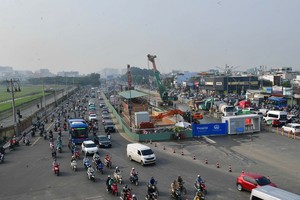
The project to build and expand National Highway 50, with a total investment of nearly VND1.5 trillion (US$57 million), was launched in 2022 and expected to be completed by the end of 2025. It is one of the city’s key public investment projects, aimed at alleviating congestion at major entry points.
Transport infrastructure connecting to Terminal T3 at Tan Son Nhat International Airport has been completed, while a series of new, expanded and upgraded roads has helped reduce traffic pressure in the area surrounding the airport.
The operation of Metro Line No. 1 (Ben Thanh–Suoi Tien) has marked a major shift in public transport. In addition, several gateway hospitals and cultural and tourism facilities, such as Ton Duc Thang Museum and Phu Tho Circus, have been completed, improving service quality and urban living standards.
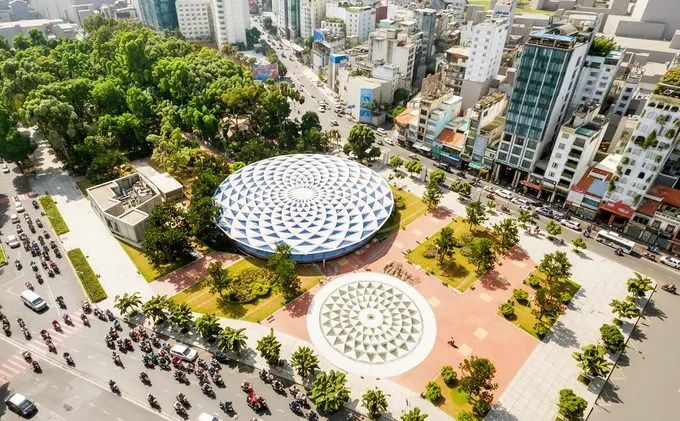
Many other projects have also seen accelerated progress. Notably, Phase 1 of the Ho Chi Minh City–Moc Bai Expressway has completed legal procedures and broke ground last year; nearly 15 kilometers of the Tham Luong–Ben Cat–Nuoc Len Canal project have been opened to technical traffic; Metro Line No. 2 (Ben Thanh–Tham Luong) has recently commenced construction; and projects including Ring Roads 3 and 4 and Phase 2 of the environmental sanitation program continue to be implemented, with many components already completed or ready for traffic.
In 2025, the Prime Minister assigned HCMC to disburse more than VND120 trillion (US$4.6 billion) in public investment capital. As of January 8, 2026, the city had disbursed over VND96 trillion (US$3.7 billion), reaching nearly 80 percent of the plan. This represents a sharp increase compared to the same period last year, both in absolute value, up more than VND40.5 trillion (US$1.5 billion) and in disbursement rate, up 10.7 percent year on year.
The HCMC Department of Finance said that, based on aggregated disbursement commitments from relevant units, total public investment disbursement for the 2025 planning year, as of January 31, 2026, is expected to exceed VND114 trillion (US$4.3 billion), equivalent to 95 percent of the plan. In January, the department will continue reviewing and accelerating projects with large 2025 disbursement targets and consulting the Municipal People’s Committee on the timely issue of directives, striving to achieve a 100 percent disbursement rate of the capital assigned by the Prime Minister.
Accelerating the allocation of contingency capital in the first quater
Beyond site clearance challenges, to ensure the completion of the 2026 public investment disbursement plan, Vice Chairman of the Ho Chi Minh City People’s Committee Bui Xuan Cuong said that the city will instruct project owners to promptly coordinate with relevant departments and agencies to finalize procedures and fully allocate the contingency fund of VND18.4 trillion (US$700 million) within the first quarter.
The city will prioritize the early distribution of reserve capital, cut administrative processing time by at least 30 percent, strengthen digital monitoring, decisively reallocate funds from slow-moving projects, and prioritize high-impact projects.

Speeding up site clearance
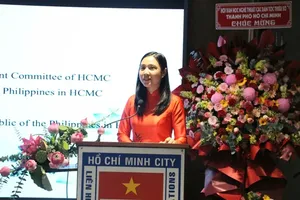
Speaking at a recent conference reviewing socio-economic performance in 2025 and setting out tasks for 2026, Chairman of the Ho Chi Minh City People’s Committee Nguyen Van Duoc stressed that the city will make site clearance a top priority in 2026 as part of its push to accelerate public investment disbursement.
Regarding site clearance, as of December 29, 2025, total disbursed compensation capital has exceeded VND43.4 trillion (US$1.7 billion), reaching 71.99 percent of the plan. Of this amount, the former Ho Chi Minh City area recorded a disbursement rate of 91.23 percent, while the former Ba Ria–Vung Tau reached 71.96 percent and the former Binh Duong 52.48 percent.
To implement this year’s plan, the HCMC Department of Finance outlined a range of solutions, including mobilizing the entire political system, closely monitoring progress, and conducting regular inspections of compensation and site clearance to ensure timely handover to contractors, avoiding delays caused by projects waiting for cleared land.
At the conference reviewing the implementation of government tasks in 2025 and rolling out key tasks and solutions for 2026, leaders of the Municipal Department of Construction said that this year, the department has identified the acceleration of transport and urban infrastructure investment, along with stronger regional connectivity, as its key focus to drive socio-economic development.
Ho Chi Minh City strives to commence on around 15 major projects and works, including Ring Road 4, the Can Gio–Ba Ria–Vung Tau sea-crossing bridge, Thu Thiem 4 Bridge and BOT projects. At the same time, the city plans to complete and put into operation 12 major projects, such as Ring Road 3, the An Phu and My Thuy interchanges and the renovation of the Tham Luong–Ben Cat–Nuoc Len Canal.
The City’s Department of Construction will continue to improve the institutional framework, strengthen decentralization and delegation of authority, closely monitor indicators related to social housing, infrastructure, traffic safety and urban renewal; and take the lead in applying science and technology, digital transformation and artificial intelligence in urban management.
By Quoc Hung- Translated by Huyen Huong



)