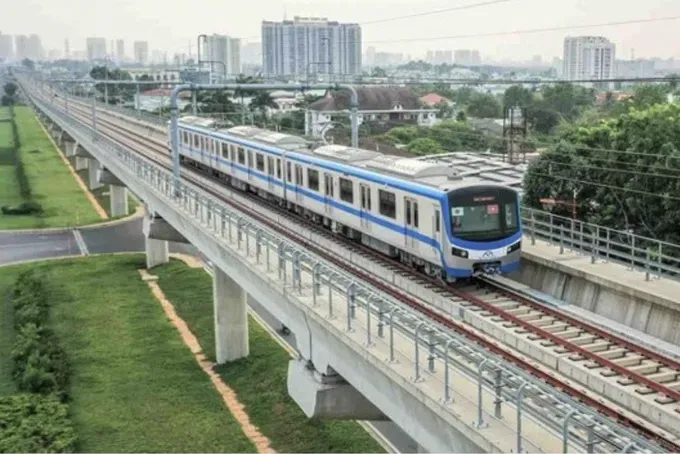
In the period leading up to 2030, Ho Chi Minh City prioritizes investment in six metro lines and line sections, with a combined length of approximately 187 kilometers and a preliminary total investment of an estimated US$17 billion. In addition, several major enterprises have proposed conducting further research and mobilizing investment for additional routes under the Public-Private Partnership (PPP) model.
On the afternoon of March 2, the Department of Construction of Ho Chi Minh City dispatched an urgent official document to the Ministry of Construction, the standing agency of the Steering Committee for national key projects in the railway sector, reporting on the implementation status of railway projects across the city.
The report was prepared pursuant to Decision No. 609/QD-TTg dated March 15, 2025, issued by the Prime Minister on the establishment of the Steering Committee, as well as directives from the Ho Chi Minh City People’s Committee, to facilitate consolidation and submission to the Central Steering Committee.
About the North–South high-speed railway axis, the city has established a Steering Committee for the Development of the Urban Railway Network, headed by the Secretary of the Ho Chi Minh City Party Committee as Chairperson, with the Chairman of the Ho Chi Minh City People’s Committee serving as Standing Vice Chairperson.
The city has allocated approximately six hectares of land at the Long Buu Resettlement Area for Phase 2, with an estimated 200 affected households to be accommodated. Concurrently, Ho Chi Minh City has proposed that the central authorities allocate VND10.8 trillion (US$413 million) from the 2026 State budget to finance compensation, support, and resettlement activities for the section traversing the city’s jurisdiction.
Currently, the city is awaiting the official handover of the site clearance boundaries to proceed with subsequent implementation steps in accordance with established procedures.
Regarding railway links to Long Thanh International Airport, the city has identified three main axes.
Among them, Metro Line No. 2 (Ben Thanh–Tham Luong section) commenced construction on January 15, 2026, and is scheduled for completion in the 2026–2030 period. The Ben Thanh–Thu Thiem and Thu Thiem–Long Thanh routes are currently finalizing procedural requirements for implementation under the PPP model, with the goal of breaking ground in 2026 and completing the projects by 2030.
For Metro Line 6 (Tan Son Nhat International Airport–Phu Huu section), Ho Chi Minh City has prioritized Phase 1 investment during 2026–2030 to ensure connectivity with Long Thanh Airport.
In addition, the project to extend Metro Line No. 1 (Ben Thanh–Suoi Tien) to the Dong Nai Provincial Administrative Center and Long Thanh International Airport, with an estimated length of approximately 38.5 kilometers, has been approved by both the Ho Chi Minh City People’s Council and the Dong Nai Provincial People’s Council. The People’s Committee of Dong Nai Province has been designated as the competent authority, with implementation expected to occur within the 2026–2030 timeframe.
The city is directing the development of underground metro lines within the inner-city area (inside Ring Road No. 2), with a focus on optimizing subterranean space and promoting urban development under the Transit-Oriented Development (TOD) model. Concurrently, authorities are reviewing and proposing a unified technical standards framework to ensure synchronization, modernity, and interoperability across different lines, thereby laying the groundwork for the gradual formation of a domestic railway industry.
In the period leading up to 2030, Ho Chi Minh City prioritizes investment in six metro lines and sections, totaling approximately 187 kilometers in length, with a preliminary overall investment of around US$17 billion. In addition, several major enterprises have proposed conducting research and mobilizing capital to develop new routes under the Public-Private Partnership (PPP) modality.
The Department of Construction of Ho Chi Minh City affirmed that it will continue to closely coordinate with the Ministry of Construction and relevant ministries and sectors to expedite project implementation, ensure quality standards, and progressively complete the urban railway network. These efforts aim to strengthen regional connectivity and create fresh momentum for socio-economic development in the coming period.




)