On March 8, 2022, Ho Chi Minh City marked a milestone in green transportation development with the official launch of the first electric bus route, D4, operated by VinBus.
The route connects Saigon Bus Station with the Vinhomes Grand Park urban area. Operating 94 trips per day with 20-minute intervals, each journey takes about 100 minutes, and fares are VND7,000 (US$0.26) per trip and VND3,000 for students, offering residents a modern alternative linking high-demand areas such as the high-tech zone, new urban developments, factories and businesses.
At the inauguration ceremony, the leaders of the municipal People’s Committee emphasized that the electric bus route not only improves public transport quality but is also a key step in reducing emissions and changing private vehicle habits. Since then, Ho Chi Minh City’s electric bus market has become a competitive field between Futa Bus Lines and VinBus.
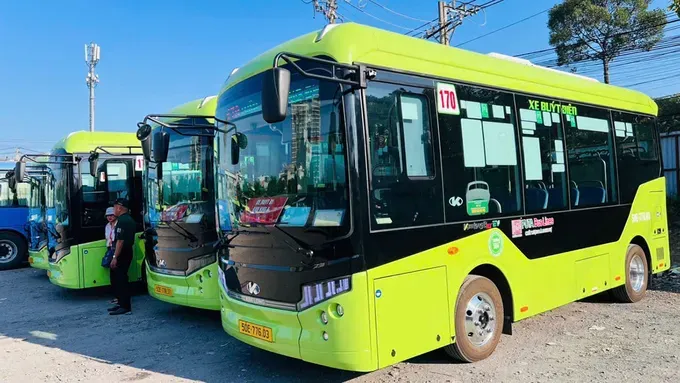
As the city organized tenders for bus routes, electric buses began appearing in significant numbers. Specifically, in 2024, Futa Bus Lines won the tender for 17 routes connecting to Metro Line 1, deploying 150 buses. Later, at the end of March 2025, the Ho Chi Minh City Public Transport Management Center under the Ho Chi Minh City Department of Construction announced a tender for operating 37 subsidized bus routes across the city, divided into 17 lots.
Futa Bus Lines won 15 out of 17 lots, covering 35 routes, while VinBus won two lots covering 2 routes. In the October tender for 13 routes, Futa Bus Lines won four routes, and VinBus won nine. By early November, Futa Bus Lines had secured 12 more routes, leading the city in the number of electric buses by the end of 2025. These buses, produced by Kim Long Motor in Hue, have flexible seating for 30–60 passengers.
Meanwhile, VinBus announced in February that it had converted all 169 buses on nine routes to VinFast electric buses. Previously, VinBus had operated 58 electric buses on routes 33 and 150. All VinBus electric buses are manufactured and assembled by VinFast at its Hai Phong plant.
While both companies prioritize electric buses, their approaches differ. Futa Bus Lines focuses on rapidly expanding subsidized routes, leveraging extensive operational experience. VinBus emphasizes “high standardization,” synchronizing vehicles, charging infrastructure and service quality. Futa Bus Lines concentrates charging stations at depots, while VinBus develops a wider charging network for flexibility.
Overall, by the current time, the competition between VinBus and Futa Bus Lines is delivering tangible benefits to residents, modernizing the city’s bus system, and replacing old, overcrowded vehicles with clean, comfortable buses that restore confidence in public transport.
Mr. Bui Hoa An, Deputy Director of the Ho Chi Minh City Department of Construction: "A fare-free policy could boost bus ridership by up to 30 percent."
The city is rapidly finalizing the legal framework and technical plans to implement a fare-free bus policy. Initially, the policy will apply to all 135 intra-city bus routes. The Department of Construction is working closely with relevant agencies to draft a resolution for submission to the Ho Chi Minh City People’s Committee, before it is approved by the City Council later this month.
Regarding the ordering and tendering mechanisms under the fare-free policy, preliminary technical plans have been agreed upon but still require further refinement, particularly in coordination with the Ho Chi Minh City Departments of Justice and Finance, to balance the interests of both passengers and transport operators. The goal is to provide the best possible service to commuters while ensuring fair compensation and manageable operating costs for bus companies.
According to estimates, the fare-free policy could increase bus ridership by around 30 percent compared with 2025, and the existing infrastructure is capable of handling this growth even if passenger numbers exceed expectations.
Currently, Ho Chi Minh City has around 1,200 electric buses. By 2030, the city plans to convert all 3,011 diesel and CNG buses to electric, achieving a 100 percent electric public bus fleet in line with sustainable urban development goals. Tendering for subsidized routes has already saved the city substantial funds of VND138 billion (US$5.2 million) in 2025 and an estimated VND363 billion (US$13.8 million) in 2026.
The city is also investing in electric transport infrastructure, including around 1,000 charging stations citywide, 900 of which are operated by V-Green with over 9,400 charging posts. Plans are underway to add at least 1,500 fast-charging stations. Land at 19 bus depots, covering nearly 110,000 square meters, will be used to expand charging infrastructure using the CCS2 standard.
Phasing out older buses has proven difficult
For example, Quyet Thang Transport Cooperative, once operating eight diesel routes with 200 buses, is now liquidating 140 buses due to low tender prices and difficulty reselling CNG vehicles. Many former drivers and ticketing staff have joined Futa Bus Lines or VinBus.