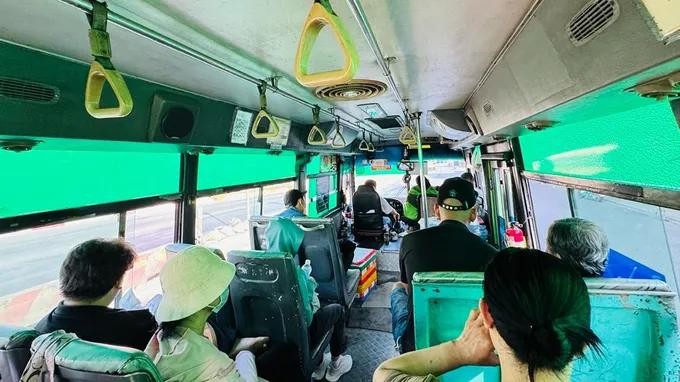
While many bus routes powered by CNG or electricity are gradually shaping a more modern and civilized image for Ho Chi Minh City’s public transport system, a significant number of older routes remain outdated in both service quality and passenger experience.
Decaying fleets and rising fares plague HCMC’s outdated bus routes
At 3 p.m. on April 5, Sai Gion Giai Phong reporters boarded bus route No. 613 departing from Thu Dau Mot bus station, formerly part of Binh Duong’s network, bound for An Suong Bus Station. Leaving the station with 12 passengers, the trip quickly became a series of unpleasant surprises, resembling long distance coaches from decades past.
The bus had no air conditioning, relying instead on open windows for ventilation. Seat cushions were torn and worn, and the engine was loud. Whenever the bus followed vehicles emitting black smoke or garbage trucks, passengers were forced to endure the fumes.
Throughout the journey, the bus not only stopped at designated stations but also picked up passengers along the roadside. For example, near the Lai Thieu Ward gateway, despite the absence of an official stop, the bus slowed down to take on passengers. Along National Highway 1A and National Highway 13, it continued to stop for people waiting by the road. The trip to An Suong Bus Station took about one hour and 30 minutes.
Hong Hoa, a passenger on the bus, said, “Today I am visiting relatives in An Suong. This is the only route with a fixed itinerary, so I have no choice but to take it, even though it is quite exhausting. Today is still considered fast. On weekdays during rush hour, congestion can be severe, and it can take nearly three hours to arrive.”
Ticket collector Thuy An explained that this route does not receive government subsidies. As a result, operators lack the resources to upgrade vehicles and must adjust fares based on market conditions. On April 5, the ticket price rose to VND50,000 per passenger due to higher fuel costs, compared to VND30,000 to VND35,000 previously for the 32 km journey, several times higher than subsidized routes. Currently, only two buses remain in operation on this route, one at each terminal.
Even within the city, some subsidized routes remain inconvenient. At around 2 p.m. on April 3, the reporters boarded bus route No. 19, running from Ben Thanh to Linh Trung Export Processing Zone and Vietnam National University Ho Chi Minh City. Despite being a major route serving a large number of passengers, especially students, the bus interior showed clear signs of wear after years of operation.
Seats were made of hard plastic without cushioning, making the ride uncomfortable, particularly on uneven roads. A student seated nearby said, “There are days when the air conditioning does not work, and the bus becomes hot and stuffy.”
A similar experience occurred on bus route No. 91, running from Mien Tay Bus Station to Thu Duc Agricultural Market. At 3:55 p.m. on April 3, they waited at a stop near Hoa Binh Park in An Dong Ward heading toward Mien Tay Bus Station. Upon boarding, passengers were immediately confronted with the discomfort of a diesel powered engine, which was noisy, along with worn interiors that made the space unpleasant despite having air conditioning.
Long waits and a shrinking fleet are driving commuters to shun buses
After several days of traveling by bus, it becomes clearer why many residents remain reluctant to give up private vehicles, despite the affordability, safety, and weather protection that buses offer.
One of the main issues is scheduling. On the morning of April 3, the reporters waited for bus route No. 19 at the Saigon bus station near September 23 Park in Ben Thanh Ward to travel to Vietnam National University Ho Chi Minh City. Despite waiting more than 20 minutes past the scheduled departure time, the bus had yet to leave. When asked, the driver said he was waiting for more passengers.
Nguyen Minh Ngoc, who has commuted by bus for 15 years along this route, said delays are frequent, with waits sometimes stretching to 30 minutes. A staff member at the bus operations center explained that the number of buses on route No. 19 has dropped from more than 20 vehicles in the past, with intervals of 7 to 8 minutes, to just over 10 buses currently, resulting in waiting times of 20 to 30 minutes between trips.
Nguyen Huu Nguyen from the Vietnam Urban Planning and Development Association of Ho Chi Minh City said that a noteworthy issue is that currently, approximately 72 percent of urban roads have a width of only 5-6 meters. Therefore, the development of small electric buses and electric taxi buses is essential to enhance accessibility to residential areas and narrow alleys, thereby contributing to the expansion of the service network.
Additionally, organizing transportation connections plays a crucial role. Each bus stop and terminal should include motorcycle parking facilities to facilitate convenient transfers for residents. These solutions are expected to improve convenience, thereby encouraging more residents to utilize bus services.