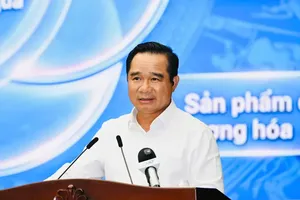
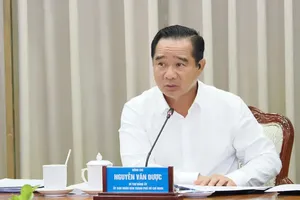
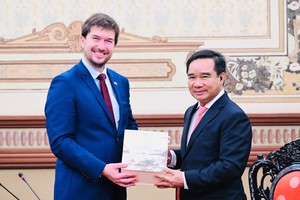
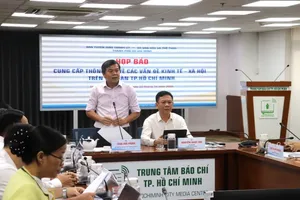
At the working session regarding the review of socio-economic performance in May and the first five months of 2026, key tasks and solutions for June 2026, and public investment progress with communes, wards and special administrative zones on the afternoon of June 4, Mr. Nguyen Van Duoc, Chairman of the Ho Chi Minh City People's Committee, stated that the session was focused not on routine assessments but on addressing key priorities, particularly public investment disbursement.
The working session was chaired by Mr. Nguyen Van Duoc, Member of the Party Central Committee, Deputy Secretary of the Ho Chi Minh City Party Committee and Chairman of the Ho Chi Minh City People's Committee; Mr. Nguyen Loc Ha, Member of the Standing Committee of the City Party Committee and Standing Vice Chairman of the Ho Chi Minh City People's Committee; Mr. Hoang Nguyen Dinh, Member of the Standing Committee of the Ho Chi Minh City Party Committee and Vice Chairman of the Ho Chi Minh City People's Committee; and Vice Chairmen of the municipal People’s Committee Bui Xuan Cuong, Bui Minh Thanh, Nguyen Cong Vinh and Tran Van Bay.
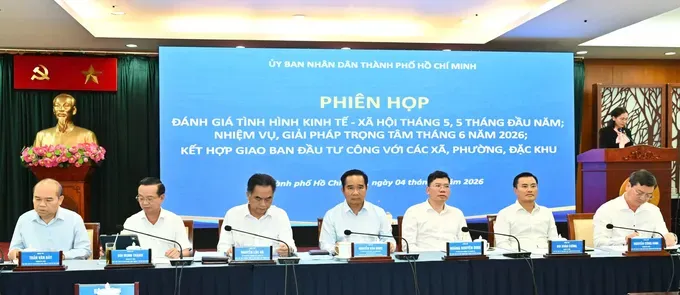
With public investment disbursement reaching just over 16 percent of the annual plan, Mr. Nguyen Van Duoc said the current pace falls short of expectations, especially as the city targets double-digit economic growth. The session therefore concentrated on solutions to accelerate project implementation and remove bottlenecks, particularly those related to compensation and site clearance.
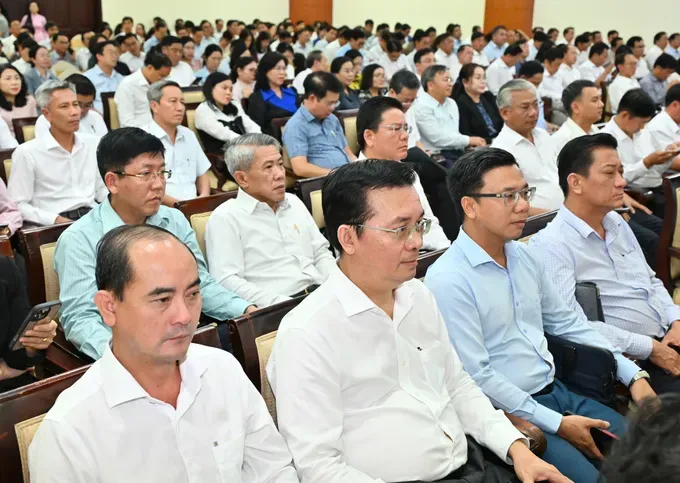
According to Chairman of the Ho Chi Minh City People's Committee Nguyen Van Duoc, more than two-thirds of wards and communes recorded low public investment disbursement rates during the first quarter.
The city will consider reallocating funds from slow-moving localities to projects with better implementation progress if disbursement rates do not improve in the second quarter. There should be no shortage of investment capital in one place while funds sit idle in another, he said.
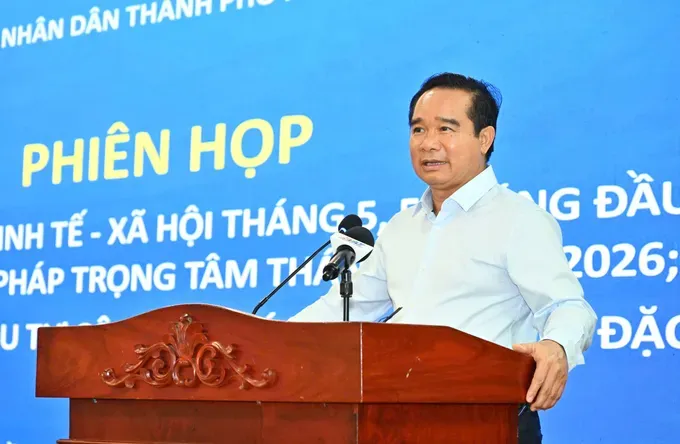
Chairman Nguyen Van Duoc also emphasized the importance of administrative reform, describing it as a mandatory task. The city plans to develop a digital monitoring and evaluation system to provide objective assessments of administrative services and ensure citizens experience genuine satisfaction with public services.
Mr. Hoang Vu Thanh, Director of the municipal Department of Finance, reported that public investment disbursement reached 16.9 percent of the annual capital plan assigned by the Prime Minister as of May 31.
Although the figure represents an improvement compared with the same period last year, it remains below expectations.
He explained that 2026 is the first year of the 2026-2030 medium-term public investment plan, with many projects still completing preparation and approval procedures. Several approved projects are currently finalizing designs, cost estimates, appraisals, and contractor selection, limiting the volume of completed work eligible for payment during the early months of the year.
Additional obstacles include difficulties in land acquisition and compensation, relocation of electricity infrastructure, legal issues involving disposal sites for soil and dredged materials, international contract disputes, and unstable construction material supplies accompanied by price fluctuations.
Targeting full-year disbursement
To accelerate progress, the Ho Chi Minh City Department of Finance proposed that all agencies and local authorities work toward achieving 100 percent disbursement of the capital allocated by the Prime Minister.
The city aims to reach a 40 percent disbursement rate by the end of the second quarter and 70 percent by the end of the third quarter. Officials described public investment disbursement as a critical political task that will contribute to achieving the city's economic growth goals.
Authorities were also urged to adopt a more results-oriented approach, shifting from traditional administrative management to modern governance focused on performance and measurable outcomes.
The municipal Department of Finance further recommended increasing field inspections and prioritizing solutions for persistent bottlenecks involving land clearance, technical infrastructure relocation, planning and design approvals, contractor selection, and digital project management.
Economic indicators remain positive
Despite challenges in public investment, Ho Chi Minh City's economy maintained positive momentum during the first five months of 2026.
Retail sales and consumer service revenue reached VND799.9 trillion (US$30.4 billion), up 12.8 percent year-on-year. Exports totaled US$39.47 billion, rising 5.3 percent, while imports increased 10.8 percent to US$44.29 billion.
Industrial production continued to expand, with the Industrial Production Index (IIP) increasing 11 percent. Manufacturing remained the key growth driver, posting growth of 11.8 percent.
Foreign direct investment (FDI) exceeded US$3.8 billion during the period, up 20.3 percent from a year earlier. The city also attracted 338 science and technology projects with newly registered and additional capital totaling US$420.9 million.
Meanwhile, authorities approved investment policies for 14 projects and additional capital for eight domestic investment projects with a combined investment of approximately VND170 trillion (US$6.5 billion).
The city has also approved the outline for its 2025-2050 master plan with a 100-year vision and is preparing strategic plans for the expanded Ho Chi Minh City seaport and logistics network, including the Cai Mep–Thi Vai, Can Gio, Hiep Phuoc and Cat Lai areas.