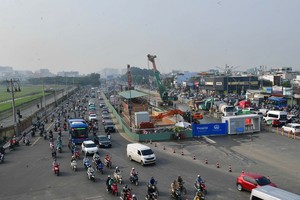
HCMC is going to simultaneously break ground on four strategic infrastructure projects, namely Metro Line 2 (Ben Thanh – Tham Luong), Can Gio Bridge, Phu My 2 Bridge, and Rach Chiec National Sports Complex, with a total investment of nearly VND240 trillion (approx. $9.4 billion) on January 15. This comprehensive infrastructure deployment reflects the city’s vision for spatial development and economic structure in the new era.
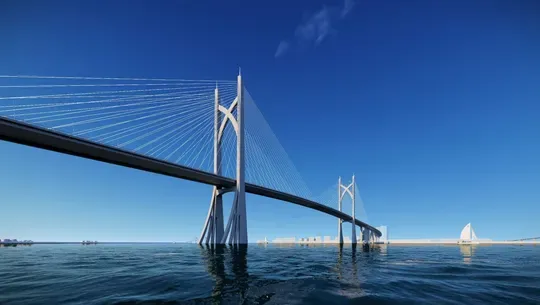
If Metro Line 2 is identified as the “backbone” to reduce traffic pressure for the Northwest gateway, Can Gio Bridge will form a direct connection axis between the coastal peninsula and the city’s central core. Along with Phu My 2 Bridge, this new bridge and road system will expand development space to the South, creating conditions to restructure urban, industrial, and logistics functional zones.
In the East, the existing Metro Line 1 (Ben Thanh – Suoi Tien) will be “enhanced” through its linkage with Rach Chiec National Sports Complex, a multi-functional hub serving large-scale sports events while developing the city’s service and conference-exhibition sectors.
Spatially, with these strategic works deploying simultaneously, all three directions of Northwest, East, and South of HCMC are being expanded. This creates “satellite strength” to support the central core while connecting peripheral areas with the Southeast region.
In terms of function, the bridges (Phu My 2, Can Gio) and rail (Metro) systems not only solve traffic needs but also perfect the logistics network. Once connection axes from the South through Dong Nai Province to Long Thanh International Airport are formed, the aviation logistics route will be complete, not to mention the marine economy and seaport connections from Can Gio to Ba Ria – Vung Tau areas.
Meanwhile, the Rach Chiec National Sports Complex project plays the role of a “balance point” in HCMC’s development strategy. Besides large-scale transport infrastructure, synchronous investment in sports and high-quality services shows the city is focusing more on the “soft values” of a modern metropolis.
In the orientation of tourism development, especially MICE (Meetings, Incentives, Conferences, and Exhibitions) tourism, a world-class sports complex is a necessary preparation, creating a foundation for HCMC to participate deeper in the international event chain.
These projects also clearly reflect the positive impact of specific mechanisms and policies recently issued by the National Assembly for HCMC. The breakthrough in mechanisms has created “fiscal space,” allowing the city to be more proactive in mobilizing resources, organizing investment, and deploying infrastructure.
While Metro Line 1 was implemented mainly with Official Development Assistance (ODA) capital, the shift to using state budget capital for Metro Line 2 has helped resolve various obstacles regarding procedures, site clearance, and funding, thereby accelerating progress.
Simultaneously, the participation of strategic investors and domestic private corporations in key transport infrastructure projects proves that the policy of developing the private economy has gradually entered practical reality.
Even more notably, beyond the four strategic projects mentioned above, tomorrow (January 15) will also see the formation of a new “virtual road” in the Northern region of the metropolitan area, a road of science, technology, knowledge economy, and innovation.
This is the Science and Technology Urban Model, with its “headquarters” placed at Becamex Group (sited in formerly Binh Duong New City). The approach of placing the “brain” of science, technology, and innovation right within a large-scale high-tech production zone in the North and Northwest of the city demonstrates practicality and a priority on products that serve society.
When this center is surrounded by a system of next-generation science-technology industrial parks such as Riverside, Lai Hung, Cay Truong, and VSIP III, the cycle from Research & Development (R&D) and testing to transfer, production, and commercialization will be maximally shortened.
This is a fundamental difference compared to models that separate science and technology from production spaces, which have revealed limitations in creating added value and technological spillover.
Clearly, a “distribution of roles” is increasingly taking shape:
- The Central Area continues to promote its role as a center for finance, high-end services, culture, and creativity;
- The Northern Area assumes the role of a nucleus for R&D, high-quality human resource training, and innovation linked with high-tech production;
- Strategic Transport Infrastructure gradually covers the East and South, creating a foundation for the balanced, sustainable, and long-term development of HCMC.