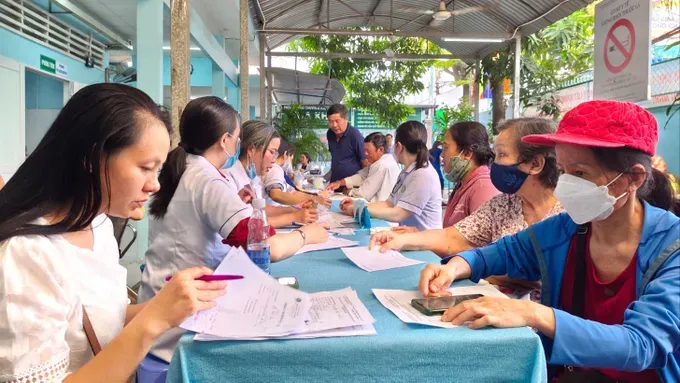
On the morning of April 17, at Binh Trung Ward Clinic, a large number of elderly residents arrived early to participate in a major health screening drive organized by the HCMC health sector. The examination areas were arranged scientifically, with medical teams from Le Van Thinh Hospital and the ward clinic staff coordinating smoothly to provide dedicated check-ups and consultations.
For Nguyen Thi Thuy, a 54-year-old lottery ticket vendor, the initiative has provided a rare sense of relief. “I’ve never dared to go for a check-up before; whenever I felt pain, I’d just buy a few doses of medicine at the pharmacy and call it a day. Hearing the local announcement about free exams made me so happy,” she explained while waiting for her turn.
This represents the second phase of a campaign to provide free health screenings for nearly 15 million city residents. According to Director Tang Chi Thuong of the HCMC Department of Health, early detection and data connection to electronic health records help manage public health continuously and long-term, rather than treating illnesses only when they become severe. This activity aims to concretize the Politburo’s Resolution 72 on strengthening the protection, care, and improvement of people’s health.
Alongside healthcare activities, HCMC is expanding its social security system toward covering specific target groups, with many new policies already enacted. Notably, Resolution No. 56/2025/NQ-HDND regarding health insurance support for the elderly and students stands out. Accordingly, individuals aged 65 to under 75 who don’t yet enjoy other support policies will have 100 percent of their health insurance premiums covered by the city budget, while primary and secondary students are supported to ensure free health insurance participation.
This policy benefits over 2.7 million people, helping reduce the burden of medical costs while rapidly increasing the universal health insurance coverage rate. Simultaneously, social assistance policies for the elderly and vulnerable groups continue to be maintained and expanded, ensuring access to essential health and welfare services. In education, the policy of waiving tuition fees for students at all levels is being implemented steadily, helping reduce expenditure pressure for many families.
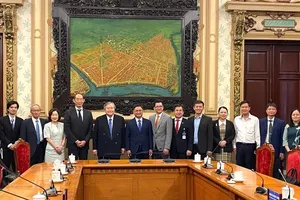
During meetings with voters, HCMC People’s Committee Chairman Nguyen Van Duoc has repeatedly affirmed that the city remains steadfast in building a multi-layered social security system covering all citizens. He emphasized taking care of those with meritorious service and the vulnerable, while improving the quality of sustainable poverty reduction. He firmly believes that citizens must enjoy the fruits of development.
Continuing the human care movement, HCMC is preparing breakthrough programs in education. Immediately following the 1st HCMC Party Congress for the 2025-2030 term, the HCMC Party Committee and People’s Committee drastically directed the acceleration of school and classroom construction. This is also the solution for HCMC to concretize the Politburo’s Resolution 71 regarding breakthroughs in education and training development.
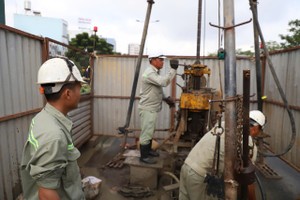
In early 2026, construction began on Binh Chuan 3 Primary School in Thuan Giao Ward. Built with investment from social mobilization, the school features 40 classrooms along with auxiliary works and equipment meeting high-quality standards. Contractors are currently pushing the pace to ensure completion by the end of July 2026. Meanwhile, Tran Dai Nghia Primary School in Binh Hung Hoa Ward has been finished, ready for its inauguration on May 19 and enrollment in early June. These new schools will partially address the learning needs of students in areas experiencing rapid mechanical population growth.
Director Nguyen Van Hieu of the HCMC Department of Education and Training stated that until the end of 2026, the city expects to complete and put into use 66 schools with about 1,200 classrooms, striving to reach the ratio of 300 classrooms per 10,000 school-aged residents by 2030.
To speed up progress, Chairman Nguyen Van Duoc requested departments to boldly innovate implementation methods. Procedures don’t necessarily have to be performed sequentially but can be carried out in parallel to shorten timeframes. The city aims to cut processing time by about 50 percent across all stages, from filing to project approval.
Recently, the city launched a 150-day competition campaign to complete 1,000 classrooms before September 5, in time for the 2026-2027 school year. Once the classroom puzzle is solved, the city will achieve the goal of 100 percent of students studying two sessions per day. This doesn’t just improve educational quality but also creates conditions for students to develop skills, physique, and mindset more comprehensively.
Mr. Cao Thanh Binh, Head of the Culture and Social Affairs Committee under the HCMC People’s Council shared that investing in people remains a steadfast pillar of HCMC’s development strategy. To concretize national resolutions, the city’s Party Committee and People’s Council have launched rigorous action plans, ensuring economic growth parallels enhanced living standards.
In education, officials are addressing land and staffing shortages to reduce class sizes. Simultaneously, healthcare reforms prioritize primary capacity and digital transformation. At the end of the day, these systemic upgrades aim to empower citizens through proactive wellness.
HCMC’s strategic goals
Healthcare: From 2026, citizens will receive free annual health screenings and lifelong electronic health management. By 2030, the target is 35.1 beds, 21 doctors, and 35 nurses per 10,000 people.
Education: 1,200 new classrooms in 2026 and 1,500 in 2027; reaching 300 classrooms per 10,000 school-aged children by 2030.
Social welfare: By 2026, over 95 percent of the population will have had health insurance, reaching 100 percent universal coverage by 2030.






)