Amid mounting risks that pose a direct threat to residents’ lives and property, the city is expediting the implementation of anti-erosion projects. These efforts are aimed at reinforcing vulnerable sections, enhancing disaster resilience, and ensuring the safety and stability of affected communities.
Landslide risks mounting
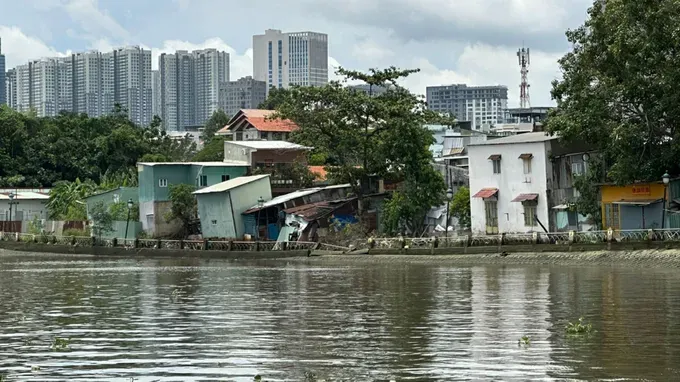
At the embankment along Thanh Da Canal in Thanh My Tay Ward, a landslide stretch exceeding 200 meters has been recorded and continues to expand. Several embankment pillars have collapsed, leaving nearby houses precariously tilted and posing significant safety risks.
To ensure public safety, local authorities have relocated 15 households to temporary accommodation for more than two years. Along the canal, numerous houses have been vacated, sealed off, and marked with hazard warnings. However, several residents continue to remain in the area, living in constant uncertainty.
Mr. N.T., a resident of Alley 886 on Xo Viet Nghe Tinh Street, said that although his household is not subject to relocation, cracks have appeared in the walls of his house. “My family has lived here for over 20 years and has witnessed two major subsidence incidents. Residents only hope that the issue will be thoroughly addressed soon so they can live with peace of mind,” he stated.
Along the Saigon River section running through Thanh Da Peninsula in Binh Quoi Ward, several new erosion sites have emerged. According to Mr. N.T.H., a resident of Alley 352 on Binh Quoi Street, homes in the past were located at a considerable distance from the riverbank, but the eroded edge has now encroached close to house walls. “Whenever high tides coincide with heavy rainfall, water levels rise, and many households are inundated. We hope the anti-erosion project in the Thanh Da Peninsula will be completed soon to help stabilize our lives,” he said.
Similarly, along both banks of the Giong Ong To River in Binh Trung Ward, multiple dangerous erosion points have formed, creating deep undercut sections that eat into the land foundation. Ms. Nguyen Thi Van, a resident of Alley 18 on Street No. 17, said that to mitigate erosion, residents have had to reinforce their homes by installing stakes, placing sandbags, and adding soil and construction debris to their foundations—measures that must be repeated every few years.
Accelerating the implementation of embankment construction projects
According to official statistics, among the 43 identified erosion sites, eight are classified as extremely dangerous and 35 as dangerous, distributed across 27 wards and communes. Several localities have recorded a high concentration of erosion points, including Tan Uyen Ward, An Phu Dong Ward, Binh Quoi Ward, Nha Be Commune, Hiep Phuoc Commune, and Thuong Tan Commune.
Over the years, local authorities have coordinated with relevant departments and agencies to implement embankment construction projects along rivers, canals, and waterways. While a number of these projects are currently under construction, others remain in the stage of preparing feasibility study reports.
According to the Ho Chi Minh City Department of Agriculture and Environment, Binh Quoi Ward alone has recorded three erosion sites along the Saigon River, with three corresponding projects currently under implementation, reaching progress rates of between 68 percent and 80 percent.
Regarding the erosion site along Thanh Da Canal, Mr. Phan Thanh Hieu from the Division of Economy, Infrastructure, and Urban Affairs of Thanh My Tay Ward stated that the erosion has persisted since June 2023. Shortly thereafter, 15 households were urgently relocated.
In June 2025, the project to construct a reinforced embankment along Thanh Da Canal (Section 1.1) was officially approved. The project is scheduled for completion by 2027 and is expected to affect 69 households.
Recently, the ward authorities submitted a formal proposal to the municipal Department of Construction and the Ho Chi Minh City People’s Committee, requesting the allocation of housing and land funds to serve resettlement needs for households affected by the project. In the coming period, the ward will coordinate with relevant units to accelerate compensation procedures and promptly hand over cleared sites to facilitate project implementation, Mr. Hieu stated.
At the erosion site near Giong Ong To Bridge, an anti-erosion embankment project has been approved, with the Ho Chi Minh City Traffic Construction Investment Project Management Board serving as the investor. The project is expected to affect approximately 98 households and is scheduled for completion in 2028.
To promptly tackle erosion along rivers and canals, Vice Chairman of the Ho Chi Minh City People’s Committee Bui Minh Thanh has issued a directive requiring local authorities to urgently and synchronously implement effective solutions.
Accordingly, the municipal Department of Construction is tasked with expediting the preparation of pre-feasibility study proposals as well as the appraisal and approval of anti-erosion embankment projects, enabling investors to commence construction at the earliest possible time to ensure the safety of lives and property in affected areas.
People’s Committees of wards and communes where erosion sites are located are required to closely coordinate with the Department of Agriculture and Environment and project investors in carrying out compensation and site clearance for embankment projects, thereby protecting residential areas.