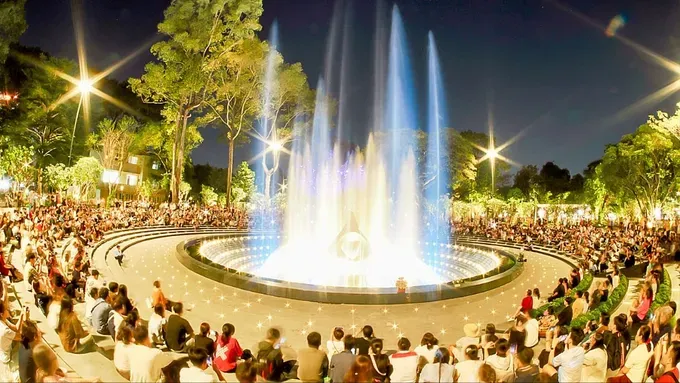
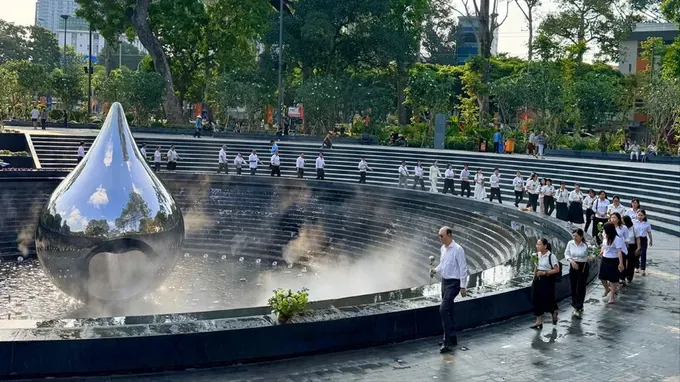
As dusk falls, sunlight lingers on the young canopies at No. 1 Ly Thai To Park in Vuon Lai Ward. Along the neatly paved stone paths, the grass carpets have taken root, sprouting vibrant green leaves. Right next to the Cong Hoa Roundabout area, a spacious courtyard is crowded with badminton players. Further inside, strollers exercise, and families gather to enjoy the cool breeze under the shade of trees. At the central square, where the water-drop symbol stands as a memorial for those who perished during the Covid-19 pandemic, many footsteps slow down, as people stand in silence reading each line inscribed on the stone.
Modest in scale, No. 1 Ly Thai To Park nonetheless embraces a momentous significance. On land that was once “weighed and measured” for various profit-driven economic schemes, the city decided to dedicate it entirely to the people serving as both a “green lung” and a place to anchor the memories of Covid-19 victims, a tragic but resilient part of history inseparable from HCMC.
Not far away, a temporary park situated on the land of the Phan Dinh Phung Sports Complex project (at the address of 8 Vo Van Tan Street in Xuan Hoa Ward) is also bustling with the footsteps of strollers every dawn and dusk. Around the city center, cold corrugated iron fences blocking off “prime real estate” plots are gradually being dismantled, making way for trees, pedestrian paths, and benches.
The once-closed urban core has now become a collective asset that everyone can enter, utilize, and experience. “In the past, passing by only revealed barriers. Now it’s a park that anyone can enter. Transforming vacant ‘prime land’ into parks for people to play and visit carries immense meaning,” Mrs. Pham Thi Hue, a resident of Ban Co Ward, expressed.
The story at No. 1 Ly Thai To Park clearly reveals that a shift is occurring in the urban development thinking of HCMC, where public land is gradually being converted into communal spaces. Along Nguyen Tat Thanh Street, the Nha Rong – Khanh Hoi area is being prepared to form a large-scale landscape park. What was once considered “prime riverside land” will soon become an open space, connecting history and culture with the urban rhythm.
In an era when HCMC constantly grapples with intense growth pressures, earmarking “prime real estate” for public parks necessitates forgoing numerous immediate lucrative opportunities. It’s a calculated choice rooted in a far-sighted vision. Recent statements from city leaders reportedly reveal a steadfast consensus: development shouldn’t merely be quantified by growth rates but must be converted into tangible quality of life for every resident.
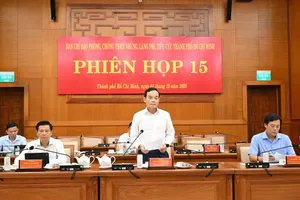
This philosophy of placing individuals at the core and utilizing living space as a metric for administrative efficacy was articulated by HCMC Party Committee Secretary Tran Luu Quang during the 5th Conference of the Party Executive Committee for the 2025-2030 tenure. He affirmed that the city is going to accelerate urban rejuvenation to ensure citizens enjoy the fruits of progress, including a comprehensive audit of public assets to prioritize schools and parks.
Practical implementation suggests that repurposing underutilized land has triggered a distinctly positive ripple effect. From lush sanctuaries to memorial spaces bridging history and modernity, HCMC is asserting a sustainable, human-centric trajectory. Every square meter of communal space serves as vivid evidence that all decisions are directed toward the people.
Beyond green initiatives, the city has launched universal free health check-ups across 168 wards. Authorities have also proposed free bus fares, with a projected annual budget of VND7 trillion (US$275 million), alongside waiving seaport infrastructure fees. At the end of the day, these initiatives aim to fulfill one of the tasks General Secretary and State President To Lam assigned to HCMC, namely focusing on resolving traffic congestion and pollution while shielding businesses from global volatility.
Assoc Prof Dr Nguyen Duc Loc, Director of the SocialLife Institute, remarked that in a metropolis where every square meter’s value translates into cash, HCMC’s decision to preserve the plot at No.1 Ly Thai To Street as a park is noteworthy. Transforming the Nha Rong-Khanh Hoi complex into a landscape park similarly defies purely commercial logic.
Beyond returning land to the community, these choices signal that development isn’t merely about vertical growth but daily enjoyment. When neighborhoods offer playgrounds, shade for the elderly, and rest areas for laborers, the city evolves into a genuine living space rather than a cold business environment.
Nevertheless, alongside these commendable milestones, certain inquiries regarding the trajectory of sustainable development must be addressed. Primarily, it’s the issue of spatial disparity between the urban core and suburban wards. The city’s public welfare map reportedly needs equitable expansion rather than mere punctuation in specific locales.
Additionally, public space planning must be anchored in a robust legal framework to ensure it doesn’t succumb to personnel shifts or planning pressures. Since space has returned to the community, a permanent retention mechanism is vital. Furthermore, true ownership requires a community voice in design and management. Without substantive consultation, these areas appear as “gifts” rather than co-created spaces, ultimately determining long-term civic attachment.
A path worth pursuing has opened up, and it’ll require much dedicated investment and preservation in the coming time. Therefore, the city shouldn’t only continue to recover more “prime real estate,” but also needs to institutionalize a consistent development philosophy: viewing public and cultural spaces as part of basic infrastructure, protected by law, expanded to non-prioritized areas, and co-created with the community.
)