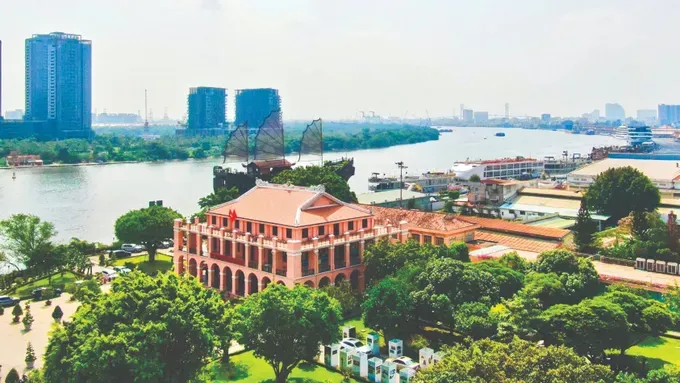
Over the years, this historic site has remained a “red address” in the hearts of people across the country, preserving historical memories and serving as a destination for many generations to learn about the life and revolutionary career of President Ho Chi Minh through the exhibition system of the Ho Chi Minh Museum – Ho Chi Minh City Branch.
Following directives from the Standing Committee and the Standing Board of the Ho Chi Minh City Party Committee, the Ho Chi Minh City People’s Committee has decided to revoke the investment policy for the former Nha Rong-Khanh Hoi Complex project. The area has been replanned for the development of the Nha Rong–Khanh Hoi Port Park project, in which the Ho Chi Minh Memorial Area will be developed on a larger scale, connected with the existing space of the Ho Chi Minh Museum.
According to Dr. Nguyen Thi Viet Ha, lecturer in Ho Chi Minh Thought at the Faculty of Political Education, Saigon University, Nha Rong (Dragon House) Wharf is not only a historic site associated with President Ho Chi Minh’s departure to seek a path for national salvation but also a symbol of revolutionary ideals and the aspiration for independence of the Vietnamese people.
She noted that the expansion of the memorial space within the overall Nha Rong – Khanh Hoi Port Park project is highly significant in bringing the values of Ho Chi Minh’s legacy closer to social life. When historical relics are placed within an open cultural space, they enable the public—especially younger generations—to access history in a more natural, vivid, and flexible manner.
Ho Chi Minh’s legacy does not exist in isolation; it is always closely associated with specific historical stories and sites—places that preserve memories, records of activities, and the values reflecting his life, career, ideology, methods, and working style. Therefore, one of the most effective approaches to preservation is to integrate this legacy into the daily life of the people so that each historical site is not only a place of remembrance of the past but also infused with the vitality of the present. When historical memory is connected with contemporary urban space, the values of Ho Chi Minh’s heritage can continue to be widely and sustainably disseminated within the community, becoming a spiritual resource for today’s society and future generations, Dr. Nguyen Thi Viet Ha expressed.
Ms. Luu Thi Tuyet Trinh, Director of the Ho Chi Minh Museum – Ho Chi Minh City Branch, said that the adjustment of the planning for this area will allow the museum to extend beyond its current premises, thereby forming a more integrated heritage complex.
This development not only helps ease the pressure on the museum, which typically experiences large numbers of visitors during major holidays and commemorative occasions, but also creates more favorable conditions for improving the overall visitor experience and service quality.
From the perspective of residents, many have expressed their expectation that the project will become a distinctive cultural space of the city.
Ms. Nguyen Thi Hoa, residing on Ton That Thuyet Street, Xom Chieu Ward, Ho Chi Minh City, stated that Nha Rong Wharf has long been a sacred place for the people of Ho Chi Minh City. With the expansion of this area, the people will have more space to learn about history, enjoy cultural life, and feel a deeper connection with the city.
Upon completion, the Nha Rong–Khanh Hoi Port Park will become a landmark landscape feature in the city’s central urban area and a Ho Chi Minh cultural space in the heart of the city, where the values left behind by President Ho Chi Minh will continue to be preserved and passed on across generations.
Fifty years after the city was honored to bear the name of President Ho Chi Minh, the Nha Rong Wharf area—where he began his journey to seek a path for national salvation—is preparing to take on a new appearance.
The Nha Rong – Khanh Hoi Port Park project is expected to be launched on the occasion of National Day on September 2 this year. It includes the expansion of the Ho Chi Minh Relic Site–Museum complex and the widening of Nguyen Tat Thanh Street, forming a modern riverside cultural space. From here, the heritage values associated with President Ho Chi Minh will become more closely integrated into urban life, serving as a vibrant cultural gathering place for the community.
According to the planning scheme, the Ho Chi Minh Relic Site–Museum complex will be expanded to a larger scale, while the remaining area will be developed into a green park with functional public amenities, including public spaces, recreational areas, and facilities serving residents, cultural activities, museums, and visitors.
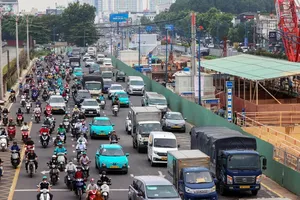
At the same time, Ho Chi Minh City will construct a new bridge to replace the existing Tan Thuan Bridge 1 and widen Nguyen Tat Thanh Street, a key arterial route connecting the city center with the southern area.
This space is oriented toward becoming a riverside cultural and historical park that harmoniously connects the Nha Rong Wharf relic site, the Saigon riverside landscape, and community activities.


)