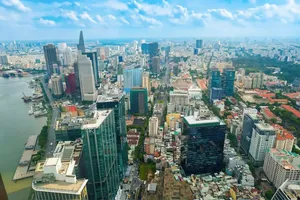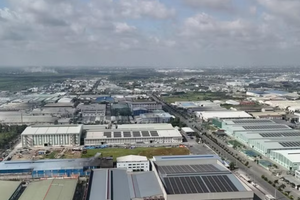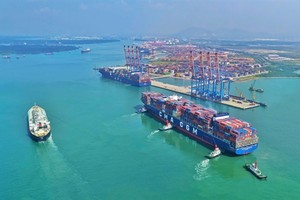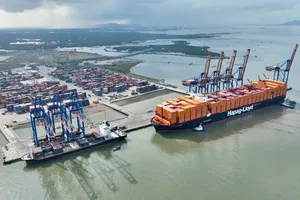
For decades, Ho Chi Minh City has been regarded as the nation’s economic locomotive. While market factors such as population, geography, and corporate capacity still hold significant potential for breakthroughs, the primary bottleneck appears to lie elsewhere including the institutional framework. Consequently, the proposal to establish a Special Urban Law for the city is being positioned as a critical institutional breakthrough.
Ho Chi Minh City’s transformation trap
Representing approximately 23.5 percent of the national GDP and contributing nearly 30 percent of the state budget, Ho Chi Minh City is truly a national megacity and a regional economic and financial hub. Currently, the city stands at a pivotal threshold. It is no longer a low-cost labor destination for labor-intensive manufacturing, yet it has not yet reached the productivity and innovation levels of global hubs like Shanghai or Singapore.
Economists refer to this as a "transformation trap", which is a state where an economy or a metropolis outgrows its initial development phase but fails to ascend the ladder due to a lack of essential conditions, particularly regarding institutions and resources. For the city, these requirements include fiscal autonomy, investment decision-making power, and, most crucially, the authority to pilot new policies. When these factors are constrained, the city cannot proactively restructure its economy. In such a context, slowing growth is not an anomaly but an inevitable consequence.
Against this backdrop, the proposal for a Special Urban Law for Ho Chi Minh City is profoundly necessary. However, if such legislation is designed using traditional management logic, it may merely create additional regulations rather than genuine empowerment, potentially increasing complexity. Only if the law is crafted as a tool to establish an institutional space that allows for experimentation, flexibility, and accountability can it generate a genuine breakthrough.
From incremental adjustments to an institutional sandbox
Rather than pursuing incremental "institutional expansions," the focus should shift toward a breakthrough design: transforming Ho Chi Minh City into a genuine institutional sandbox. This would serve as a true "policy laboratory," acting as a national-level experimental space where the city is empowered to pilot novel policies in fields such as finance, technology, and urban management.
Under this framework, new policies would be applied within limited scopes and durations, undergoing periodic evaluations before any broader rollout. This approach offers a critical advantage by allowing the system to learn. Instead of waiting for a finalized legal framework, policies can be tested in real-world conditions, refined based on results, and subsequently institutionalized.
However, such a sandbox can only function under two conditions: substantive autonomy and a clear accountability mechanism. Without these pillars, the sandbox remains merely symbolic. The city must possess the jurisdictional and fiscal autonomy to design and execute long-term development strategies independently. Crucially, the city must demonstrate its capacity to utilize resources efficiently and transparently to provide the government with the confidence to reduce direct oversight. Embracing experimentation and innovation inherently means accepting potential errors, as new models rarely succeed immediately.
Prioritizing an open mechanism for Ho Chi Minh City, the nation’s primary growth engine, is the most logical path forward. Ultimately, the discourse surrounding a Special Urban Law for Ho Chi Minh City is not purely a legal matter; it reflects the logic and vision of future national governance.
Ho Chi Minh City faces a defining test of whether Vietnam’s economic powerhouse shifts from a centralized, control-oriented model to one that empowers metropolises to drive growth. Economists warn that the choice is not about avoiding risk but managing it. Without a radical institutional overhaul, the city risks losing its position as a leading hub—turning a local slowdown into a national economic crisis.
In today’s global competition, where megacities battle for capital, technology, and talent, institutions are no longer secondary. They are decisive.
For Ho Chi Minh City, the question is no longer whether to change, but how fast and how fundamental that change must be. The city stands at a decisive crossroads: either execute a profound institutional breakthrough to operate as a global megacity, or remain tethered to current administrative frameworks and face the risk of stagnation. The core issue is not simply the existence of a law, but the willingness to establish substantive decentralization, fiscal autonomy, and result-based accountability.
In an era of intensifying global competition, maintaining a safe but rigid governance mechanism is far riskier than controlled experimentation. International experience demonstrates that substantive empowerment and institutional flexibility, rather than legal formalities and strict control, are the ultimate determinants of success. Ho Chi Minh City should become a national institutional sandbox, embracing necessary strategic trade-offs to bolster the long-term competitiveness of the economy.