Metro Line No. 2: The backbone of urban transformation
In recent days, a sense of anticipation has been evident among local residents at the Binh Khanh ferry terminal, following news that construction of Can Gio Bridge is set to begin.
Mr. Hung, who lives on the opposite bank of the Binh Khanh ferry, said enthusiastically that this is a dream local people and his family have waited for. He shared that from his grandparents and parents to now his children and grandchildren, this ferry has been part of their lives, along with all the inconvenience it brings. Once the bridge is completed, the rural area will certainly change in many ways.
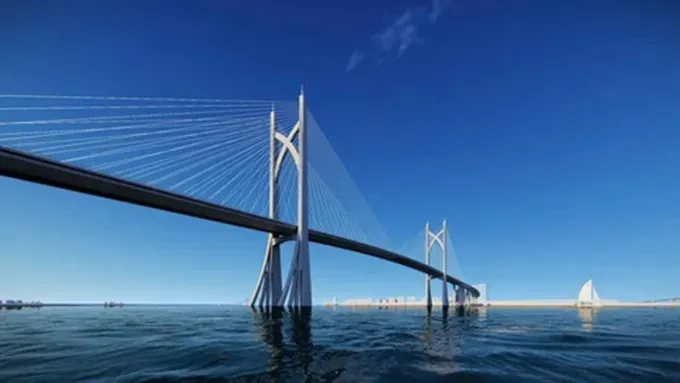
Can Gio Bridge is a key project in southern Ho Chi Minh City, spanning the Soai Rap River to replace the existing Binh Khanh ferry and opening up new opportunities for socio-economic development in the area. Once operational, the bridge will help connect the coastal urban area of Can Gio with Vung Tau, creating fresh momentum for the city’s expansion toward the sea.
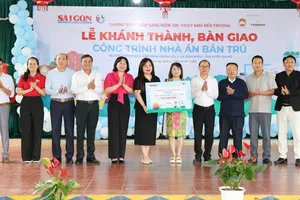
Another project of particular significance, running east to west across the city and offering a chance to reshape Ho Chi Minh City’s urban transport system, is Metro Line No. 2 (Ben Thanh–Tham Luong). Identified as the “backbone” of the city’s urban railway network, the line links the central area with the northwestern gateway, where population density is high and travel demand is substantial.
Approved in 2010 with ODA loan funding, the project has faced numerous challenges related to investment procedures, capital allocation, and site clearance. These prolonged obstacles resulted in repeated delays of several years, significantly affecting the city’s public transport development strategy.
Shortening the construction time compared to Metro Line No. 1
According to Mr. Phan Cong Bang, Head of the Ho Chi Minh City Urban Railway Management Board, the project applies special mechanisms and policies under National Assembly Resolution 188, which streamline administrative procedures and enhance local autonomy, thereby accelerating implementation.
Under the plan, Metro Line No. 2 will be constructed over 57 months and completed by the end of 2030, significantly faster than Metro Line No. 1, which took 12 years to build.
In terms of funding, with an estimated total investment of VND57 trillion (US$2.2 billion), the city will pilot alternative capital mobilization mechanisms such as transit-oriented development (TOD), bond issuance, and retaining budget revenues exceeding planned targets. This approach enables Ho Chi Minh City to be more self-reliant financially, rather than depending on ODA loans, which often come with conditions related to design standards, technology, and equipment, leading to technical inconsistencies among metro lines.
Metro Line No. 2 will adopt GoA4 automation, which is the highest level under European standards. Trains will operate fully automatically, without drivers or driver cabins, with all operations controlled through a central system. Once in service, the line is expected to carry around 140,000 passengers per day in the initial phase.
In response to these realities, Ho Chi Minh City has decided to shift the investment model to public investment using the city’s budget. This is regarded as a major turning point, removing long-standing bottlenecks and creating conditions for more decisive project implementation. Up to now, site clearance for Metro Line No. 2 has been completed, and the relocation of technical infrastructure is being carried out urgently, paving the way for construction along the entire route.
Next is Phu My 2 Bridge construction project, which will connect Ho Chi Minh City with Dong Nai Province. The bridge will have a total length of about 6.3 kilometers, starting at Nguyen Huu Tho Street in Ho Chi Minh City and ending at the intersection with Lien Cang (interport) Road in Dong Nai Province. Together with the Cat Lai Bridge investment and construction project currently under construction, it will help open wide the gateway to Dong Nai Province, giving fresh momentum to growth in the Southern Key Economic Region.
Alongside transport infrastructure, the groundbreaking of the Rach Chiec National Sports Complex is particularly necessary, as the city has yet to develop a modern, large-scale cultural and sports facility matching its scale and importance.
Built to international standards, the complex will feature a central stadium with a seating capacity of 65,000–75,000, a multi-purpose indoor arena accommodating approximately 18,000 spectators, and a range of specialized facilities, including an aquatic sports center, a tennis complex, multi-sport venues, and dedicated areas for elite training and competition.
Beyond serving professional sports, the project is planned as a fully integrated service and public urban area, featuring a sports hospital, convention and exhibition center, accommodation for athletes and coaches, large public squares, green parks, and community spaces.
Driving force for growth
Commenting on the significance of the key projects being launched and broken ground by Ho Chi Minh City, numerous urban economics experts affirmed that these initiatives not only address long-standing infrastructure “bottlenecks” but also contribute to restructuring urban space in a more modern and sustainable direction.
Dr. Nguyen Ngoc Quang, an expert in urban planning and transport infrastructure, noted that the Rach Chiec National Sports Complex carries strategic significance beyond that of a conventional sports facility. Investing in a modern, integrated sports complex is a necessary step for Ho Chi Minh City to move closer to major regional and global cities, while also helping to complete a multi-centered urban spatial structure.
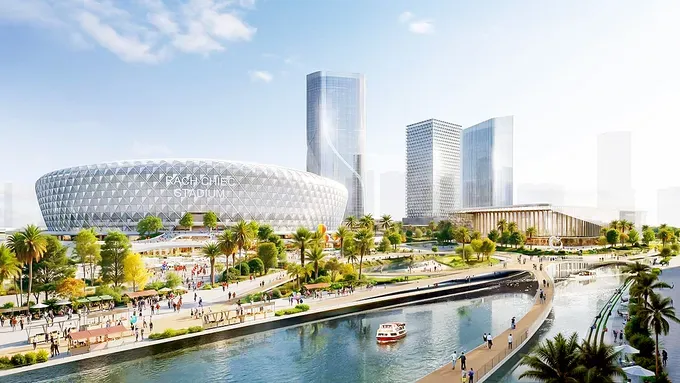
Sharing the same view, Associate Professor–Dr. Vu Anh Tuan, Director of the Vietnam–Germany Transport Research Center under the Vietnamese-German University said that the Rach Chiec National Sports Complex functions as a “soft symbol” of the city. It will serve as a hub for elite sports activities, cultural and entertainment events, and community life, catering not only to professional athletes but also enabling the public to access sports and improve health. Integrating conference, exhibition, service, and public spaces will help the complex emerge as a new growth pole, boosting the service economy in the eastern part of the city.
Regarding Metro Line No. 2, Associate Professor–Dr. Vu Anh Tuan emphasized that the line plays a particularly important role in Ho Chi Minh City’s urban transport structure.
The Ben Thanh – Cach Mang Thang Tam – Truong Chinh corridor is currently under extremely heavy traffic pressure, while land available for road widening is almost exhausted.
Investment in the metro line, especially with a high proportion of underground sections, is therefore a fundamental and sustainable solution to easing congestion, shortening travel times, curbing the use of private vehicles, and improving the urban environment.
Ho Chi Minh City simultaneously launches four key infrastructure projects
For Metro Line No. 2 (Ben Thanh – Tham Luong), this project is estimated to have a total investment of approximately VND57 trillion (US$2.2 billion), with its length of more than 11.2 kilometers, including ten underground stations, one elevated station and the Tham Luong depot.
The Rach Chiec National Sports Complex in Binh Trung Ward is estimated total investment of over VND145.6 trillion (US$5.5 billion), with its scale of more than 186 hectares, implemented under the BT (build–transfer) model.
Phu My 2 Bridge in Phu Thuan Ward, Tan My Ward and Nha Be Commune has a total investment of over VND23 trillion (US$874 million). The bridge is designed with eight lanes. Once completed, the bridge will connect Ho Chi Minh City with Dong Nai Province, forming a key transport corridor from the city center to Long Thanh Airport.
Can Gio Bridge in Binh Khanh Commune and Nha Be Commune has a total investment of over VND13.2 trillion (US$502 million). The bridge wwill replace the Binh Khanh ferry, creating direct connectivity between Can Gio and the inner city, and promoting socio-economic development in southern Ho Chi Minh City.
Total estimated investment for the projects is nearly VND240 trillion (US$9.1 billion).