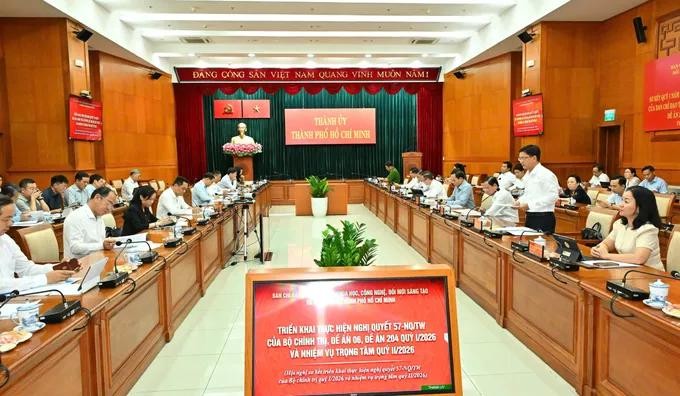
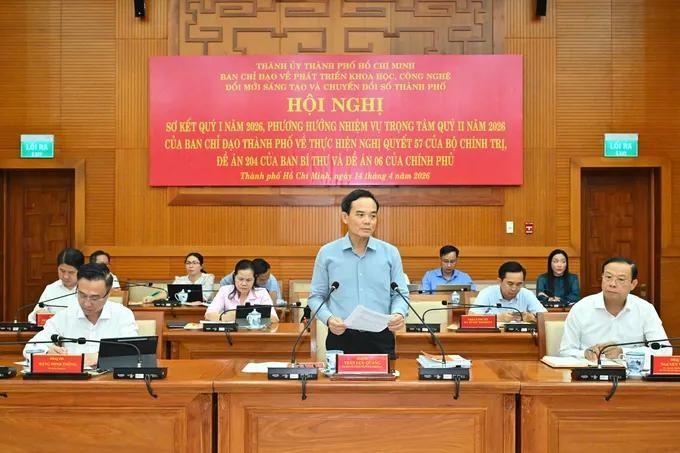
On the afternoon of April 14, the city’s Steering Committee for Science and Technology Development, Innovation, and Digital Transformation (hereinafter referred to as the Steering Committee) held its Q1 2026 review meeting on the implementation of Politburo Resolution 57, Secretariat Project 204, and Government Project 06.
Tran Luu Quang, Secretary of the Ho Chi Minh City Party Committee and Head of the Steering Committee, chaired the meeting.
At the meeting, Nguyen Manh Cuong, Vice Chairman of the Ho Chi Minh City People’s Committee, presented a report on the implementation of Resolution 57, Project 204, and Project 06 in the first quarter of 2026.
According to the report, the city has completed 16 out of 44 tasks assigned by the central government and 11 out of 14 tasks under its own plan. The remaining tasks are progressing on schedule, with none overdue. Budget allocation and planning for science and technology, innovation, and digital transformation have also been carried out.
Notably, Ho Chi Minh City is the first locality nationwide to issue a comprehensive digital data development strategy for the 2026–2030 period, with a vision to 2035.
In 2026, the city allocated VND12.705 trillion (approximately 4.16 percent of total budget expenditure), including over VND9.538 trillion in recurrent spending and VND3.166 trillion in investment. To date, more than VND5.025 trillion has been assigned, while projects worth over VND4.159 trillion have been identified but not yet allocated, and over VND3.520 trillion remains in reserve.
In terms of the science and technology market, the city has piloted the commercialization of 54 technology products, attracting around VND500 billion in investment. A newly launched technology exchange platform has facilitated 17 transfer contracts valued at approximately VND22 billion.
Ho Chi Minh City’s innovation ecosystem includes 35 incubators and innovation centers, ranking among the Top 5 in Southeast Asia and Top 110 globally, with an estimated value of US$7 billion–US$7.5 billion. The city has also recorded 3,385 intellectual property applications.
Digital economy targeted to contribute at least 30 percent of GRDP
The city has issued a plan to implement strategic technologies, identifying nine key technology groups and 26 priority products. It has launched a UAV sandbox program and selected six science and technology organizations to establish internationally standardized Centers of Excellence (CoE). Additionally, a science and technology development program for 2026–2030 is being developed with a focus on strategic technologies.

Policies to attract human resources have been introduced, gradually standardizing talent recruitment processes with income levels ranging from VND30 million to VND100 million per person, alongside granting autonomy to organizations. Mechanisms to retain scientists and skilled professionals in public science and technology institutions are also being implemented.
At the same time, the city’s ecosystem of science and technology, innovation, and digital transformation enterprises has expanded significantly, with nearly 30,000 ICT companies accounting for 40 percent of the national total forming a strong foundation for the digital economy.
Support for startups and science and technology enterprises continues to be strengthened. Nine companies have received incentives, including over VND20 billion in tax reductions, VND3.6 billion in preferential loans, and VND1.5 billion in budget support.
The city is also expanding its network of partners, mobilizing financial resources, and enhancing cooperation with international organizations and major technology corporations. High-quality human resource training is being prioritized through international cooperation programs.
Efforts to develop digital citizens are being accelerated. The administrative procedures system has been upgraded, with over 31,700 accounts issued and a dossier digitization rate of nearly 88 percent. The city has also issued more than 12.7 million chip-based ID cards and 8.6 million electronic identification accounts.
Ho Chi Minh City has proactively translated Resolution 57 into coordinated action plans, aiming for the digital economy to contribute at least 30 percent of GRDP by 2026. A key focus is the creation of a digital investment environment featuring “green lane” mechanisms and sandbox frameworks.
The city is also advancing strategic initiatives, including plans for 12 inter-regional digital technology zones (covering 1,000 hectares linking Ho Chi Minh City, Binh Duong, and Ba Ria–Vung Tau), the development of a “Science and Technology Urban Area in the northern part of the city,” and partnerships with major corporations such as AMD to promote the semiconductor industry, artificial intelligence, and core technologies.
Digital transformation is being comprehensively implemented across key economic sectors, including logistics, tourism, and digital finance, enhancing productivity and reinforcing the city’s position as a leading economic hub.
In parallel, a digital society is being developed through initiatives such as the “Digital Literacy for All” movement, focusing on four pillars of digital citizenship. The city aims to achieve 95 percent coverage of VNeID, laying the foundation for widespread digital skills and greater public participation in the digital space.
Despite these achievements, Nguyen Manh Cuong, Vice Chairman of the Ho Chi Minh City People’s Committee, also highlighted several shortcomings and challenges that require continued attention in the coming period.
At the meeting, leaders of various agencies, units, and localities presented reports and discussed difficulties and bottlenecks, seeking timely solutions to ensure effective implementation of Resolution 57, Project 204, and Project 06.