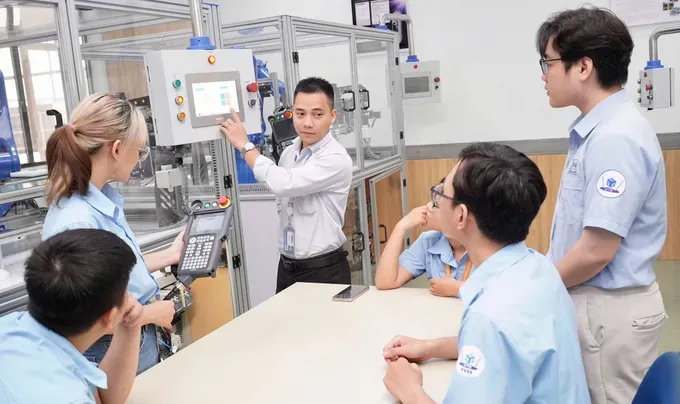
The period 2026–2030 will be pivotal for Ho Chi Minh City to rise as a leading regional and global center of economy, finance, and science–technology.
During this phase, the city aims for the digital economy to account for 30 percent–40 percent of GRDP; total social expenditure on research and development (R&D) to reach 2 percent–3 percent of GRDP; and at least 4–5 percent of annual budget spending to be allocated to S&T and digital transformation. To achieve these goals, Ho Chi Minh City requires robust mechanisms and policies to pave the way and attract global giants to invest in the city.
HCMC is a pioneer city
In the global landscape of escalating competition for knowledge, technology, and innovation, science and technology, innovation, and digital transformation have emerged as the decisive drivers of competitiveness and strategic advantage. Against this backdrop, Ho Chi Minh City is establishing itself as a frontrunner not merely in economic size but in productivity, technological capability, and innovative strength, thereby serving as a powerful catalyst for both regional and national development.
Chairman of the Ho Chi Minh City People’s Committee Nguyen Van Duoc affirmed that the city has identified key priorities and strategic directions for both immediate and long-term development. Among its tasks are establishing a multi-purpose high-tech center (innovation, artificial intelligence, GIS, semiconductor chips), a High-Tech Industrial Park, and advancing high-quality education and healthcare.
According to Director Lam Dinh Thang of the Ho Chi Minh City Department of Science and Technology, S&T and innovation activities have achieved foundational results, confirming their role as drivers of socio-economic development toward industrialization and modernization. The city is accelerating commercialization of research outcomes by supporting technology refinement, product testing and standardization, and intellectual property protection and exploitation.
To realize these objectives, Ho Chi Minh City has established a distinctive digital economy development model tailored to the characteristics of a dynamic, creative megacity and the nation’s largest economic hub. The framework is built on a "one space – three zones" model, creating a unified digital environment across the entire city that integrates a core zone for advanced data infrastructure, an innovation and technology zone, and an intelligent applications and production zone. Through this approach, the city works to strengthen institutions and policies, establish an innovation-friendly legal system, nurture new digital business models, and build robust data infrastructure and digital platforms that support seamless connectivity, data sharing, and smart governance.
Ho Chi Minh City currently has more than 21,000 individuals working in S&T, over 135 strong and dynamic research groups engaged in international collaboration. Its innovation startup ecosystem is growing rapidly, approaching the global top 100 most dynamic startup ecosystems.
The city is developing four key ecosystems including agriculture, EdTech, AI–IoT, healthcare, organizing hundreds of training and networking events, and supporting thousands of enterprises and individuals. The provision of online public services has significantly reduced administrative procedures.
The city has eliminated nearly 300 procedures related to business operations, equivalent to more than 1,900 working days. It has also established dedicated task forces to provide direct and timely support to strategic investors. As a result, in just the first six months of 2025, the S&T sector attracted US$1.6 billion in foreign direct investment (FDI), accounting for 40 percent of the total. Currently, the city hosts more than 140 S&T enterprises, ranking second nationwide.
HCMC promotes emerging sectors
Director Lam Dinh Thang of the Ho Chi Minh City Department of Science and Technology affirmed that the digital economy is becoming the city’s primary growth driver in its new development phase. However, bottlenecks remain. The greatest challenge lies in institutional and policy frameworks, which lack consistency and coherence, while the legal foundation for new digital business models is still being finalized.
In addition, attracting and retaining high-tech talent, particularly in fields such as AI and semiconductors, continues to pose difficulties, underscoring the need to refine mechanisms and policies.
To address these issues, the draft resolution amending Resolution 98 proposes allowing Ho Chi Minh City to deduct 200 percent of actual R&D expenses when calculating corporate income tax. Actual R&D costs would be determined in accordance with accounting regulations.
The draft also suggests that income from new investment projects located in Free Trade Zones in certain industries and sectors be subject to a corporate income tax rate of 10 percent for 20 years, with a four-year tax exemption and a 50 percent reduction for the following nine years. Eligible sectors include semiconductors, AI, R&D centers, new materials, semiconductor materials, and supporting industries for high technology.
Deputy Director of the Ho Chi Minh City Digital Transformation Center Nguyen Thanh Hoa noted that refining these mechanisms would not only facilitate operations for institutes, universities, and enterprises but also directly accelerate implementation of Resolution No. 57-NQ/TW. At present, supportive policies remain insufficient, and coordination channels are still fragmented.
Once the amended Resolution 98 is passed, the city will have the foundation to vigorously promote research in emerging fields such as AI, semiconductors, new materials, supporting industries, energy infrastructure, digital infrastructure, and petroleum technology creating new drivers to complement future growth momentum.
The Deputy Director of the Digital Transformation Center stressed that, bolstered by the innovative mechanisms introduced in the amended Resolution 98, Ho Chi Minh City is fully equipped to meet its digital economy targets for the 2025–2030 period.













)