The initial phase alone will require more than US$40 billion, and once the entire metro network is completed, total investment is expected to reach nearly US$60 billion.
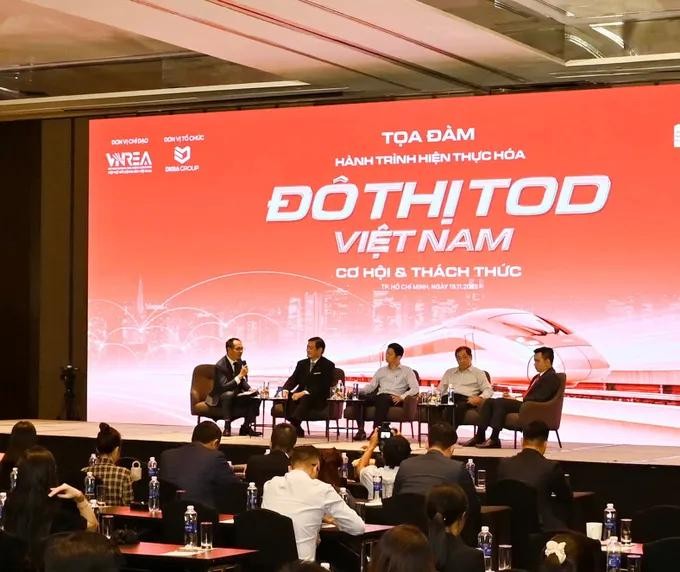
Faced with enormous capital demands and the need for sustainable urban growth, the Transit-Oriented Development (TOD) model is emerging as a key strategic solution. However, experts emphasize that for TOD to deliver tangible benefits, the city must quickly establish a coherent institutional and legal framework that supports integrated metro and urban development.
Bottlenecks are identified
According to the Ho Chi Minh City Department of Planning and Architecture, the city has identified 11 pilot TOD locations along Metro Line No. 1 (Ben Thanh – Suoi Tien), Metro Line No. 2 (Ben Thanh – Tham Luong), and Ring Road No. 3. These areas are envisioned as high-density compact cities that integrate commercial centers, offices, and residential zones to optimize land value. The municipal People’s Council has already passed Resolution No. 38, establishing an initial legal foundation for TOD implementation.
Deputy Head of the Department’s Technical Infrastructure Planning Division Nguyen Tat Thang said the city is reviewing more than 160 hectares of land along Metro Line No. 1 (covering Thu Duc, Long Binh, and Long Truong Wards) and studying a 500–1,000-meter radius around stations on Metro Line No. 2 to better leverage land resources. TOD projects along Ring Roads No. 2 and 3 are also being prepared, with ground-breaking expected by late 2025.
Despite this progress, the Department of Construction acknowledged that TOD development remains constrained by fragmented regulations across sectors including land, planning, transportation, resettlement, finance, and public-private partnerships (PPP). The lack of a central coordinating authority has made the process cumbersome and slow.
For instance, many Metro Line No. 1 stations were originally designed purely for transportation, without integrated commercial or service spaces or proper connections to surrounding urban areas, which are all essential elements of the TOD model. As a result, introducing TOD afterward has proven difficult due to high land clearance costs and inconsistent infrastructure planning.
To address these challenges, the Ho Chi Minh City People’s Committee has proposed that the Government amend the Land Law and the Urban Planning Law to:
- Clearly define TOD zones with specific construction densities, land-use coefficients, and mixed-use functions.
- Simplify procedures for land recovery and urban redevelopment.
- Introduce a Land Value Capture (LVC) mechanism, allowing the city to reinvest the increased land value resulting from transport infrastructure development back into public projects such as metro lines and community facilities.
The city also plans to adjust its urban planning framework to prioritize development along public transport corridors. Areas within 300–500 meters of metro stations will be permitted to increase building height limits and land-use ratios, encouraging mixed-use developments combining residential, office, retail, and public amenities.
Key areas such as Thu Duc, Tan Kien, and Tan Tao, along with the Metro Line No. 2 and Bus Rapid Transit (BRT) Line No. 1 corridors, are envisioned as satellite urban centers designed to attract residents and businesses while alleviating pressure on the city core.
Ultimately, Ho Chi Minh City’s vision is to create a modern, connected, and sustainable metropolitan area where public transport forms the backbone of urban life unlocking both economic potential and quality of living for millions of residents.
Improving tailored policy frameworks
Transit-Oriented Development (TOD) projects are only feasible when accompanied by effective mechanisms to leverage land resources surrounding metro lines. Accordingly, Ho Chi Minh City has proposed applying land auctions, long-term leasing, and attracting investment through Public-Private Partnerships (PPP) in areas near stations, thereby generating revenue to support transport infrastructure development.
The city also recommends that the Government allow the establishment of an Urban Transport Development Fund, pooling revenues from parking fees, congestion charges, land use, and commercial services around stations. This fund would be used to supplement capital for metro and Bus Rapid Transit (BRT) projects.
In addition, Ho Chi Minh City has suggested creating a TOD Development Agency to coordinate and manage land resources while serving as the focal point for investment promotion, thereby resolving overlaps among departments and agencies. This agency would also publish TOD planning data and maps to facilitate business access to information.
In its submission to the Government regarding the draft resolution amending Resolution No. 98/2023/QH15 of the National Assembly on piloting special mechanisms and policies for Ho Chi Minh City, the Ministry of Finance noted that the draft focuses on revising policies related to strategic investor conditions; simplifying procedures for project registration and investor selection; and adding provisions on investment incentives for infrastructure projects.
A key innovation in the draft is the provision allowing Ho Chi Minh City to assess planning compliance during the appraisal, approval of investment policies and projects, investor selection, and issuance of investment registration certificates, based on any of several applicable planning frameworks — provincial, urban, national sectoral, or technical/specialized plans.
The city would also be authorized to determine land-use targets beyond those allocated under the national land-use plan, ensuring alignment with urban infrastructure development needs.
Another important proposal is to replace rigid criteria on charter capital, total assets, and investment experience with the ratio of equity contributed to the project. This adjustment aligns with international practice and facilitates the attraction of strategic investors.
At the same time, procedures for selecting strategic investors would be streamlined to ensure transparency and consistency with laws on investment, bidding, and PPP.
Notably, the draft empowers investors to prepare and adjust zoning and detailed plans themselves, which is a solution regarded as critical to removing the biggest bottleneck in implementing large-scale projects such as TOD.