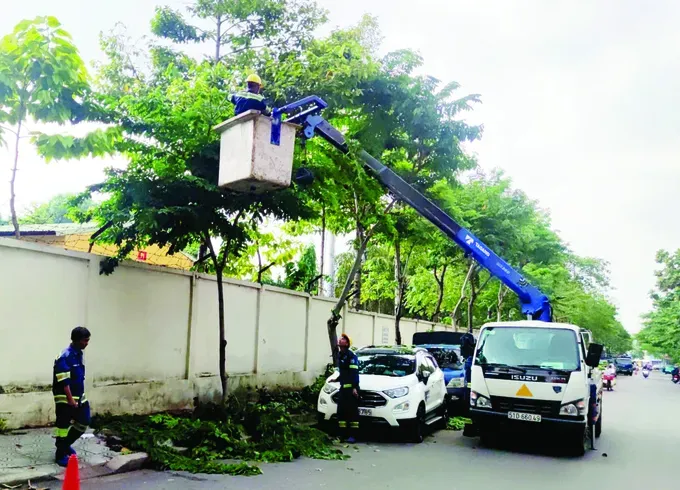
Tree management units in Ho Chi Minh City have proactively implemented various measures to protect trees, as well as safeguard the property and lives of residents.
Although tree pruning and height reduction have been regularly and continuously carried out by local authorities, thousands of trees still suffer broken branches, snapped limbs, or uprooting every rainy season. According to statistics from Vung Tau Urban and Green Park Development Joint Stock Company, during the 2025 rainy season, nearly 1,000 cases of trees and branches falling or breaking occurred in Vung Tau, Tam Thang, Rach Dua, Phuoc Thang wards, and Long Son Commune.
Ba Ria Urban Services Joint Stock Company said that the areas of Tam Long, Ba Ria, and Long Huong wards have 26,470 trees of various types, with common species including resin tree (Dipterocarpus alatus), rain tree (Samanea saman), copperpod (Peltophorum pterocarpum), giant crape-myrtle (Lagerstroemia speciosa), and rosewood (Pterocarpus macrocarpus).
The main cause of tree falls is prolonged rainfall over many days, which weakens the soil foundation; when strong winds occur, trees are more likely to break or topple. In Kim Long and Chau Duc communes, among others, since the beginning of the 2026 rainy season, a large number of trees have been knocked down by heavy rain and strong winds, causing widespread obstruction, power outages, and traffic disruptions.
In central Ho Chi Minh City, tree-fall incidents have also occurred recently. A notable case involved a flamboyant tree about 20 meters tall that fell onto an exercise area at September 23 Park in Ben Thanh Ward on June 16. On Tran Xuan Soan Street, Tan Hung Ward, in the afternoon of June 14, an old bodhi tree suddenly uprooted and fell onto a moving truck cabin, crushing it.
Proactively respond to natural disasters
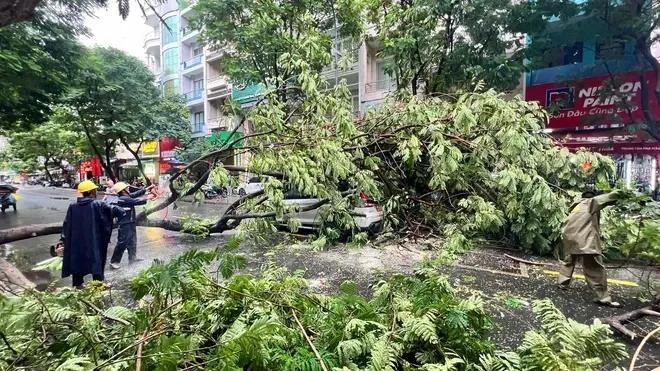
According to Mr. Le Ngoc Linh, Deputy Director of the Ho Chi Minh City Department of Construction, to ensure urban tree safety during the 2026 storm season, the department has directed agencies and units responsible for managing parks and urban greenery to develop plans to inspect and review the tree system along streets and in parks. The plans aim to remove and replace trees that are diseased, old, or leaning and at risk of breaking or falling, which could pose dangers.
Special attention will be paid to trees whose root systems have been affected by the construction of infrastructure projects, such as sidewalk upgrades, water supply and drainage works, and power and telecommunications projects. For traffic management units, it is necessary to identify key traffic routes and areas where falling trees may obstruct traffic, thereby developing plans for warning measures, traffic diversion, regulation, and timely response when incidents occur.
Mr. Do Luong, Deputy Head of the Planning Division of Vung Tau Urban and Green Park Development Joint Stock Company, said that since the beginning of 2026, thousands of trees under the company’s management have been pruned and had their foliage reduced. Many old trees and large-canopy trees in densely populated areas have been installed with support poles and technical bracing systems to enhance their ability to withstand the impacts of extreme weather.
For nearly 700 old trees, the company maintains regular inspections at least twice a month. In addition to relying on practical experience, the company has also applied various modern equipment, such as drones, tree trunk soundness testing hammers, and specialized endoscopes, to assess the internal condition of tree trunks and detect potential risks at an early stage.
In addition to measures to inspect and address tree-related risks to prevent falls during the storm season, the Department of Agriculture and Environment has also proactively applied digital transformation in disaster prevention and response, including the development of a Ho Chi Minh City disaster monitoring software system.
Mr. Tran Nhan Nghia, Deputy Head of the Irrigation, Flood and Storm Prevention Division under the Department of Agriculture and Environment, said that Ho Chi Minh City is currently developing a disaster monitoring software system, which is expected to be put into operation in September this year. Accordingly, disaster forecasts and warnings will also be continuously updated on the website of the Civil Defense Command and a mobile application, enabling authorities to promptly direct and manage response efforts while allowing residents to easily access updates.
The former Ho Chi Minh City area had developed 54.04 hectares of green space and planted new trees while renovating more than 42,500 existing trees. Meanwhile, in the eastern area of the city, there are currently around 140,000 trees of various types, distributed across most streets, parks, public areas, and government offices in 30 communes and wards.




)