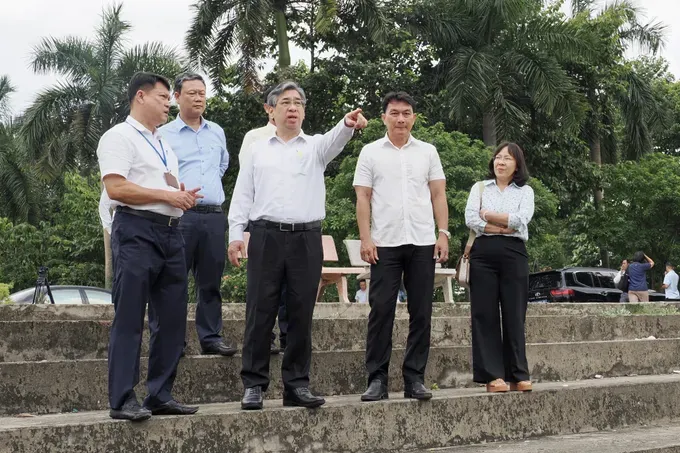
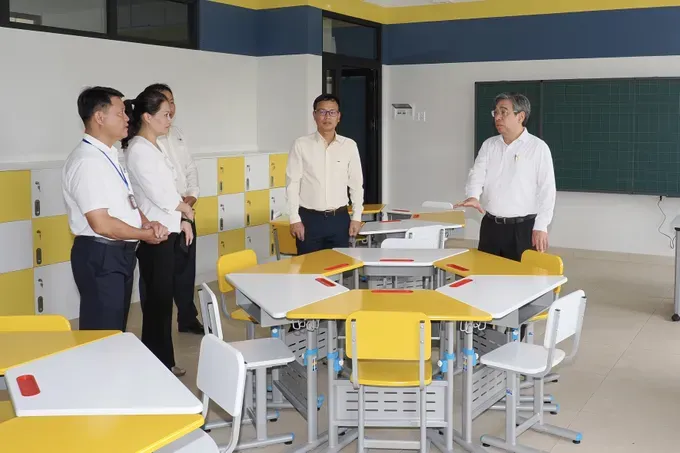
On June 22, a delegation from the Ho Chi Minh City Party Committee, led by Mr. Nguyen Phuoc Loc, Member of the Party Central Committee, Deputy Secretary of the municipal Party Committee and Chairman of the Vietnam Fatherland Front Committee of Ho Chi Minh City, held a working session on school development and social rental housing projects in Tan Dong Hiep and Dong Hoa wards.
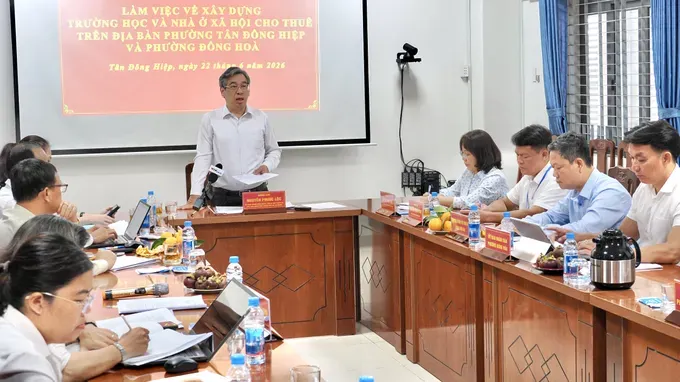
At the session, Chairman of the Tan Dong Hiep Ward People's Committee Nguyen Thanh Huy reported that the ward currently has 32,542 children and students aged between 3 and 18. The figure includes 11,558 primary school students, 10,074 lower secondary students and 6,307 upper secondary students.

During the 2025–2026 academic year, the ward managed 12 public schools, comprising three preschools, six primary schools, two lower secondary schools, and one upper secondary school. These institutions served a total of 21,693 students across 498 classes.
However, according to current planning standards, the ward is still facing a significant classroom shortage, with a deficit of 202 classrooms at the primary level and 34 classrooms at the lower secondary level.
To meet the target of 300 classrooms per 10,000 residents, the ward proposed the construction of five new public schools, including two primary schools, one lower secondary school, one combined primary and lower secondary school, and one upper secondary school. Land has already been cleared and prepared for all five projects.
Meanwhile, Nguyen Van Yem, Vice Chairman of the Dong Hoa Ward People's Committee, said that the ward currently has 15 public schools across four educational levels, providing sufficient school places for local students. During the 2026–2027 academic year, the ward plans to open an additional preschool and lower secondary school, creating 36 new classrooms for approximately 800 students.
Despite meeting current enrollment demand, many school facilities in Dong Hoa have deteriorated due to age and require major renovations. Localized overcrowding also remains a challenge, preventing some lower secondary schools from implementing full-day learning schedules.
Representatives of the private sector also expressed interest in contributing to educational development. Le Nhu Thach, Chairman of the Ho Chi Minh City Association of Construction Science and Technology and Chairman of Bcons Group, said that the company has already built and put into operation two preschools and one inter-level school, serving around 1,000 students.

He pledged that Bcons would develop 10 additional schools by 2030 if obstacles related to social housing and education investment projects are resolved.
Concluding the meeting, Mr. Nguyen Phuoc Loc acknowledged the efforts of both localities in ensuring sufficient school places despite strong population growth. However, he stressed that achieving the target of 300 classrooms per 10,000 residents would require stronger action from local authorities and education agencies.
He emphasized that the Ho Chi Minh City Department of Education and Training must advise the city on decisive measures to ensure all students have access to schools, eliminate third-shift classes and guarantee that all primary school students receive two sessions of instruction per day in accordance with national standards.
Mr. Nguyen Phuoc Loc also proposed that Tan Dong Hiep and Dong Hoa pioneer an interconnected school-cluster model. Under this approach, relevant agencies would coordinate across ward and commune boundaries to optimize public investment and school planning.
Administrative boundaries must not affect children’s right to education, Mr. Nguyen Phuoc Loc said, calling for more efficient resource allocation and stronger inter-local cooperation.
He further encouraged social investment in education that would offer foreign-language instruction, life skills and extracurricular activities at lower secondary schools. In addition to English, he suggested expanding language programs to include Korean and Japanese to better align with local economic development and business needs.
Regarding social housing, the deputy secretary instructed authorities to pay greater attention to rental social housing for young civil servants, workers and vulnerable groups. He stressed that social housing projects should be developed alongside schools, healthcare facilities, parks, green spaces and fire safety infrastructure to ensure sustainable and livable communities.
He also suggested reserving a portion of social housing units as rewards or gifts for individuals who have made significant contributions to the city and the country.

Local officials reported that Dong Hoa Ward currently has five apartment projects under construction, providing 5,160 units, including 330 rental apartments. Tan Dong Hiep Ward has approved detailed plans for 27 projects, including two large developments that will allocate land for social housing. Together, these projects are expected to provide nearly 2,500 social housing units, contributing to the city’s affordable housing goals.